
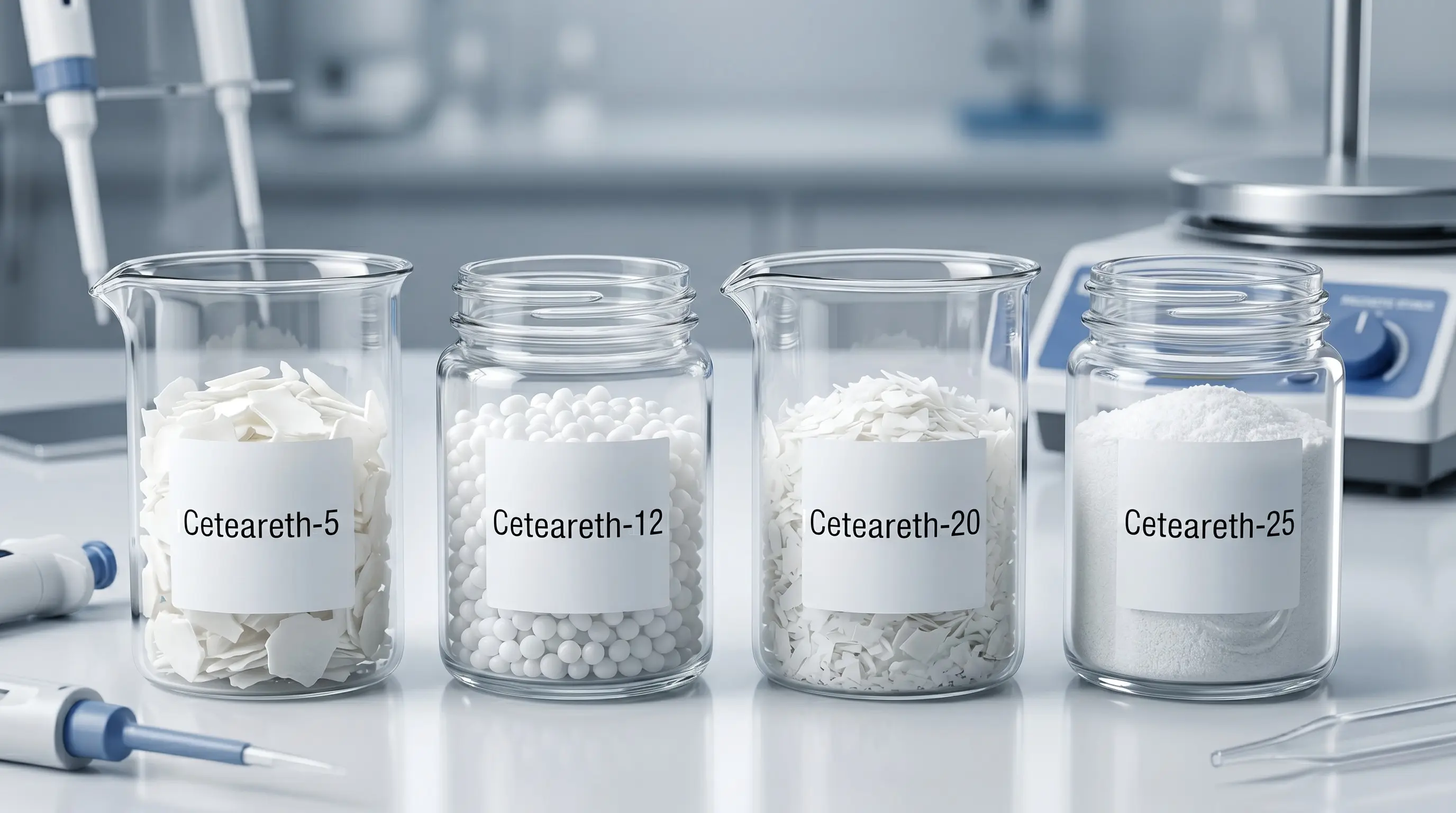
Ceteareth-5, 12, 20 & 25: Pharmaceutical-Grade Emulsifiers Powering Global Topical Formulations




AI Summary
Ceteareth grades - Ceteareth-5, Ceteareth-12, Ceteareth-20 and Ceteareth-25 - are non-ionic polyethylene glycol ethers of cetostearyl alcohol widely used in pharmaceutical and dermatological formulations across Europe, the USA, Russia and the Middle East. Each grade offers a distinct hydrophilic-lipophilic balance (HLB), enabling formulators to precisely engineer emulsion type, viscosity and stability. From oil-based creams and microemulsions to lamellar gel structures and stiff medicinal ointments, these pharma-grade excipients - all compliant with USP-NF, EP and BP standards - have become indispensable ingredients in modern topical drug delivery.
 WhatsApp Now
What Are Ceteareth Emulsifiers and Why Do They Matter in Pharmaceutical Formulations?
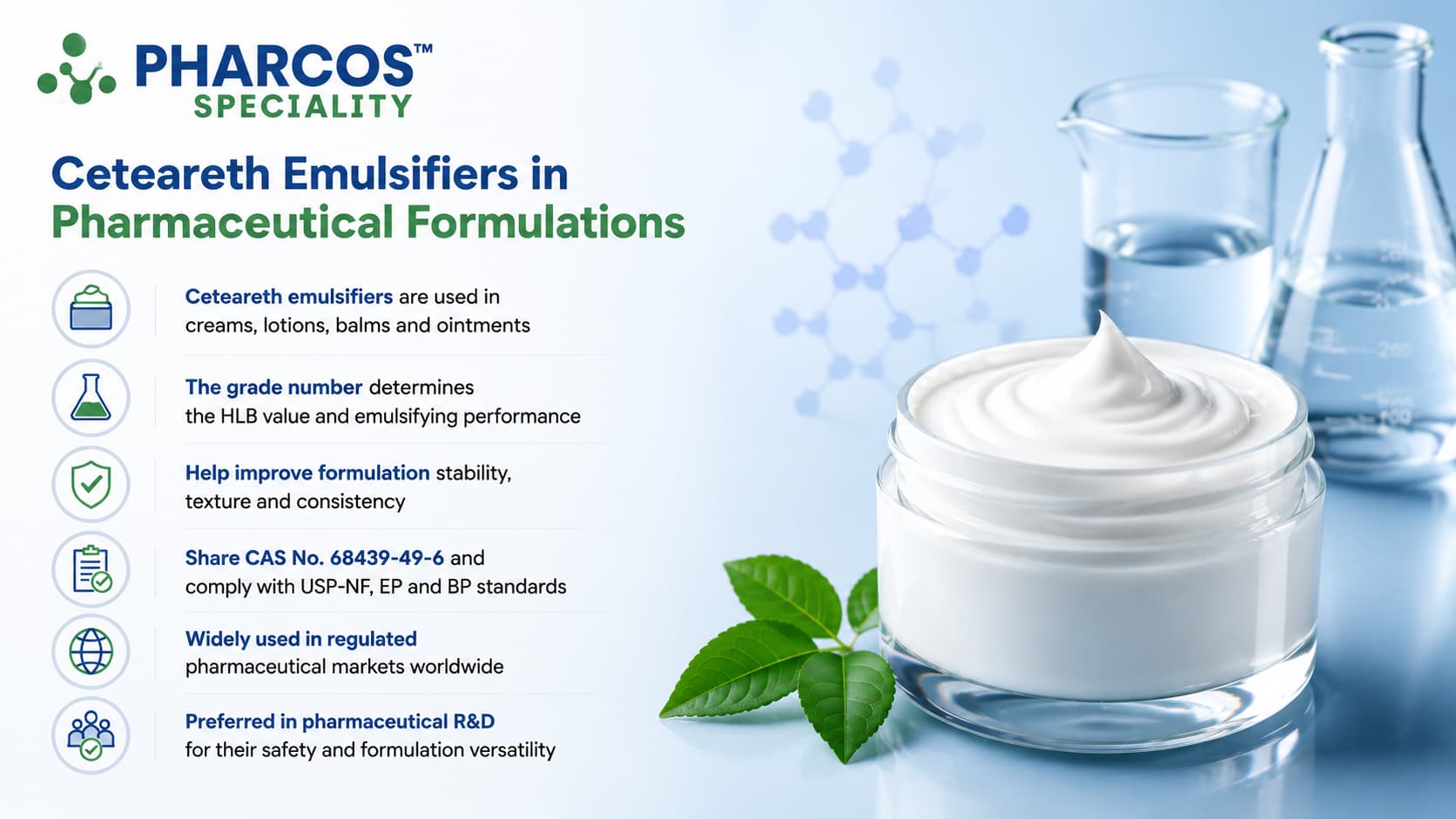
In pharmaceutical manufacturing, achieving a stable, elegant topical formulation - whether a cream, lotion, balm or ointment - depends critically on selecting the right emulsifier. Ceteareth grades are polyoxyethylene ethers of cetostearyl alcohol, produced through ethoxylation to varying degrees. The number in each grade name directly reflects the average number of ethylene oxide units attached, which determines the compound's HLB value and therefore its functional role in a given formulation system.
All four grades share the CAS number 68439-49-6, fall under the broader Ceteareth category and comply with USP-NF, EP and BP pharmacopoeial standards. This uniform compliance profile is a critical differentiator for pharmaceutical manufacturers operating in regulated markets across the USA, Europe, Russia and the Middle East, where excipient documentation and monograph alignment are non-negotiable requirements. Combined with proven safety and functional versatility, this is why Ceteareth-based excipients continue to dominate emulsifier selection in topical pharmaceutical R&D worldwide.
Ceteareth-5: The Low-HLB Co-Emulsifier for Oil-Based Systems
Ceteareth-5 is a polyoxyl 5 cetostearyl ether with a relatively low degree of ethoxylation, resulting in a low HLB value. This characteristic makes it hydrophobic in nature and particularly suited to oil-continuous formulation systems rather than water-continuous ones.
In pharmaceutical applications, Ceteareth-5 is primarily deployed as a co-emulsifier alongside higher-HLB surfactants. The combination of a low-HLB and a high-HLB emulsifier is a well-established formulation strategy - it creates a stable interfacial film at the oil-water boundary, preventing droplet coalescence and improving long-term physical stability.
For formulators in Europe and the Middle East developing heavy oil-based creams and pharmaceutical ointments - such as barrier creams, emollient bases and topical steroid preparations - Ceteareth-5 serves as a critical stabilizing component. Its emulsifier and wetting agent functionality ensures that active pharmaceutical ingredients (APIs) are uniformly dispersed within the lipid phase, supporting consistent dosing and improved bioavailability at the skin surface. Its USP-NF, EP and BP compliance further simplifies regulatory dossier preparation across multiple markets simultaneously.
Manufacturers in Russia catering to dry-climate dermatology markets and formulators in the USA working on OTC skin protection categories also recognize Ceteareth-5 pharma grade as a dependable co-emulsifier when building robust oil-based pharmaceutical bases.
Ceteareth-12: The Intermediate-HLB Emulsifier for Microemulsions and Topical Stabilization
Ceteareth-12 or polyoxyl 12 cetostearyl ether, sits in the intermediate HLB range - a crucial positioning that makes it a versatile and truly universal emulsifier across a broad spectrum of pharmaceutical topical systems.
At intermediate HLB values, Ceteareth-12 is uniquely effective in dispersing microemulsions - thermodynamically stable, optically clear or translucent systems where oil droplets are dispersed at the nanometre scale within an aqueous phase. Microemulsions are increasingly important in pharmaceutical innovation, particularly for enhanced dermal penetration of APIs.
Beyond microemulsions, Ceteareth-12 serves reliably as a dispersing agent in formulations containing mixed oil-and-water components. Topical anti-inflammatory gels, medicated creams combining aqueous and oily active fractions and dual-phase sunscreen bases with SPF actives frequently rely on it to maintain uniform phase distribution throughout product shelf life.
In regulated pharmaceutical markets across Europe and the USA, where stability data requirements are stringent, Ceteareth-12's ability to stabilize complex emulsion systems is a formidable advantage. Its compliance with USP-NF, EP and BP monographs ensures it can be directly referenced in regulatory submissions across all three major pharmacopoeial regions. Middle Eastern and Russian markets, which increasingly demand premium pharmaceutical-grade topical products, are also seeing broader adoption of Ceteareth-12 as local formulation sophistication grows.
Our Other Product
Ceteareth-30 (Flakes / Powder | Emulsifiers)Ceteareth-20: The Industry Standard Oil-in-Water Emulsifier and Lamellar Gel Builder
Among all Ceteareth grades, Ceteareth-20 - polyoxyl 20 cetostearyl ether - is the most widely used in the pharmaceutical industry globally. Its higher degree of ethoxylation gives it a strong hydrophilic character, making it highly effective at stabilizing oil-in-water (O/W) emulsions, the dominant formulation type for dermatological creams and lotions.
What distinguishes Ceteareth-20 beyond basic emulsification is its unique capacity to promote the formation of lamellar gel network structures. When combined with fatty alcohols such as cetyl or stearyl alcohol and water, it self-assembles into ordered liquid crystalline phases that dramatically increase the viscosity and mechanical stability of the cream matrix. This lamellar network also mimics the lipid bilayer structure of the stratum corneum, potentially enhancing the skin-compatibility and moisturizing performance of the final product.
Ceteareth-20 pharma grade is a standard ingredient in reference formulations cited in USP-NF, EP and BP monographs and is widely used across pharmaceutical manufacturers in the USA and Europe. It functions simultaneously as an oil-in-water emulsifier, solubilizer for lipophilic APIs and thickener - delivering three critical formulation functions in a single ingredient.
Emerging pharmaceutical markets in the Middle East and growing topical manufacturing capacity in Russia have similarly embraced Ceteareth-20 as the backbone emulsifier in dermatological cream bases, given its predictable rheological performance, lamellar gel-building properties and well-characterized safety and compliance profile.
Ceteareth-25: The High-HLB Gelling Agent and Rheology Modifier for Ointments and Balms
At the highest ethoxylation level in this series, Ceteareth-25 - polyoxyl 25 cetostearyl ether - is a highly efficient non-ionic surfactant with full compliance across USP-NF, EP and BP, aligning with the same broad pharmacopoeial acceptance as the other grades in this range. Its elevated HLB value translates into exceptional water affinity and unique gel-forming behaviour.
Ceteareth-25 is particularly valued as a gelling agent and rheology modifier in pharmaceutical formulations that demand stiff, semi-solid consistency - including pomades, hair-and-scalp medicinals, heavy lip balms and dense therapeutic ointments used in wound care or chronic dermatological conditions. When incorporated into suitable aqueous or hydroalcoholic systems, it contributes to network formation that resists flow under stress, ensuring the product remains in place at the application site.
As a rheology modifier, Ceteareth-25 gives formulators precise control over spreadability, yield point and recovery behaviour - properties that are especially critical in hospital-grade or prescription ointments where dosing consistency is paramount.
With USP-NF, EP and BP compliance, Ceteareth-25 pharma grade is widely specified in pharmaceutical procurement and regulatory submissions across Europe, the USA and internationally regulated markets, including select programmes in the Middle East and Russia. It is the grade of choice wherever multi-pharmacopoeial dossier alignment is a formulation requirement.
Combining Ceteareth Grades: Multi-Grade Emulsifier Systems in Modern Formulation
One of the most powerful aspects of the Ceteareth series is that grades are routinely combined within a single formulation. A typical pharmaceutical cream may use Ceteareth-5 as a lipophilic co-emulsifier and Ceteareth-20 as the primary O/W emulsifier - achieving a well-balanced interfacial layer that neither grade could accomplish alone. Similarly, Ceteareth-25 may be introduced alongside Ceteareth-12 in a gel-based formulation where both rheology control and emulsion stabilization are required simultaneously.
Since all grades carry identical USP-NF, EP and BP compliance, multi-grade blending does not introduce additional regulatory complexity - a significant practical advantage for pharmaceutical teams filing dossiers in the USA, Europe, Russia and the Middle East within the same product lifecycle. This blending approach is standard practice among pharmaceutical R&D teams globally and understanding the HLB gradient across Ceteareth-5, Ceteareth-12, Ceteareth-20 and Ceteareth-25 is foundational knowledge for any formulation scientist working in the topical pharma space.
Our Other Product
Ceteareth-80 (Flakes / Powder | Emulsifiers)About Pharcos Speciality Ltd.
Pharcos Speciality Ltd. is a dedicated manufacturer and supplier of pharmaceutical-grade excipients, with a focus on non-ionic surfactants and emulsifiers for the global topical pharmaceutical industry. The company's Ceteareth product range - including Ceteareth-5, Ceteareth-12, Ceteareth-20 and Ceteareth-25 - is manufactured in full compliance with USP-NF, EP and BP pharmacopoeial standards. Pharcos serves regulated markets across Europe, the USA, the Middle East and Russia, providing consistent quality, comprehensive technical documentation and formulation support to pharmaceutical manufacturers, contract development organizations (CDOs) and dermatological product developers worldwide.
 Call Us Now!
Conclusion
Ceteareth-5, Ceteareth-12, Ceteareth-20 and Ceteareth-25 represent a carefully graduated series of pharmaceutical excipients that collectively address the full spectrum of topical formulation needs - from oil-based co-emulsification at low HLB to gel formation and rheology modification at high HLB. All four grades comply with USP-NF, EP and BP standards, making them straightforward to specify in regulatory submissions across the USA, Europe, Russia and the Middle East without additional pharmacopoeial hurdles. Their combined applicability across emulsification, solubilization, thickening, dispersing and wetting functions makes them indispensable in the pharmaceutical formulator's toolkit. As global demand for sophisticated, stable and skin-compatible pharmaceutical creams and ointments continues to rise, the strategic selection and combination of Ceteareth grades will only grow in importance for topical drug product development worldwide.
FAQs on Ceteareth-5, 12, 20 & 25

Dr. Avinash Dubey (R&D Head)
Dr. Avinash Dubey is a PhD in Organic Chemistry with a distinguished career spanning more than four decades. As the head of R&D at Pharcos, he focuses on the development of novel molecules for a wide array of industrial sectors, blending long-standing experience with a passion for innovation.

Mr. Ankit Shah (Managing Director)
Mr. Ankit Shah has led Pharcos Speciality for over three decades, establishing it as a pioneer in specialty chemicals. He currently directs the company’s strategic expansion into the APIs, Excipient and Speciality Surfactants markets, upholding a steadfast commitment to "Make in India" and world-class manufacturing quality and new product development.