
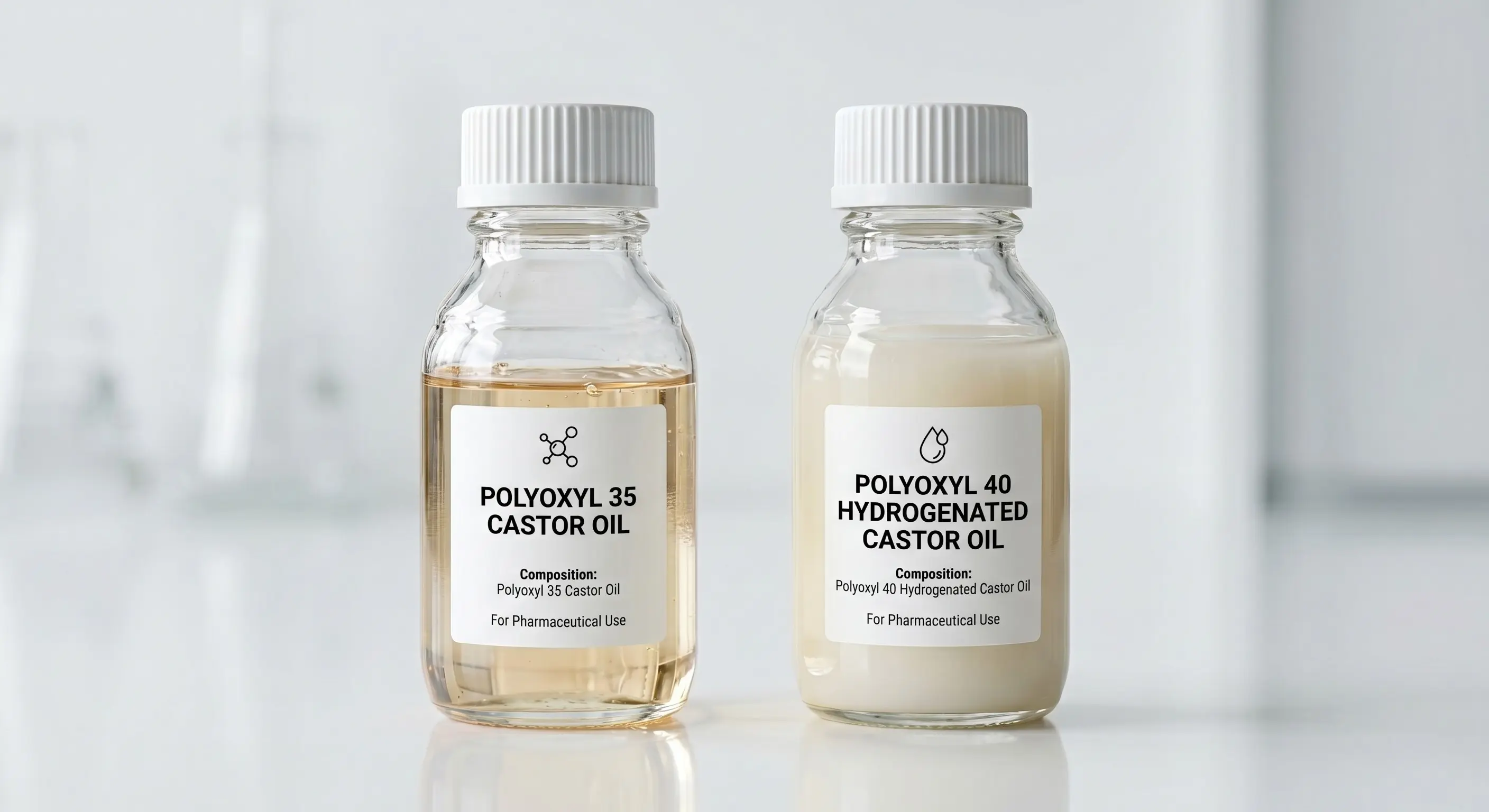
Polyoxyl 35 Castor Oil and Polyoxyl 40 Hydrogenated Castor Oil: Pharmaceutical Applications, Global Demand and Formulation Advantages




AI Summary
Polyoxyl 35 Castor Oil and Polyoxyl 40 Hydrogenated Castor Oil are non-ionic surfactant excipients derived from castor oil through ethylene oxide reactions, widely used in pharmaceutical formulations across the USA, Europe, Russia and the Middle East. Both grades serve critical roles as solubilizers and emulsifiers in liquid, semi-solid and topical drug products, while each brings distinct advantages - Polyoxyl 35 Castor Oil excels in solubilizing water-insoluble injectable drugs, whereas Polyoxyl 40 Hydrogenated Castor Oil offers superior stability and patient tolerability in oral and softgel applications. Compliant with USP-NF, EP, BP and IP standards, both are trusted pharmaceutical-grade excipients for regulated global markets.
 Call Us Now!
Introduction: The Role of Castor Oil Derivatives in Pharmaceutical Formulation
Formulators working with poorly soluble APIs face one of the most persistent challenges in modern drug development - getting an insoluble molecule into a stable, bioavailable dosage form. Functional excipients are central to solving this problem and among the most relied-upon in regulated pharmaceutical manufacturing are Polyoxyl 35 Castor Oil and Polyoxyl 40 Hydrogenated Castor Oil.
Both are ethoxylated castor oil derivatives produced through the reaction of castor oil - or its hydrogenated form - with ethylene oxide. The result in each case is a non-ionic surfactant with a well-defined hydrophilic-lipophilic balance that enables it to interact with both aqueous and lipophilic phases in a formulation. Their widespread adoption across the USA, Europe, Russia and the Middle East reflects their technical reliability, multi-pharmacopoeial compliance and compatibility with diverse dosage form requirements.
Polyoxyl 35 Castor Oil: Chemistry, Grade and Pharmaceutical Profile
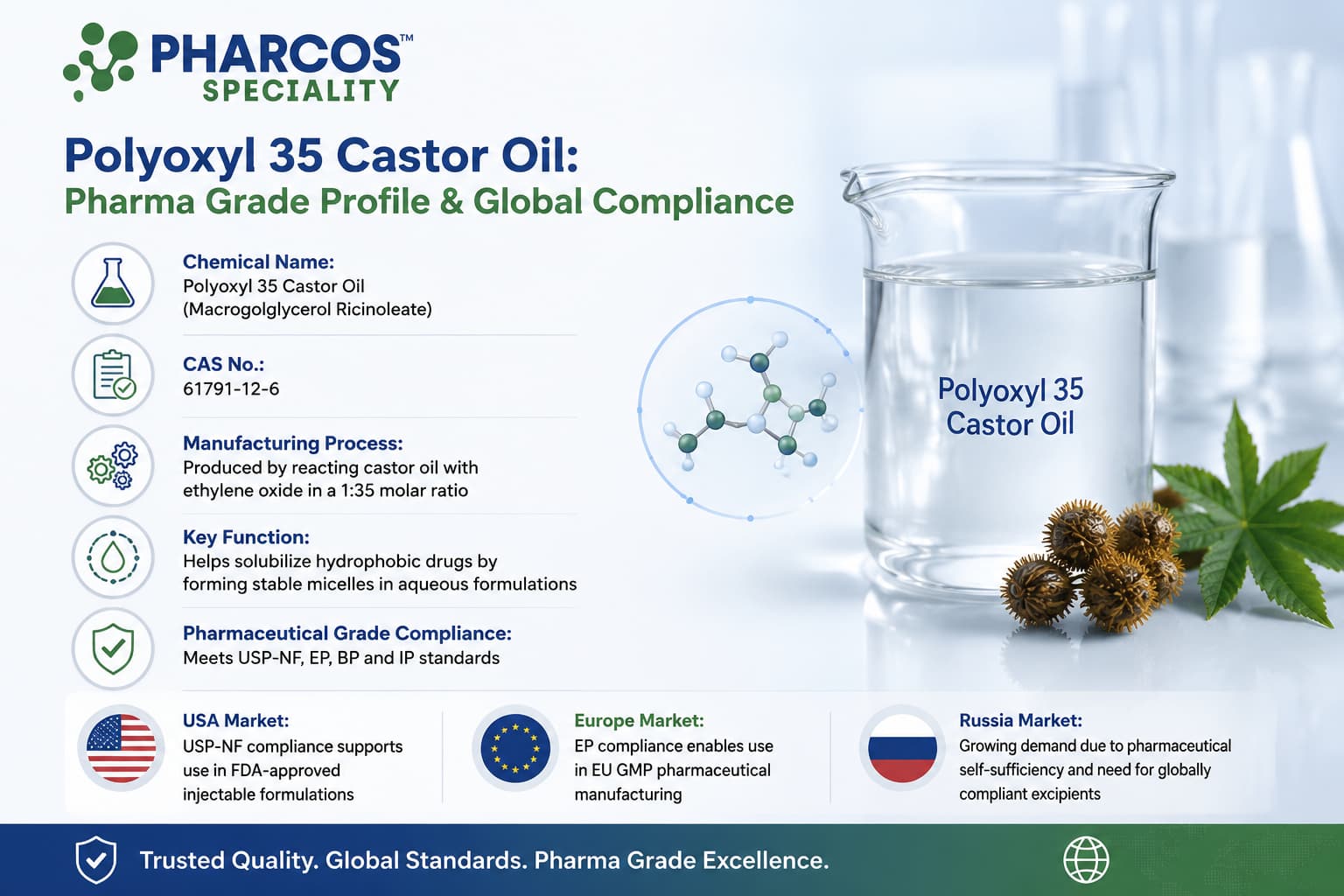
Polyoxyl 35 Castor Oil (INCI/INN: Macrogolglycerol Ricinoleate, CAS No. 61791-12-6) is synthesized by reacting castor oil with ethylene oxide at a molar ratio of 1:35. This precise ratio governs the molecule's HLB value and determines its effectiveness in forming stable micellar structures around hydrophobic drug molecules in aqueous environments.
Polyoxyl 35 Castor Oil Pharma Grade complies with USP-NF, EP, BP and IP monographs - a compliance profile that covers the primary regulated pharmaceutical markets across North America, Europe and beyond. In the USA, USP-NF compliance is a prerequisite for inclusion in FDA-approved injectable formulations. Across Europe, EP compliance enables seamless use within EU GMP-certified manufacturing operations. In Russia, growing pharmaceutical self-sufficiency initiatives have created sustained demand for internationally compliant excipients that can be validated within domestic regulatory frameworks.
Polyoxyl 40 Hydrogenated Castor Oil: Chemistry, Grade and Pharmaceutical Profile
Polyoxyl 40 Hydrogenated Castor Oil (INCI/INN: Macrogolglycerol Hydroxystearate, CAS No. 61788-85-0) is produced by reacting hydrogenated castor oil with ethylene oxide. The hydrogenation of the fatty acid chains prior to ethoxylation is what fundamentally distinguishes this grade - it produces a surfactant with minimal taste and odor and a substantially reduced tendency to trigger histamine release compared to standard castor ethoxylates.
Polyoxyl 40 Hydrogenated Castor Oil Pharma Grade shares the same multi-pharmacopoeial compliance profile - USP-NF, EP, BP and IP - making it equally suitable for regulated drug manufacturing globally. Its reduced immunogenic risk and superior sensory profile make it a preferred excipient for oral solutions, softgel capsules and topical preparations where patient tolerability and product elegance are formulation priorities. In the Middle East and Russia, where temperature variability during storage and distribution can challenge product integrity, its enhanced chemical and thermal stability makes it a particularly practical choice.
Our Other Product
Steareth-2 | Polyoxyl 2 Stearyl EtherApplications:
1. Solubilization of Poorly Soluble Drugs and Vitamins
Both Polyoxyl 35 Castor Oil and Polyoxyl 40 Hydrogenated Castor Oil function as potent solubilizers - this is the application area they most directly share - though the drug candidates and dosage forms they serve differ in important ways.
Polyoxyl 35 Castor Oil is the established standard for solubilizing critically water-insoluble injectable drugs, most notably paclitaxel (an oncology agent) and cyclosporine (an immunosuppressant). These molecules present extreme aqueous solubility challenges and this grade's micellar solubilization capacity at the molar ratio of 1:35 is well-characterized for parenteral use across the USA and Europe.
Polyoxyl 40 Hydrogenated Castor Oil applies comparable solubilization chemistry to different targets - fat-soluble vitamins (A, D, E and K) and lipophilic drug molecules incorporated into oral liquid and semi-solid preparations. Where taste, odor and mucosal tolerability matter - as they do in oral solutions and softgel fills - this grade's hydrogenated structure gives it a clear sensory and tolerability advantage.
When formulators in Europe or the USA are selecting between the two for a solubilization role, the route of administration typically determines the choice: parenteral applications default to Polyoxyl 35 Castor Oil, while oral and topical applications lean toward Polyoxyl 40 Hydrogenated Castor Oil.
2. Emulsification in Liquid and Semi-Solid Formulations
Emulsification is a shared functional role for both grades and in this application they can often be considered alongside one another based on the formulation type and stability requirements.
Both excipients reduce interfacial tension between oil and water phases, enabling stable emulsions in pharmaceutical liquids, creams, lotions and ointments. In liquid oral preparations, both can maintain homogenous emulsion systems throughout the product shelf life. In topical semi-solid formulations - creams, gels and ointments - both contribute to emulsion stability and consistent product texture.
The practical difference lies in performance under thermal stress. Polyoxyl 40 Hydrogenated Castor Oil offers a meaningful stability advantage in formulations exposed to elevated or fluctuating temperatures - a relevant consideration for pharmaceutical manufacturers distributing products across the Middle East, where ambient storage and transport conditions routinely challenge excipient and product stability. For temperature-controlled, parenteral or EU/US-manufactured emulsion products where thermal stress is managed, Polyoxyl 35 Castor Oil remains a well-established emulsifier with a strong pharmacopoeial track record.
3. Distinct Application: Bioavailability Enhancement vs. Stabilization
This is where the two grades diverge most clearly in their application profiles and where formulators must avoid conflating them.
Polyoxyl 35 Castor Oil carries an explicit role as a bioavailability enhancer. By forming micellar structures that improve the effective solubility of poorly soluble APIs at the gastrointestinal absorption site, it directly supports improved drug uptake in oral formulations. This is a pharmacologically significant function - particularly in the context of BCS Class II and IV drugs where dissolution is the rate-limiting step in absorption. Pharmaceutical manufacturers across Europe, the USA and Russia formulating generic oncology and immunology oral products rely on this property to demonstrate bioequivalence to reference products.
Polyoxyl 40 Hydrogenated Castor Oil, by contrast, is recognized for its role as a stabilizer - a distinct functional contribution that Polyoxyl 35 Castor Oil does not primarily offer. In softgel capsules and oral solutions, it stabilizes the formulation against physical and chemical degradation, preserving API integrity and emulsion homogeneity over the product's intended shelf life. For manufacturers in the Middle East producing vitamin-based oral liquid products or nutraceutical softgels, this stabilization function is a critical selection driver. It ensures that products maintain their quality attributes from manufacturing through distribution and end use - regardless of logistical conditions.
Our Other Product
Steareth-21 | Polyoxyl 21 Stearyl EtherAbout Pharcos Speciality Ltd.
Pharcos Speciality Ltd. is a specialized manufacturer and global supplier of pharmaceutical excipients, with particular expertise in castor oil derivatives including both Polyoxyl 35 Castor Oil and Polyoxyl 40 Hydrogenated Castor Oil pharma grades. The company's products comply with USP-NF, EP, BP and IP pharmacopoeial standards, supporting drug manufacturers, formulation scientists and generic pharmaceutical companies across the USA, Europe, Russia, the Middle East and Asia. Pharcos Speciality Ltd. combines technical expertise with a consistent focus on quality assurance and regulatory compliance, making it a dependable excipient partner for both development-stage and commercial-scale pharmaceutical manufacturing operations.
 WhatsApp Now
Conclusion
Polyoxyl 35 Castor Oil and Polyoxyl 40 Hydrogenated Castor Oil together address the full spectrum of solubilization, emulsification, bioavailability and stabilization needs that modern pharmaceutical formulation demands. Where their applications overlap - as solubilizers and emulsifiers - the choice between them is guided by route of administration, thermal stability requirements and patient tolerability priorities. Where they diverge - bioavailability enhancement for Polyoxyl 35 Castor Oil and stabilization for Polyoxyl 40 Hydrogenated Castor Oil - each grade brings a unique and non-interchangeable value to the formulation. Their shared multi-pharmacopoeial compliance with USP-NF, EP, BP and IP standards ensures that pharmaceutical manufacturers across the USA, Europe, Russia and the Middle East can integrate either grade with confidence into regulated drug products - making both indispensable excipients in the global pharmaceutical formulation toolkit.
FAQs on Polyoxyl 35 Castor Oil & Polyoxyl 40 Hydrogenated Castor Oil

Dr. Avinash Dubey (R&D Head)
Dr. Avinash Dubey is a PhD in Organic Chemistry with a distinguished career spanning more than four decades. As the head of R&D at Pharcos, he focuses on the development of novel molecules for a wide array of industrial sectors, blending long-standing experience with a passion for innovation.

Mr. Ankit Shah (Managing Director)
Mr. Ankit Shah has led Pharcos Speciality for over three decades, establishing it as a pioneer in specialty chemicals. He currently directs the company’s strategic expansion into the APIs, Excipient and Speciality Surfactants markets, upholding a steadfast commitment to "Make in India" and world-class manufacturing quality and new product development.