

How to Evaluate Pharmaceutical-Grade PEG-40 Hydrogenated Castor Oil: Quality and Supplier Checklist




AI Summary
Pharmaceutical-grade PEG-40 hydrogenated castor oil should be evaluated through grade-specific specifications, impurity controls, manufacturing-site traceability, batch data, intended-use documentation and performance in the proposed formulation. Buyers should apply the same evaluation process when comparing manufacturers, distributors and export suppliers of Polyoxyl 40 hydrogenated castor oil. A structured review helps formulation, quality and procurement teams identify a technically suitable material and a dependable long-term supply source.
What Defines Pharmaceutical-Grade PEG-40 Hydrogenated Castor Oil?
PEG-40 hydrogenated castor oil is a nonionic surfactant produced by ethoxylating hydrogenated castor oil. It can help disperse or solubilize lipophilic materials in aqueous systems. However, a functional description does not establish pharmaceutical grade.
That status depends on defined specifications, controlled manufacture, an appropriate impurity profile, reliable documentation and suitability for the intended dosage form and administration route. A PEG-40 HCO manufacturer may also offer several commercial grades with different controls or performance characteristics.
Buyers evaluating a PEG-40 HCO exporter should identify the original manufacturing source rather than treating export capability as proof of manufacture. During the initial review, procurement and quality teams should establish whether CAS 61788-85-0 applies to the exact material being proposed and determine which compendial or internal standard supports its grade designation.
Commercial grades are not automatically interchangeable. Even where identity tests and basic chemical values are comparable, differences in feedstocks, processing, water content, impurities or physical form may affect clarity, viscosity, stability and solubilization.
 WhatsApp Now
PEG-40 Hydrogenated Castor Oil, Polyoxyl 40 HCO and CAS 61788-85-0
Names may differ among INCI, commercial, regulatory and compendial contexts. “PEG-40 hydrogenated castor oil,” “Polyoxyl 40 hydrogenated castor oil,” “hydrogenated castor oil ethoxylate” and supplier-specific names may describe related materials, but wording alone does not prove equivalence.
Before accepting an alternative name or source, verify:
- Applicable monograph or documented internal standard
- Chemical identity and composition
- Manufacturing process and site
- Specification and analytical methods
- Intended use and regulatory status
- Formulation performance
CAS 61788-85-0 assists with substance identification, but it does not certify purity, compendial compliance, pharmaceutical grade or route suitability. Materials sharing the number may still vary in composition, physical form and process-related impurities.
Pharmaceutical-Grade PEG-40 HCO Specifications to Review
The specification should identify the exact product and grade. Relevant attributes may include appearance, colour, odour, physical form, identification, water content, pH or acidity/alkalinity, hydroxyl value, acid value, saponification value, viscosity and cloud point. Assay or compositional controls and microbial limits may also be relevant.
Required tests and acceptance limits depend on the applicable standard, formulation, route and market. Buyers should not import limits from another supplier’s grade without a documented technical justification.
| Specification Area | Evidence to Examine | Key Question |
|---|---|---|
| Identity | Identification methods, name and CAS data | Is this the exact qualified material? |
| Grade | Monograph or controlled internal specification | What evidence supports the grade claim? |
| Physical and chemical quality | Defined tests, limits and methods | Are the attributes relevant to processing and use controlled? |
| Microbiological quality | Limits or risk justification, where needed | Are controls appropriate for the dosage form? |
| Lifecycle | Storage, packaging and shelf-life or retest support | Will quality remain controlled through use? |
Impurity Controls for Pharmaceutical-Grade PEG-40 HCO
Ethoxylation makes process-related impurity evaluation important. Depending on process knowledge and intended use, the assessment may cover residual ethylene oxide, 1,4-dioxane, residual catalysts, solvents, elemental impurities and degradation products. Water, microorganisms and peroxide formation may also require controls or risk-based justification.
The assessment should consider manufacturing route, daily exposure, dosage form and administration route. ICH Q3D(R2), for example, applies a risk-based approach to elemental impurities and recognises that route affects acceptable exposure. ICH Q3C provides the corresponding framework for residual solvents.
This does not mean every listed impurity requires routine testing in every batch. Supplier knowledge, process controls, validation and periodic verification may support a suitable control strategy. The resulting control plan should be documented, scientifically justified and aligned with the finished product’s exposure profile.
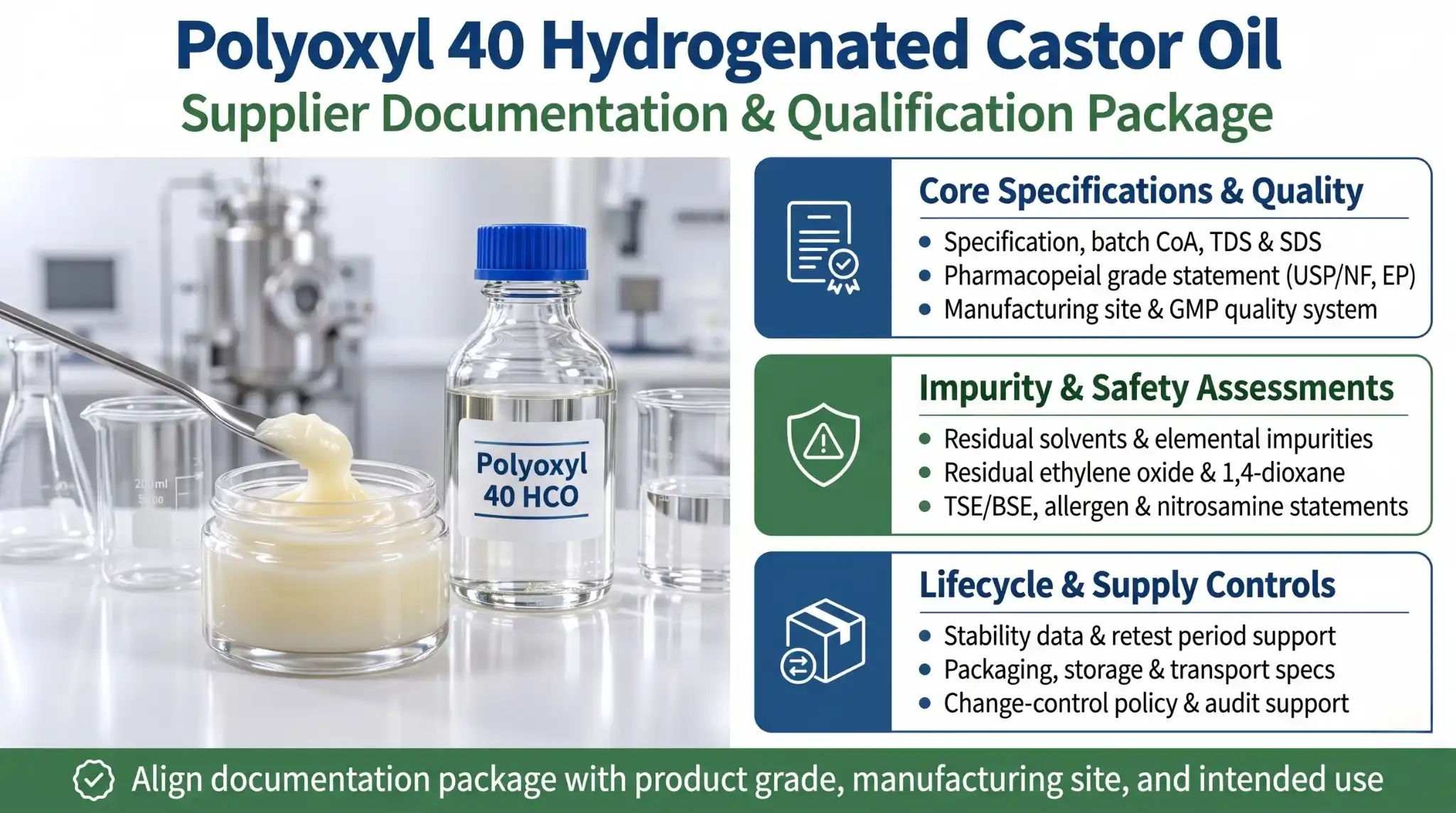
Documentation Required from a Polyoxyl 40 Hydrogenated Castor Oil Supplier
Document needs vary by jurisdiction, route and risk. A qualification package may include:
- Current specification, batch CoA, Technical Data Sheet and Safety Data Sheet
- Applicable compendial or internal-grade statement
- Manufacturing-site and quality-system information
- Residual-solvent and elemental-impurity assessments
- Residual ethylene oxide and 1,4-dioxane information
- TSE/BSE, GMO, allergen and nitrosamine statements where relevant
- Stability or retest-period support
- Packaging, storage and transportation requirements
- Change-control policy, audit support and sample availability
The documentation package should be reviewed for product, site and intended-use relevance. This helps the buyer connect general quality-system evidence with the controls applied to the specific material being qualified.
Our Other Product
PEG 100 Castor Oil (Semi-solid / Solid | Solubilizers)Batch-Specific Certificate of Analysis
A useful CoA should connect the actual batch to an approved specification. It should identify the exact product and grade, batch number, manufacturing or testing date, shelf-life or retest date, limits, actual results, methods or references, manufacturing-site traceability and quality approval. “Passes” or “conforms” may suit qualitative tests, but a generic CoA may not support qualification or trend analysis.
PEG-40 HCO Manufacturer, Supplier and Exporter Comparison
| Party | Typical Role | Qualification Focus |
|---|---|---|
| Manufacturer | Produces and may test or release the material | Site controls, process, release responsibility and change control |
| Supplier or distributor | Sells, stores and may provide technical documents | Source transparency, storage, traceability and complaint handling |
| Trader | Facilitates a commercial transaction | Actual source, chain of custody and relabelling or repacking |
| Exporter | Manages international supply and documentation | Manufacturer identity, export records, storage and batch traceability |
Confirm the legal manufacturer, actual site, testing and release responsibility, any repacking or relabelling, complaint and recall ownership, and who controls export documentation. One organisation may perform several roles, but responsibilities should remain explicit.
PEG-40 HCO Functional and Batch-to-Batch Performance Evaluation
Chemical compliance does not guarantee performance in a particular formulation. Representative samples should be assessed for solubilization capacity, clarity or turbidity, API and excipient compatibility, pH and electrolyte tolerance, foaming, viscosity, dilution behaviour, temperature response, oxidative stability and packaging compatibility.
Where the qualification risk justifies it, compare representative batches for appearance, odour, physical form, key chemical values, impurity profile, processing behaviour and finished-product stability. The approved control strategy should connect specification compliance with consistent functional performance; universal use levels should not be assumed.
PEG-40 HCO Packaging, Storage and Transportation Controls
Review container material, closure integrity, tamper evidence, labels and batch identification. Determine whether protection from moisture, oxygen, light or excessive heat is needed and how temperature excursions are assessed.
Paste and liquid grades may require different handling. Follow the current supplier documentation for storage conditions, shelf life or retest period; no unverified storage temperature should be assigned to Pharcos HCO 40.
PEG-40 HCO Supplier Change Control and Supply Continuity
The quality agreement should define advance notification for changes to the site, raw-material source, process, test methods, specification, packaging, form or regulatory status. Teams should determine whether a change requires document review, testing, validation or regulatory action.
Commercial review should cover lead time, minimum order quantity, capacity, source continuity, retained samples, technical response and export documentation. These factors reduce disruption risk but do not replace quality approval.
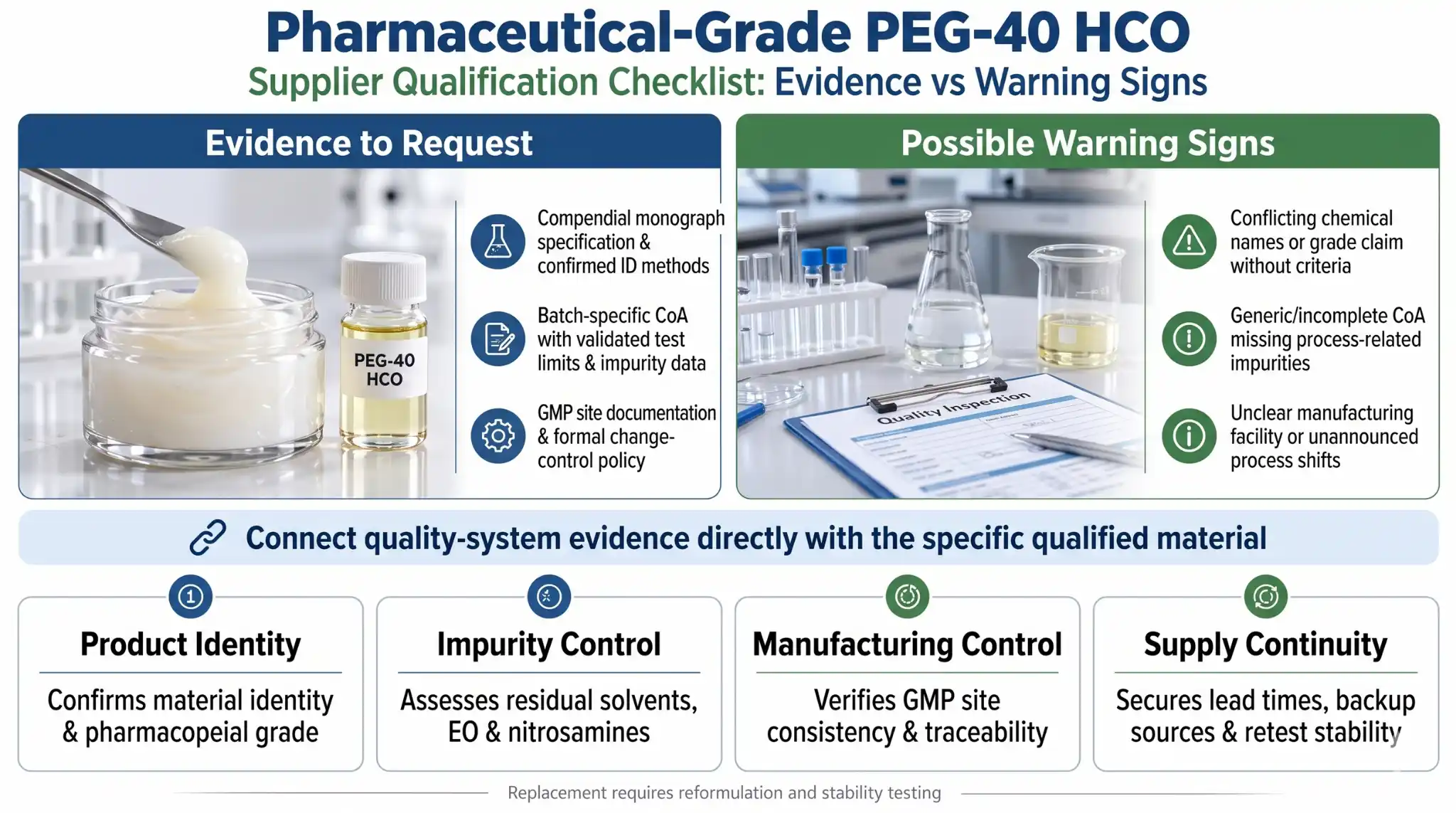
Pharmaceutical-Grade PEG-40 HCO Supplier Checklist
| Evaluation Area | Evidence to Request | Why It Matters | Possible Warning Sign |
|---|---|---|---|
| Product identity | Specification and identification methods | Confirms the supplied material | Conflicting names or missing methods |
| Grade status | Monograph or internal pharmaceutical specification | Supports the stated quality level | Grade claim without criteria |
| Batch quality | Batch-specific CoA | Shows results against limits | Generic or incomplete CoA |
| Impurity control | Relevant tests and risk assessments | Supports safety and regulatory review | Missing process-related information |
| Manufacturing control | Site and quality-system documents | Supports consistency and traceability | Unclear manufacturing location |
| Change control | Written notification procedure | Protects validated use and filings | Unannounced changes |
| Functional performance | Samples and application testing | Confirms formulation suitability | Reliance on identity alone |
| Supply continuity | Lead time, source and continuity plan | Reduces interruption risk | Frequent or unexplained source changes |
Pharmaceutical-Grade PEG-40 HCO Supplier Qualification Workflow
- Define the dosage form, administration route and daily exposure.
- Establish regulatory, compendial and internal requirements.
- Obtain documents and confirm the actual manufacturing site.
- Review specifications, methods and impurity controls.
- Qualify or audit the source according to risk.
- Test representative samples and formulation compatibility.
- Where justified by risk, compare representative batches before final approval.
- Establish quality, supply and change-control agreements.
- Monitor documentation, performance and supplier status periodically.
 Call Us Now!
About Pharcos Speciality Ltd
Pharcos Speciality Ltd manufactures pharmaceutical ingredients and speciality chemicals, with a portfolio that includes solubilizers, surfactants and related speciality products. Pharcos HCO 40 is offered in paste and liquid forms for solubilization applications. Formulation and procurement teams can contact the company to discuss their intended use and request relevant specifications, samples, technical documents, availability and commercial information.
Our Other Product
PEG 200 Castor Oil (Solid / Flake | Solubilizers)Selecting Pharmaceutical-Grade PEG-40 HCO: Conclusion
Selecting PEG-40 HCO for a pharmaceutical formulation requires more than matching a product name or CAS number. Buyers should confirm the applicable grade, review specifications and impurity controls, examine batch-specific results, verify manufacturing traceability and test the material in the intended formulation. Supplier reliability, change control and continuity of supply should then be evaluated alongside technical performance.
Pharcos Speciality Ltd offers Pharcos HCO 40 in paste and liquid forms for solubilization applications. Pharmaceutical formulators can contact the Pharcos technical team to discuss intended-use requirements and request the current specification, Certificate of Analysis, safety and technical documents, impurity information, samples, availability and export support. Final suitability should be established from the documentation supplied and the buyer’s formulation and regulatory assessment.
Pharmaceutical-Grade PEG-40 HCO FAQs

Dr. Avinash Dubey (R&D Head)
Dr. Avinash Dubey is a PhD in Organic Chemistry with a distinguished career spanning more than four decades. As the head of R&D at Pharcos, he focuses on the development of novel molecules for a wide array of industrial sectors, blending long-standing experience with a passion for innovation.

Mr. Ankit Shah (Managing Director)
Mr. Ankit Shah has led Pharcos Speciality for over three decades, establishing it as a pioneer in specialty chemicals. He currently directs the company’s strategic expansion into the APIs, Excipient and Speciality Surfactants markets, upholding a steadfast commitment to "Make in India" and world-class manufacturing quality and new product development.