
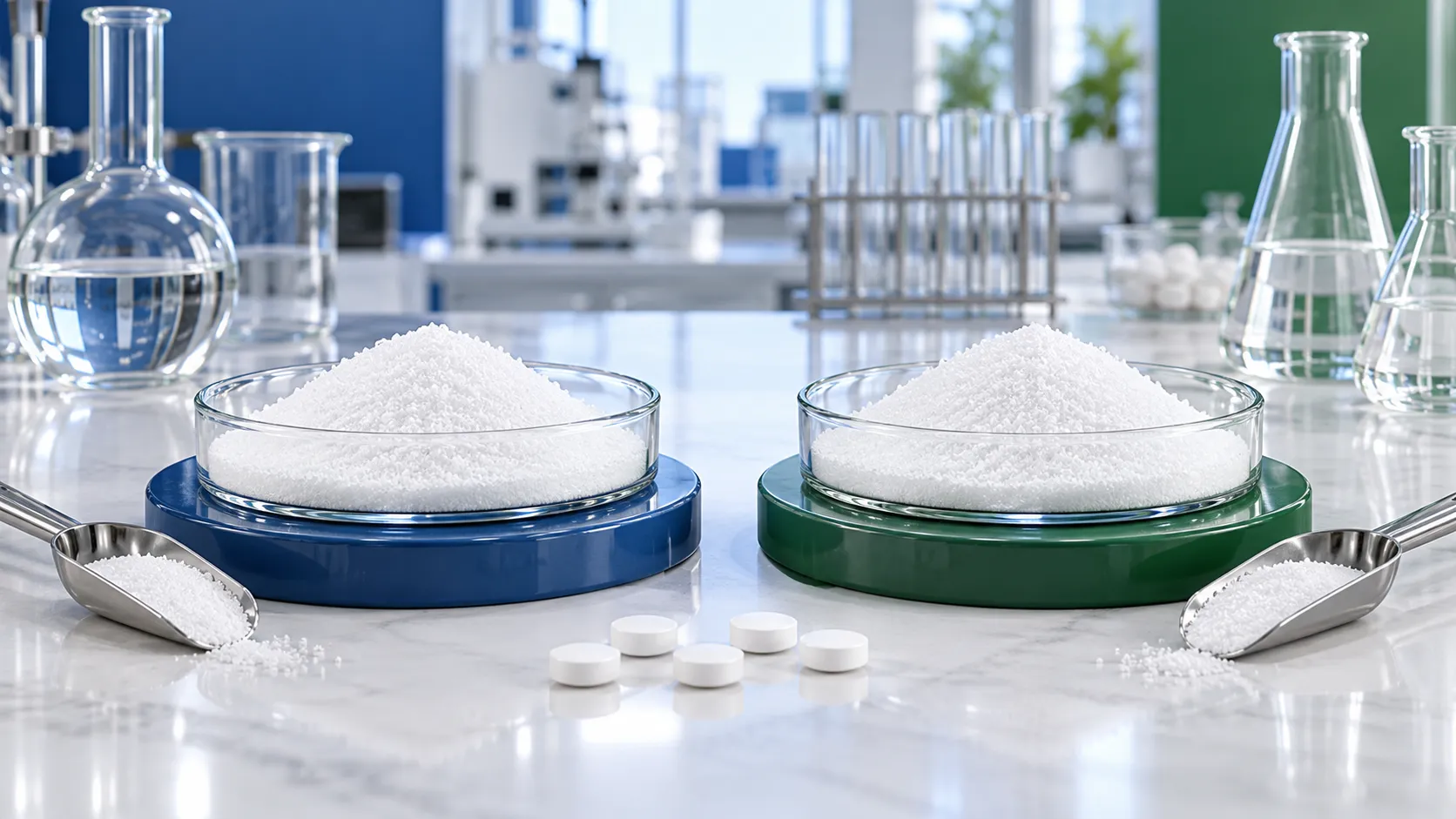
PEG 3350 vs PEG 4000: A Pharmaceutical-Grade Selection Guide



AI Summary
PEG 3350 and PEG 4000 are closely related solid polyethylene glycol grades, but differences in molecular-weight distribution, physical form, thermal behaviour and viscosity can influence pharmaceutical processing. Neither grade is universally superior. Formulators should select between them according to the required excipient function, processing conditions, applicable pharmacopeial specification, API compatibility and finished-product performance.
PEG 3350 vs PEG 4000: Why Grade Selection Matters
Polyethylene glycols are mixtures of polymer chains rather than pure compounds in which every molecule has an exact molecular weight. The numbers 3350 and 4000 identify nominal grade positions within a distribution. Because the two grades are close, many properties may overlap, yet modest differences can still influence charging, melting, mixing, binding, lubrication, solidification and dissolution.
A polyethylene glycol 3350 vs 4000 assessment becomes relevant when a process has a narrow operating range or when small changes affect tablet strength, ejection force or drug release. In practice, PEG grade selection should begin with the target product profile and supplier documents, followed by side-by-side trials under identical conditions.
 WhatsApp Now
Polyethylene Glycol 3350 vs 4000: Technical Comparison
| Selection factor | PEG 3350 | PEG 4000 | What the formulator should verify |
|---|---|---|---|
| Nominal molecular-weight position | Lower of the two grades | Higher of the two grades | Applicable monograph and supplier specification |
| Pharcos-listed physical form | Free-flowing white powder | Solid with a wax-like character | Supplied form, particle size and handling |
| Water interaction | Hydrophilic and water-soluble | Hydrophilic and water-soluble | Dissolution under formulation conditions |
| Viscosity | Generally expected to be slightly lower under equivalent conditions | Generally expected to be slightly higher under equivalent conditions | Same concentration, temperature and method |
| Thermal behaviour | May soften or melt at a somewhat lower range | May exhibit a somewhat higher range | Actual melting or congealing specification |
| Processing | Listed powder form may simplify dispensing | Wax-like form may change charging and melting | Mixing, heating, cooling and scale-up |
| Final selection | Formulation-dependent | Formulation-dependent | Comparative performance in the intended dosage form |
These are development expectations, not release specifications. Exact differences must come from current technical documentation and experimental results.
The same comparison may be described in pharmacopeial or procurement documents as Macrogol 3350 vs Macrogol 4000. Regardless of the naming convention, formulators should compare the applicable specifications and performance data rather than relying only on the grade numbers.
PEG 3350 and PEG 4000 Molecular-Weight Ranges
An average molecular weight summarizes a distribution of chain lengths. Depending on the monograph or supplier specification, grade identity may be controlled through molecular-weight-related tests such as hydroxyl value, together with identity, impurity and physical-property requirements. Nearby grades can therefore show overlapping behaviour.
Both grades may be associated with CAS 25322-68-3, but a shared CAS number identifies the polymer family rather than a particular nominal grade. Grade identity comes from the relevant specification, test methods and acceptance criteria.
PEG 3350 and PEG 4000 Melting and Thermal Processing
The higher nominal molecular-weight grade may show somewhat higher melting or congealing behaviour and melt viscosity, but the ranges can be close or overlap. Test method, molecular-weight distribution, thermal history and physical form all influence the observed result.
For melt granulation, solid dispersions or other heat-assisted processes, verify softening, mixing torque, heat-transfer demand, cooling rate and solidification. Recrystallization after cooling may also affect texture or performance. The chosen temperature must remain compatible with API thermal stability and the equipment’s controllable operating window.
Solubility and Viscosity of PEG 3350 and PEG 4000
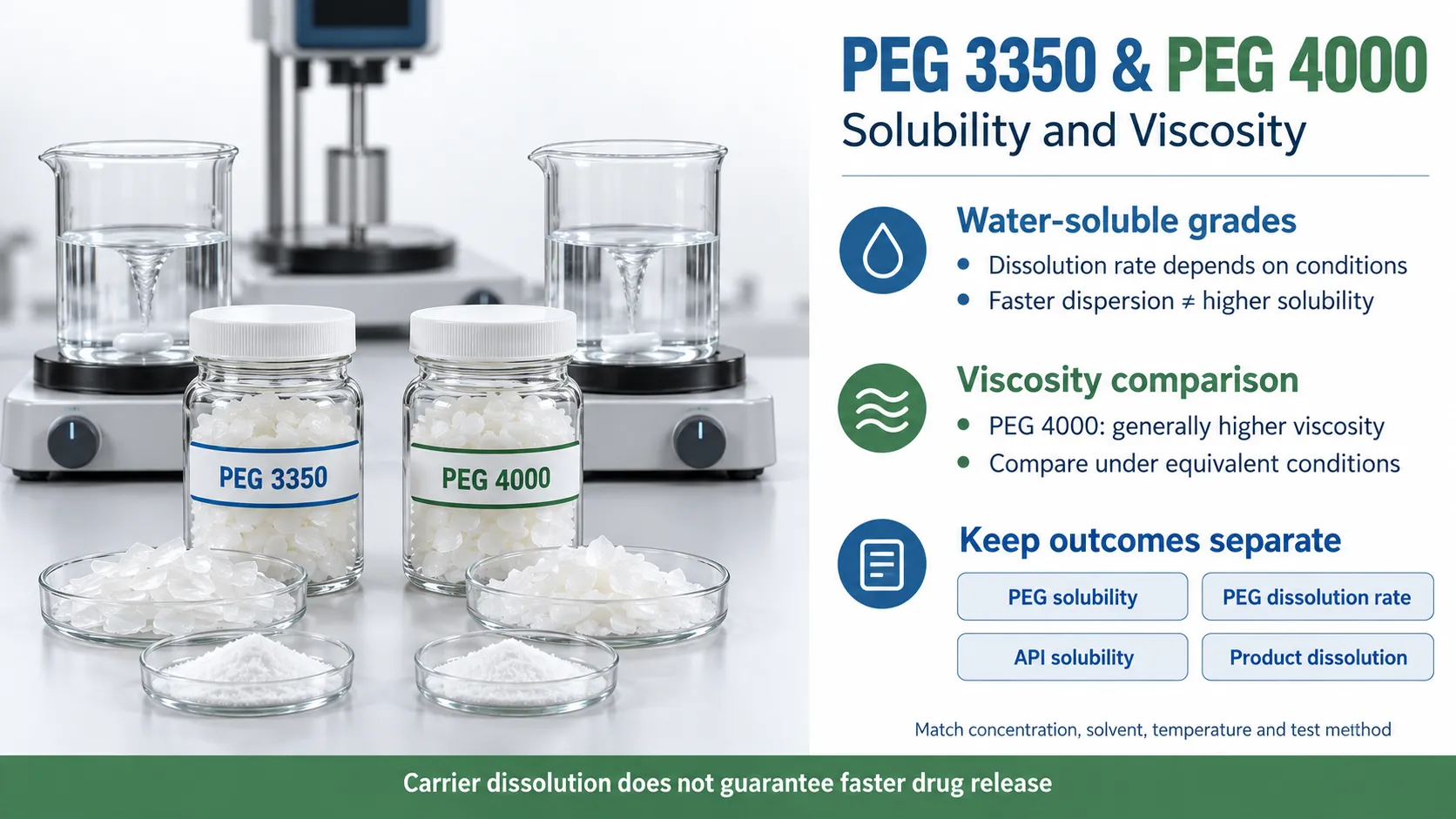
Both grades are hydrophilic and water-soluble. Their observed dissolution rate, however, can change with particle size, crystallinity, water temperature, agitation, polymer concentration and other ingredients. A powder that disperses rapidly may appear to dissolve more readily, but this does not necessarily mean it has greater equilibrium solubility.
It is equally important to separate four different outcomes: PEG solubility, PEG dissolution rate, API solubility and finished-product dissolution. Dissolving the carrier does not automatically improve API solubility or guarantee faster drug release.
PEG 4000 would generally be expected to provide somewhat greater solution or melt viscosity than PEG 3350 under equivalent conditions. A valid comparison requires the same concentration, solvent, temperature, shear conditions, instrument, method, sample preparation and equilibration time.
PEG 3350 and PEG 4000 in Granulation and Compression
Either solid PEG grade may be assessed as a binder in wet or melt granulation. Performance depends on PEG level and addition method as well as API and filler properties, mixing energy, granulation endpoint, drying or cooling, milling and compression conditions.
Useful development responses include:
- granule-size distribution, flow and compressibility;
- granule strength and tendency to generate fines;
- tablet tensile strength or hardness;
- friability, porosity and disintegration; and
- dissolution after manufacture and storage.
The higher nominal molecular-weight position of PEG 4000 may alter bonding or solidification, but stronger granules or tablets should not be assumed without supporting results.
Our Other Product
PEG 1450 (Polyethylene Glycol 1450 | Macrogol 1450)PEG 3350 and PEG 4000 as Water-Soluble Lubricants
Both grades may be evaluated as water-soluble lubricants. Examine die-wall friction, ejection force, lubricant distribution, compact strength, sticking, tablet surface, disintegration and dissolution. Processing history matters because a solid PEG can act through distribution, softening or melt-related mechanisms.
Neither grade should be substituted one-for-one for a conventional hydrophobic lubricant without evidence. The required level and mixing strategy depend on tooling, formulation, compression speed and the balance between friction reduction and compact performance.
PEG 3350 and PEG 4000 in Solid Dispersions
As hydrophilic carriers, the grades may improve API wetting or alter dissolution, but success depends on API–carrier miscibility, drug loading, process temperature and solid-state stability. Relevant studies may include thermal analysis, powder X-ray diffraction and comparative dissolution where appropriate.
| Application | PEG 3350 considerations | PEG 4000 considerations | Selection study |
|---|---|---|---|
| Wet granulation | Powder form may aid dispersion or solution preparation | Physical presentation may require different handling | Granulation and drying trials |
| Melt granulation | Lower nominal grade may affect melt handling | Wax-like character may affect binding and solidification | Thermal and granule evaluation |
| Tablet binding | May support granule and tablet cohesion | May give different compact properties | Tensile strength and friability |
| Water-soluble lubrication | Friction reduction must be demonstrated | Distribution and melt behaviour may differ | Ejection-force studies |
| Solid dispersion | Establish miscibility and physical stability | Establish thermal and solid-state behaviour | DSC, PXRD and dissolution where appropriate |
| Matrix formulation | May change porosity and release | May produce a different dissolution pattern | Comparative dissolution testing |
Neither carrier automatically creates an amorphous dispersion. Monitor phase separation, API recrystallization, dissolution changes and chemical stability throughout the proposed shelf life.
PEG 3350 and PEG 4000 in Matrix and Drug-Release Systems
PEG 3350 and PEG 4000 are water-soluble. They may influence water penetration, API wetting, matrix porosity, erosion, diffusion, disintegration and dissolution, but should not automatically be described as stand-alone controlled-release polymers.
Drug-release behaviour reflects the complete dosage-form design, including API solubility, PEG level, co-excipients, tablet porosity, compression force and dissolution medium. Comparative release profiles reveal whether a grade change is meaningful.
PEG 3350 and PEG 4000 Compatibility and Stability Risks
Compatibility studies should cover the API and relevant fillers, binders, disintegrants, lubricants, matrix polymers, surfactants, antioxidants, coating materials and packaging. Consider moisture uptake, thermal degradation, phase separation, recrystallization and changes in physical state.
Oxidative risk also deserves attention for oxidation-sensitive APIs. Published research has detected hydroperoxides in common pharmaceutical excipients, while a PEG 3350-containing coating system has been associated with oxidation of a susceptible drug. These findings do not mean every batch is unsuitable; they support risk-based review of peroxide-related impurities, supplier data and product stability.
Macrogol 3350 vs Macrogol 4000: Pharmacopeial Naming
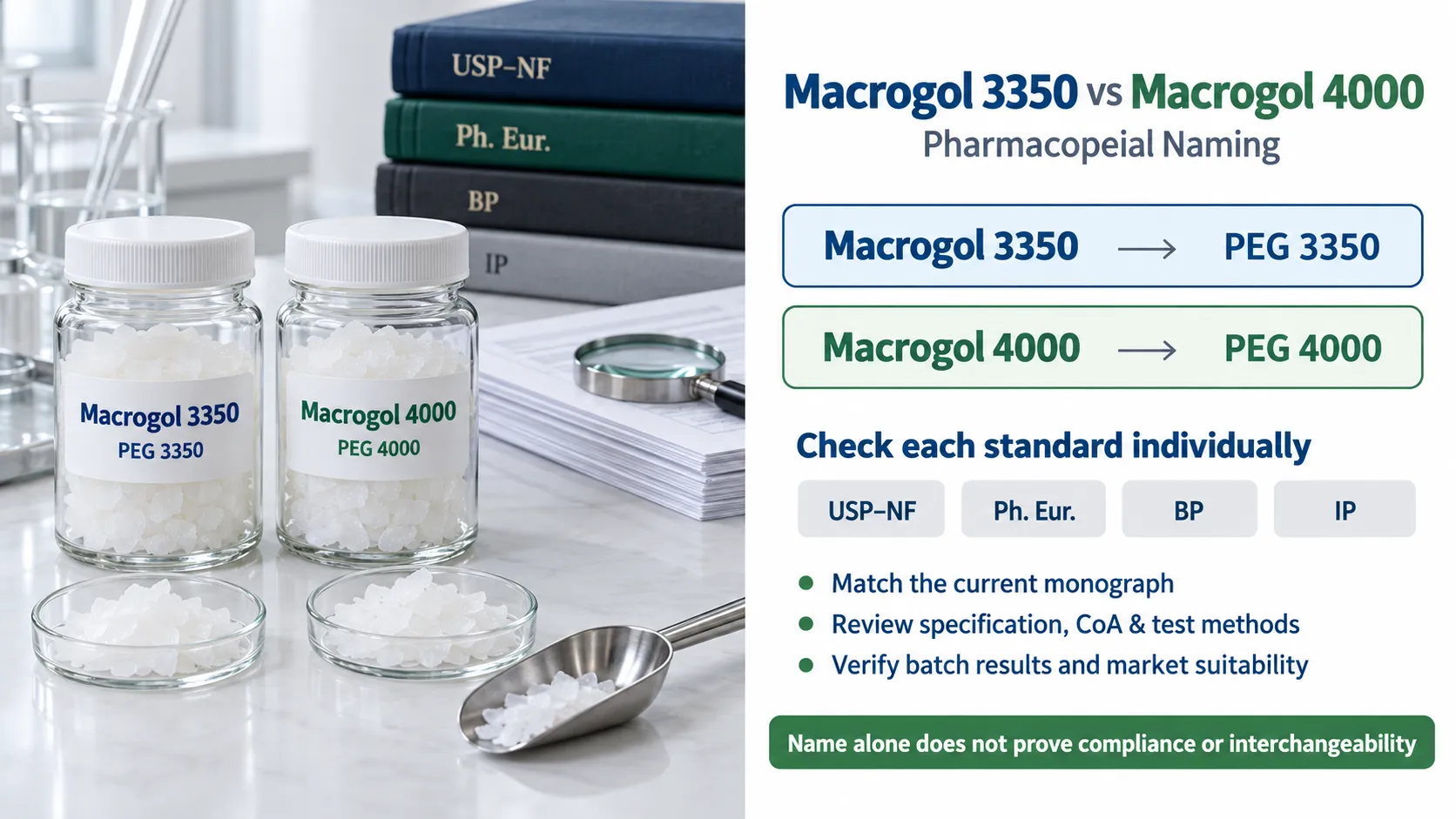
“Polyethylene glycol” and “macrogol” are naming conventions used in different pharmaceutical and pharmacopeial contexts. Macrogol 3350 corresponds to PEG 3350, and Macrogol 4000 corresponds to PEG 4000, but the name alone does not demonstrate compliance or interchangeability.
USP–NF, European Pharmacopoeia, British Pharmacopoeia and Indian Pharmacopoeia requirements should be checked individually rather than treated as identical. Buyers should match the grade to the applicable current monograph and review the supplier specification, Certificate of Analysis, analytical methods and batch-specific results. Regulatory suitability must be confirmed for the intended market.
Our Other Product
PEG 10000 (Polyethylene Glycol 10000 | Macrogol 10000)PEG 3350 vs PEG 4000 Grade Selection Checklist
Before approving either grade, confirm:
- intended dosage form and required excipient function;
- API properties and compatibility risks;
- nominal grade, physical form and particle size;
- melting or congealing behaviour and processing temperature;
- solution or melt viscosity under relevant conditions;
- binding, lubrication and granulation performance;
- tablet strength, disintegration and dissolution;
- oxidative impurity risk and storage stability;
- applicable monograph and batch CoA; and
- reproducibility during scale-up.
 Call Us Now!
About Pharcos Speciality Ltd and Its Pharcogol PEG Range
Pharcos Speciality Ltd manufactures pharmaceutical ingredients and speciality chemicals. Its pharmaceutical portfolio includes the Pharcogol polyethylene glycol range, of which Pharcogol 3350 and Pharcogol 4000 are part. The company works with pharmaceutical manufacturers, formulation teams and other business buyers. Customers can contact Pharcos Speciality Ltd to request current product specifications, Certificates of Analysis, technical documentation and samples relevant to their development, quality or procurement review.
PEG 3350 vs PEG 4000: Conclusion
The distinction between PEG 3350 and PEG 4000 is more nuanced than the grade numbers suggest. The correct decision depends on the applicable specification, supplied physical form, thermal behaviour, viscosity, API compatibility, excipient function, manufacturing process, finished-product performance and stability.
Pharmaceutical manufacturers can contact Pharcos Speciality Ltd for current Pharcogol 3350 and Pharcogol 4000 specifications, Certificates of Analysis, technical documentation, samples and commercial enquiries.
PEG 3350 vs PEG 4000 Frequently Asked Questions

Dr. Avinash Dubey (R&D Head)
Dr. Avinash Dubey is a PhD in Organic Chemistry with a distinguished career spanning more than four decades. As the head of R&D at Pharcos, he focuses on the development of novel molecules for a wide array of industrial sectors, blending long-standing experience with a passion for innovation.

Mr. Ankit Shah (Managing Director)
Mr. Ankit Shah has led Pharcos Speciality for over three decades, establishing it as a pioneer in specialty chemicals. He currently directs the company’s strategic expansion into the APIs, Excipient and Speciality Surfactants markets, upholding a steadfast commitment to "Make in India" and world-class manufacturing quality and new product development.