
Polyethylene Glycol 3350 (PEG/Macrogol 3350): Uses, Properties and Pharmaceutical Applications



AI Summary
Polyethylene Glycol 3350, also known as PEG 3350 or Macrogol 3350, is a high molecular weight polyethylene glycol, with an average molecular weight in the range of approximately 3015 to 3685 g per mol, that is best known as an osmotic laxative used in constipation formulations. Unlike stimulant laxatives, PEG 3350 works purely through osmosis, drawing and retaining water within the colon to soften stool and support natural, predictable bowel movements, without direct stimulation of the intestinal lining. Beyond its laxative role, PEG 3350 is also used as a tablet binder, matrix forming agent and excipient in solid dosage formulations, valued for its chemical stability, free flowing white powder form and high water solubility. Because PEG is manufactured using ethylene oxide as a starting material, pharmaceutical grade PEG 3350 carries a documented quality control requirement: testing for diethylene glycol and ethylene glycol impurities, a topic that has received renewed global regulatory attention following World Health Organization alerts and United States Food and Drug Administration guidance issued in 2023. This guide explains how PEG 3350 functions as an osmotic laxative, its formulation applications, the quality and compliance parameters pharmaceutical buyers must verify, and how Pharcos Speciality Ltd supports pharmaceutical manufacturers as a PEG 3350 manufacturer, supplier and exporter based in India.
What Is Polyethylene Glycol 3350
Polyethylene Glycol 3350, commonly abbreviated as PEG 3350 and referred to in pharmacopeial literature as Macrogol 3350, is a member of the polyethylene glycol family formed through the polymerization of ethylene oxide with water. The number 3350 refers to its nominal average molecular weight, which typically falls within the range of approximately 3015 to 3685 g per mol.
At this molecular weight, PEG exists as a free flowing white powder rather than the liquid or semisolid form seen in lower molecular weight grades such as PEG 400 or PEG 1000. This solid form, combined with high water solubility and chemical stability, underpins its two primary pharmaceutical roles: as an osmotic laxative active ingredient in constipation formulations, and as a functional excipient, including binder and matrix former, in solid oral dosage forms.
 WhatsApp Now
Understanding the Osmotic Mechanism of Polyethylene Glycol 3350 (Macrogol 3350)
How PEG 3350 Works Without Direct Stimulation
PEG 3350 functions as an osmotic agent rather than a stimulant. Once ingested, PEG 3350 is minimally absorbed from the gastrointestinal tract and instead remains largely within the intestinal lumen, where its osmotic activity draws water into the colon and holds that water within the stool.
The process, step by step:
- Ingestion: PEG 3350 is taken orally, typically dissolved in water as part of a powder for oral solution or sachet formulation.
- Minimal absorption: because PEG 3350 is not significantly absorbed across the intestinal wall, it travels largely intact through the gastrointestinal tract.
- Osmotic water retention: as an osmotically active molecule, PEG 3350 draws water into the intestinal lumen and prevents that water from being reabsorbed, increasing the water content of the stool.
- Stool softening: the additional retained water softens the stool consistency, making it easier to pass.
- Increased stool volume and motility: the greater fluid content within the colon increases stool bulk, which in turn stimulates the natural muscular contractions of the bowel that move stool toward evacuation.
- Natural bowel movement: because this entire process relies on physical water retention rather than direct chemical stimulation of the intestinal lining, the resulting bowel movement is generally gentler and more predictable than that produced by stimulant laxatives.
Water Retention, Stool Softening and Bowel Regularity
This mechanism is why PEG 3350 is frequently described as supporting gentle, predictable bowel regularity rather than an urgent or forceful laxative effect. Because the effect is dose dependent and osmotic rather than stimulant based, formulators and clinicians can titrate PEG 3350 dosing to achieve a target stool consistency and frequency for a given patient population.
Polyethylene Glycol 3350 (Macrogol 3350) vs Stimulant Laxatives: Understanding the Difference
| Attribute | PEG 3350 (Osmotic Laxative) | Stimulant Laxatives |
|---|---|---|
| Mechanism | Draws and retains water in the colon through osmosis | Directly stimulates intestinal nerve endings to trigger muscular contractions |
| Onset of Action | Generally gradual, often within 1 to 3 days with regular use | Often faster, sometimes within hours |
| Nature of Effect | Gentle softening and increased stool volume | More forceful stimulation of bowel contractions |
| Suitability for Regular Use | Commonly used for ongoing management of occasional and chronic constipation | Generally intended for shorter term or occasional use due to tolerance and dependency concerns with prolonged use |
| Systemic Absorption | Minimal, remains largely within the gastrointestinal tract | Varies by specific active ingredient |
| Typical Formulation | Oral solution or sachet, dissolved in water before use | Tablets, liquids or suppositories depending on the specific active ingredient |
This comparison reflects the general pharmacological distinction between osmotic and stimulant mechanisms and is intended for formulation and educational reference rather than clinical guidance. Any decision about laxative selection for an individual patient should be made in consultation with a qualified healthcare professional.
Why Polyethylene Glycol 3350 (Macrogol 3350) Is Widely Used in Constipation Formulations
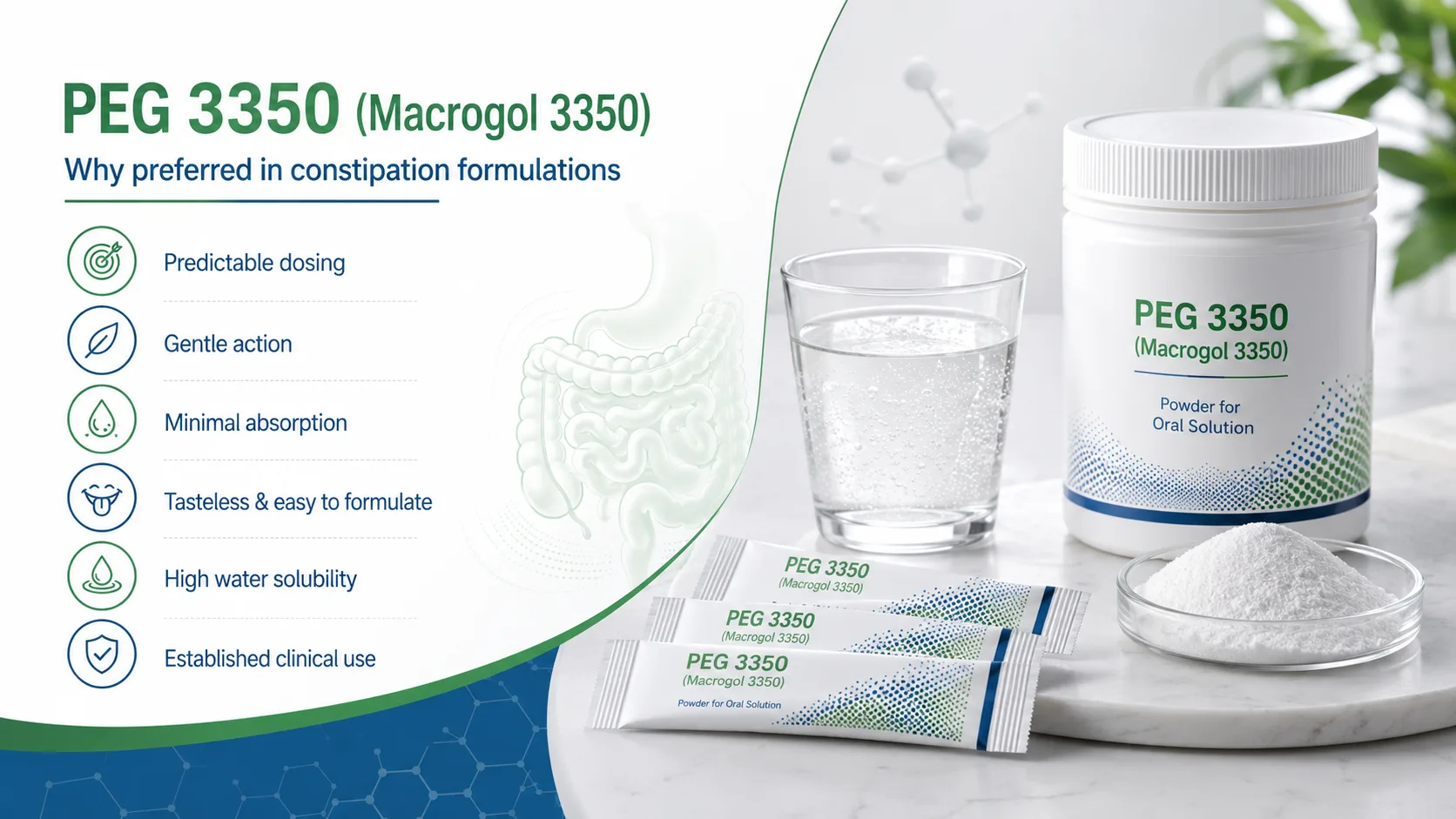
Point wise reasons PEG 3350 has become a preferred active ingredient in digestive health products:
- Predictable, dose dependent effect: the osmotic mechanism allows a relatively linear relationship between dose and stool softening effect, supporting more predictable dosing guidance for formulators and clinicians.
- Gentle mode of action: because PEG 3350 does not directly stimulate the intestinal lining, it is generally associated with less cramping and urgency compared to stimulant laxatives, an important consideration for formulations intended for regular or longer term use.
- Minimal systemic absorption: limited absorption from the gastrointestinal tract supports a favorable safety profile for use across a broad patient population, subject always to product specific labeling and healthcare provider guidance.
- Flavorless and easily formulated: PEG 3350 is essentially tasteless when dissolved in water, making it straightforward to formulate into palatable oral solutions and powder for solution sachets.
- High water solubility: its free flowing powder form dissolves readily in water, supporting consistent, accurate dosing when reconstituted by the end user.
- Established regulatory and clinical history: PEG 3350 has a long history of use in constipation management, supported by inclusion in major pharmacopeial monographs and extensive clinical literature on osmotic laxative therapy.
Applications of Polyethylene Glycol 3350 (Macrogol 3350) in Pharmaceutical Formulations
While PEG 3350 is best known as a laxative active ingredient, it also performs several distinct functions as a pharmaceutical excipient.
| Application | Role of PEG 3350 | Typical Dosage Form |
|---|---|---|
| Osmotic Laxative | Active ingredient providing osmotic water retention in the colon | Oral solution, powder for oral solution, sachet formulations |
| Tablet Binder | Improves interparticle bonding and granule cohesion during compression | Tablets, compressed solid dosage forms |
| Matrix Forming Agent | Contributes to the structural matrix in certain modified release formulations | Matrix tablets, controlled release systems |
| Lubricant | Supports smoother processing during tablet compression | Tablets, capsules |
| Excipient in Creams and Ointments | Contributes to base consistency and stability in topical formulations | Creams, ointments |
The Science Behind PEG 3350 in Digestive Health Products
Formulators developing oral powder or sachet based laxative products rely on PEG 3350's combination of high solubility, chemical stability and osmotic activity to deliver a consistent, reproducible dose in each sachet or measured spoonful. Because PEG 3350 does not require specific electrolyte co formulation to exert its osmotic effect, though many commercial formulations do include electrolytes for other clinical reasons, it can be formulated as either a simple PEG only oral solution or combined with electrolyte components depending on the target product profile.
Key Formulation Benefits for Pharmaceutical Manufacturers
- Formulation flexibility: suitable for powder for oral solution, sachets, tablets, capsules and semisolid formulations within a single raw material specification.
- Chemical stability: PEG 3350 is stable under normal storage conditions, supporting a reasonable shelf life for finished laxative and solid dosage products.
- Low toxicity profile: its established safety record across pharmacopeial standards supports its suitability for formulations intended for long term or repeated use.
- Compatibility: PEG 3350 is broadly compatible with common excipients and a wide range of active pharmaceutical ingredients, simplifying formulation development.
Our Other Product
Polyethylene Glycol 1450Why Diethylene Glycol and Ethylene Glycol Testing Is Essential for PEG 3350 Quality
Understanding the Contamination Risk
Polyethylene glycols, including PEG 3350, are manufactured using ethylene oxide as a starting material. Diethylene glycol, commonly abbreviated as DEG, and ethylene glycol, commonly abbreviated as EG, can form as process impurities during this manufacturing route or, in more serious cases, enter the supply chain through economically motivated adulteration where DEG or EG is substituted for a similarly appearing but more expensive ingredient.
A History That Regulators Take Seriously
DEG and EG contamination is not a theoretical concern. Documented poisoning incidents linked to DEG or EG contaminated pharmaceutical excipients date back to 1937 in the United States, with further incidents recorded in multiple countries through the 1990s and 2000s. Most recently, the World Health Organization issued a global alert in early 2023 regarding DEG and EG contamination and adulteration identified across multiple countries, associated with several hundred fatalities, the majority of whom were children.
Regulatory Response and Current Testing Requirements
In direct response to these events, the United States Food and Drug Administration issued a Guidance for Industry in May 2023 addressing testing of high risk drug components, including polyethylene glycol, for DEG and EG contamination. The United States Pharmacopeial Convention has separately worked to revise the USP Polyethylene Glycol monograph to include a limit test for DEG and EG, building on USP General Chapter <469>, which describes a validated gas chromatographic method for identifying and quantifying these impurities in ethoxylated substances. Current FDA guidance identifies a safety limit of not more than 0.10 percent combined DEG and EG content in high risk drug components, including polyethylene glycol grades.
What This Means for Pharmaceutical Buyers
Buyers sourcing PEG 3350 for pharmaceutical manufacturing should confirm that their supplier tests each batch, and ideally each container within a batch, for DEG and EG content against the applicable pharmacopeial limit, and should request documented test results as part of standard batch release documentation, consistent with current FDA guidance and the direction of ongoing USP monograph revisions.
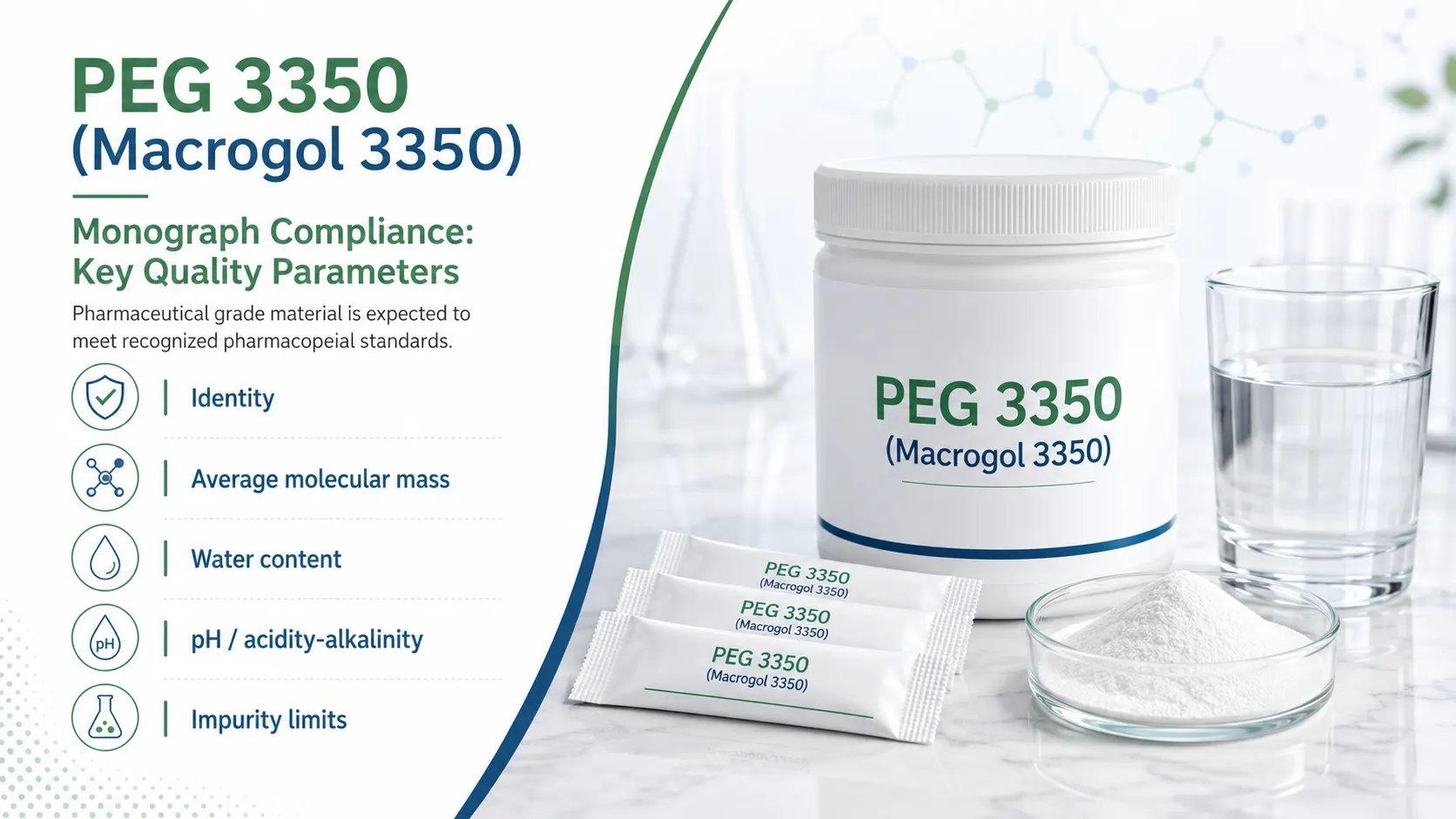
Polyethylene Glycol 3350 (Macrogol 3350) Monograph Compliance: Key Quality Parameters
Pharmaceutical grade PEG 3350 is expected to meet defined parameters under recognized pharmacopeial monographs before use in drug manufacturing.
| Quality Parameter | Purpose |
|---|---|
| Identification (Infrared Spectroscopy) | Confirms the material is genuine polyethylene glycol of the correct grade |
| Average Molecular Weight or Hydroxyl Value | Confirms the material falls within the defined PEG 3350 molecular weight range |
| Appearance | Confirms the material is a free flowing white powder without discoloration or foreign matter |
| pH (Aqueous Solution) | Confirms the material falls within the pharmacopeially defined pH range |
| Water Content | Confirms moisture levels are within acceptable limits to support stability |
| Limit of Diethylene Glycol and Ethylene Glycol | Confirms DEG and EG impurities remain within the safety limit of not more than 0.10 percent |
| Heavy Metals | Confirms the material does not exceed permitted heavy metal impurity limits |
| Microbial Limits | Confirms the material meets microbiological quality requirements where applicable |
| Standard | Full Name | Governing Body |
|---|---|---|
| USP | United States Pharmacopeia | United States Pharmacopeial Convention |
| EP (Ph. Eur.) | European Pharmacopoeia | European Directorate for the Quality of Medicines (EDQM) |
| BP | British Pharmacopoeia | Medicines and Healthcare products Regulatory Agency, United Kingdom |
| IP | Indian Pharmacopoeia | Indian Pharmacopoeia Commission, Ministry of Health and Family Welfare, Government of India |
Why Monograph Compliant PEG 3350 Matters in Pharmaceutical Manufacturing
Because PEG 3350 is both an active ingredient in laxative products and a functional excipient in other dosage forms, monograph compliance is not simply a formality. A batch that fails identification, purity or DEG and EG limit testing poses a direct patient safety risk if used in manufacturing, which is why regulators including the FDA now expect documented, batch specific testing rather than reliance on a general supplier certification alone.
How to Evaluate Polyethylene Glycol 3350 (Macrogol 3350) Suppliers for Quality, Purity and Compliance
A practical checklist for procurement and quality teams:
- Confirm pharmacopeial compliance: verify the supplier can provide a Certificate of Analysis demonstrating compliance with the applicable USP, EP, BP or IP monograph for the specific batch supplied.
- Request DEG and EG test data: ask whether DEG and EG testing is performed on every batch, and ideally every container, and request the specific test result rather than a general compliance statement.
- Review manufacturing certifications: confirm the facility holds relevant certifications such as WHO GMP, supporting documented quality management systems throughout manufacturing.
- Assess documentation completeness: a qualified supplier should be able to provide a Certificate of Analysis, Material Safety Data Sheet and, where required, Drug Master File referencing support for regulatory submissions.
- Evaluate batch to batch consistency: request historical batch data or references to confirm the supplier maintains consistent quality across production runs, not just for a single sample batch.
- Confirm traceability: ensure the supplier can trace each batch back to specific raw material lots and manufacturing records, which is essential in the event of a quality investigation.
- Review supply reliability: particularly for laxative product manufacturers with continuous production schedules, confirm the supplier has the manufacturing capacity and export experience to support reliable, ongoing bulk supply.
PEG 3350 Critical Quality Attributes and Specifications Pharmaceutical Buyers Should Review
| Attribute | Typical Reference Range |
|---|---|
| Average Molecular Weight | Approximately 3015 to 3685 g per mol |
| Appearance | White, free flowing powder |
| pH (Aqueous Solution) | Generally within pharmacopeially defined limits, typically close to neutral |
| Water Content | Within pharmacopeial limits to support product stability |
| Diethylene Glycol and Ethylene Glycol | Not more than 0.10 percent combined, per current FDA guidance and pharmacopeial direction |
| Heavy Metals | Within pharmacopeial limits |
| Residue on Ignition | Within pharmacopeial limits |
Before finalizing a supply agreement, pharmaceutical buyers should request the complete Certificate of Analysis for the specific batch intended for shipment, rather than a generic product specification sheet, since batch specific results are what regulatory guidance and internal quality systems actually require for component release.
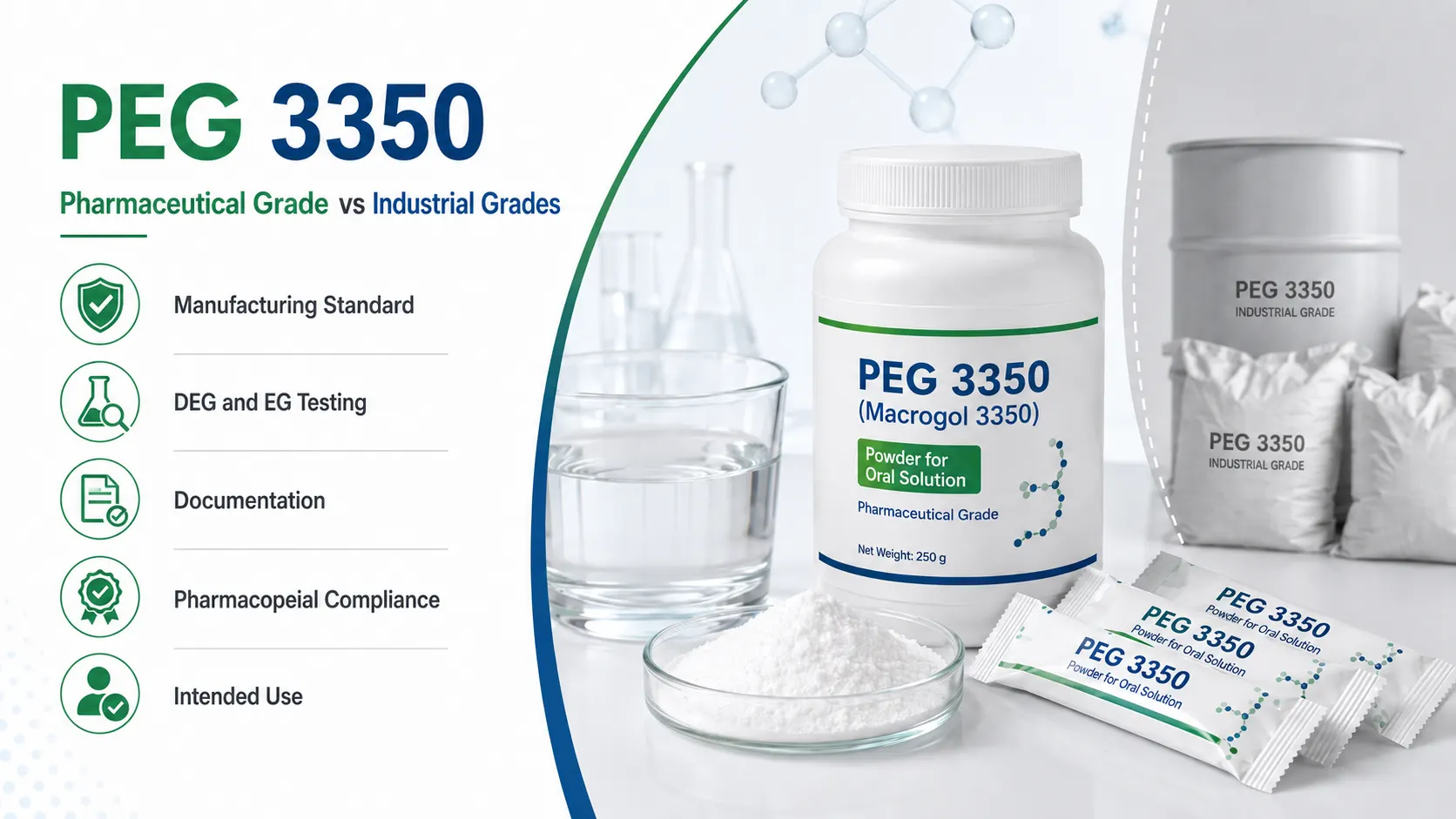
What Makes Pharmaceutical Grade PEG 3350 Different from Industrial Grades
| Factor | Pharmaceutical Grade PEG 3350 | Industrial Grade PEG 3350 |
|---|---|---|
| Manufacturing Standard | Produced under GMP aligned conditions with documented quality systems | May be produced without pharmaceutical specific quality controls |
| DEG and EG Testing | Tested against defined safety limits as part of batch release | Not necessarily tested to pharmaceutical safety limits |
| Documentation | Certificate of Analysis, Material Safety Data Sheet and regulatory support documentation available | Documentation may be limited to basic technical data sheets |
| Pharmacopeial Compliance | Manufactured to meet USP, EP, BP or IP monograph requirements | Not manufactured to pharmacopeial monograph requirements |
| Intended Use | Formulated into drug products for human use | Intended for industrial, non pharmaceutical applications |
Using industrial grade PEG 3350 in a pharmaceutical formulation is not an acceptable substitute for pharmaceutical grade material, given both the regulatory expectation for monograph compliant components and the direct patient safety implications of unverified purity, particularly regarding DEG and EG content.
Polyethylene Glycol 3350 (Macrogol 3350) Stability, Solubility and Formulation Considerations
- Solubility: PEG 3350 dissolves readily in water, forming a clear solution suitable for oral solution and sachet based laxative formulations.
- Stability: as a chemically stable, low reactivity polymer, PEG 3350 generally maintains its physical and chemical properties under normal, recommended storage conditions.
- Hygroscopicity: like other polyethylene glycols, PEG 3350 can absorb atmospheric moisture, so storage in a cool, dry environment with well sealed packaging is recommended to preserve powder flow properties and prevent caking.
- Compatibility: PEG 3350 is broadly compatible with common pharmaceutical excipients and a wide range of active pharmaceutical ingredients, though as with any excipient, compatibility should be confirmed through formulation specific stability studies.
- Shelf life: typical shelf life is confirmed against the specific supplier Certificate of Analysis and retest date, and formulators should always verify current stability data for their specific finished product formulation.
 Call Us Now!
PEG 3350 Manufacturer in India: Why Choose Pharcos Speciality
Pharcos Speciality Ltd, based in Gujarat, India, manufactures pharmaceutical grade Polyethylene Glycol 3350 under its Pharcogol brand, serving as a Polyethylene Glycol 3350 manufacturer, Polyethylene Glycol 3350 exporter and PEG 3350 supplier to pharmaceutical companies, bulk buyers, wholesale distributors and dealers across global markets, including established supply relationships across Europe, North America, and emerging markets in Asia, Latin America and the Middle East.
What sets Pharcos apart as a Polyethylene Glycol 3350 (Macrogol 3350) manufacturer and supplier:
- Pharmacopeial compliance: Pharcogol 3350 is manufactured to meet USP, EP, BP and IP monograph requirements, with support for additional regional standards available upon request.
- Research and development focus: ongoing investment in process and purity optimization, supporting consistent product performance across production batches.
- Quality controlled manufacturing: stringent in process quality controls throughout production, supporting the batch to batch consistency pharmaceutical buyers require.
- Documentation for regulated markets: availability of Certificate of Analysis, Material Safety Data Sheet and pharmacopeial compliance documentation to support procurement and regulatory review.
- Reliable bulk and wholesale supply: established capacity to serve contract manufacturers, formulation labs and pharmaceutical companies with consistent, scalable supply, an important consideration for buyers evaluating the broader PEG 3350 market and long term sourcing relationships.
- Global export experience: a track record of supplying PEG 3350 internationally, supporting pharmaceutical manufacturers, including polyethylene glycol 3350 syrup manufacturers and oral solution producers, seeking a dependable source of PEG 3350 in India.
Pharmaceutical companies evaluating PEG 3350 manufacturers in India, or seeking a certified PEG 3350 supplier for a regulated market, can contact the Pharcos technical team to request current batch documentation, including diethylene glycol and ethylene glycol test results, samples and specification sheets to support formulation and regulatory review.
Our Other Product
Polyethylene Glycol 1500Frequently Asked Questions on Polyethylene Glycol 3350 (Macrogol 3350)

Dr. Avinash Dubey (R&D Head)
Dr. Avinash Dubey is a PhD in Organic Chemistry with a distinguished career spanning more than four decades. As the head of R&D at Pharcos, he focuses on the development of novel molecules for a wide array of industrial sectors, blending long-standing experience with a passion for innovation.

Mr. Ankit Shah (Managing Director)
Mr. Ankit Shah has led Pharcos Speciality for over three decades, establishing it as a pioneer in specialty chemicals. He currently directs the company’s strategic expansion into the APIs, Excipient and Speciality Surfactants markets, upholding a steadfast commitment to "Make in India" and world-class manufacturing quality and new product development.