
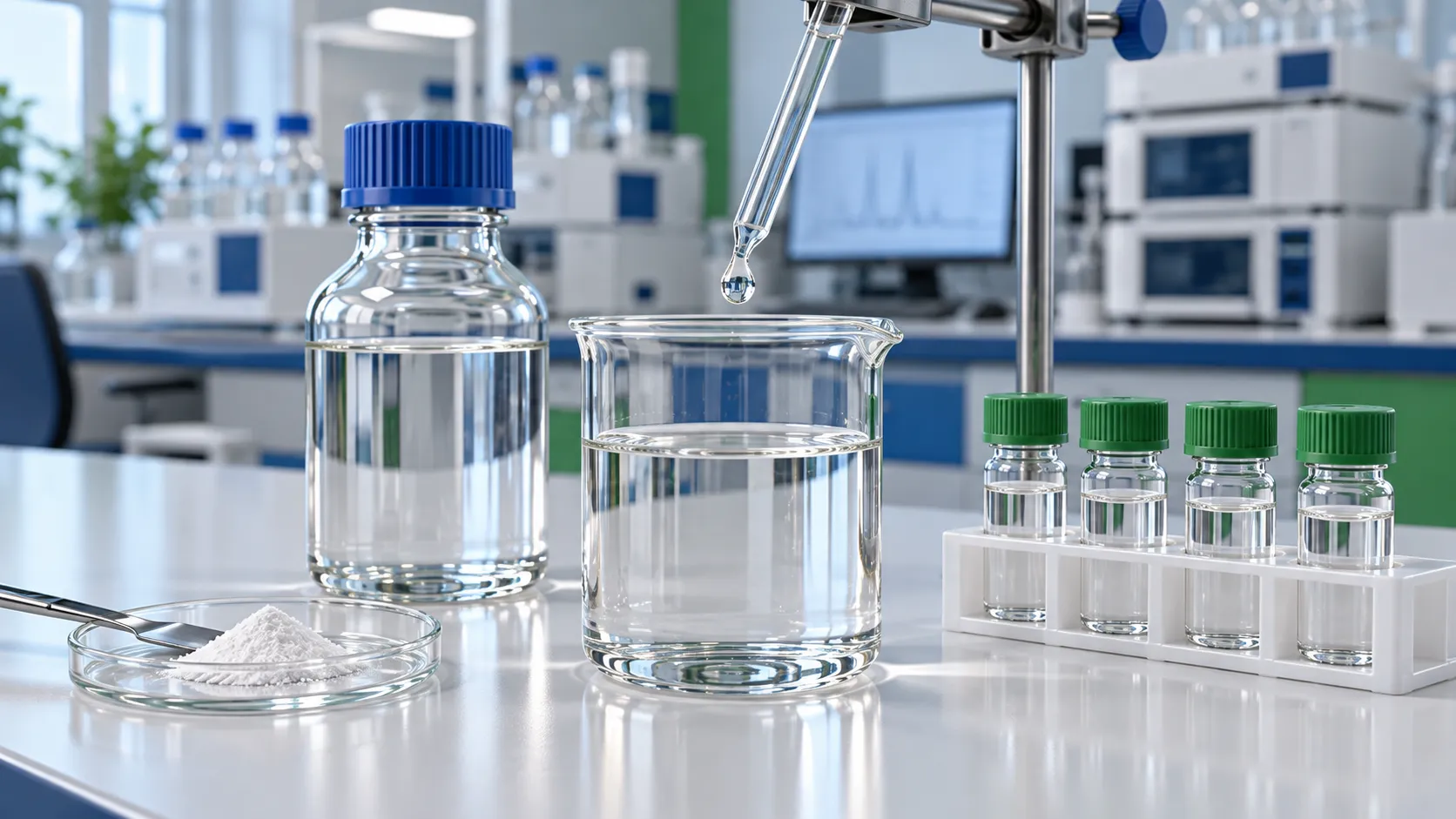
PEG 400 as a Co-Solvent for Poorly Water-Soluble APIs: Formulation and Stability Considerations




AI Summary: Solubilizing Poorly Water-Soluble APIs
PEG 400, also known as polyethylene glycol 400 or Macrogol 400, is a low-molecular-weight, water-miscible liquid used as a pharmaceutical solvent. A PEG 400 co-solvent system can modify the polarity of an aqueous vehicle and support API solubility enhancement, but performance depends on the drug’s molecular properties, solid form and ionization behaviour. Formulators must screen multiple PEG 400-to-water ratios and measure equilibrium solubility under controlled conditions. Dilution, pH changes and temperature shifts may cause precipitation, while excipient compatibility, oxidative stability, process performance and packaging interactions can determine whether the system is suitable for development.
Why Poorly Water-Soluble APIs Need a PEG 400 Co-Solvent Strategy
Poor aqueous solubility can limit the concentration of an API delivered in a liquid dosage form. It may also restrict dose volume and formulation flexibility. This challenge is common among lipophilic molecules, although strong crystal lattice energy or limited ionization may also contribute.
PEG 400 for poorly soluble drugs provides one possible way to improve the solvent environment around an API. The objective is not merely to dissolve the required dose during preparation; the drug must remain physically and chemically stable throughout manufacturing, filling, storage and intended use.
Initial dissolution does not confirm long-term physical stability. A useful formulation must maintain the required drug concentration under realistic storage and use conditions.
 WhatsApp Now
How PEG 400 Supports API Solubility Enhancement
Co-solvency works by combining water with a water-miscible solvent to change the overall character of the liquid phase. Water is highly polar, while PEG 400 has a different polarity profile and can interact favourably with some drug molecules. When a PEG 400 pharmaceutical solvent system is considered, adding it to an aqueous vehicle may reduce the energetic barrier to solvation and increase the apparent solubility of certain poorly water-soluble APIs.
The improvement cannot be predicted from PEG 400 concentration alone. Important API-related variables include:
- Lipophilicity and logP or logD
- pKa and ionization at the formulation pH
- Crystal form, polymorphism and lattice energy
- Hydrogen-bond donor and acceptor characteristics
- Molecular size and structural flexibility
- Salt form and counter-ion effects
- Susceptibility to hydrolysis or oxidation
PEG 400 may perform well for one compound and provide limited benefit for another. Experimental screening must determine whether the improvement justifies the resulting viscosity, processing requirements and route-specific constraints.
Co-Solvent Formulation Development Workflow
A logical development sequence helps prevent an attractive screening result from being mistaken for a robust formulation:
- Characterize the API: Review pKa, logP or logD, solid form, particle characteristics and known degradation pathways.
- Establish a baseline: Measure aqueous and pH-dependent solubility before introducing the co-solvent.
- Screen solvent ratios: Test a defined range of PEG 400-to-water compositions under controlled conditions.
- Confirm equilibrium: Quantify dissolved drug after adequate equilibration and examine aged samples for delayed crystallization.
- Assess dilution robustness: Challenge selected systems using realistic diluents, ratios, temperatures and addition rates.
- Evaluate compatibility: Study buffers, surfactants, preservatives, antioxidants and other intended excipients.
- Investigate degradation: Use stress studies to understand chemical stability and select suitable analytical methods.
- Check process and packaging: Confirm pumpability, filling behaviour, contact-material compatibility and container suitability.
- Conduct formal stability studies: Evaluate the final composition under applicable long-term, accelerated and in-use conditions.
Each stage should narrow the formulation space using data and expose precipitation, incompatibility or manufacturing risks.
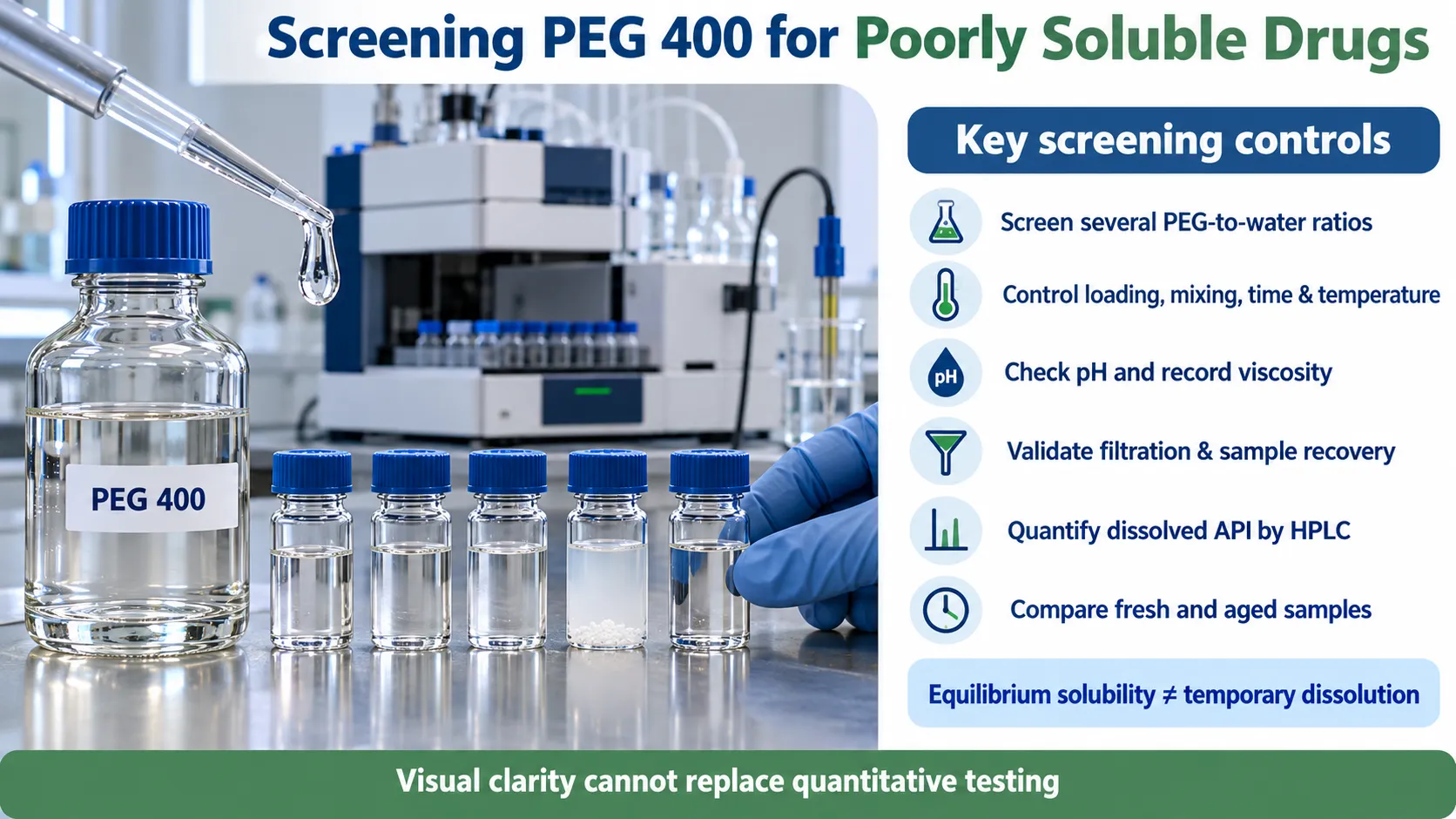
Screening PEG 400 for Poorly Soluble Drugs
A screening study should distinguish equilibrium solubility from temporary or supersaturated dissolution. It requires controlled preparation, sufficient equilibration and a stability-indicating analytical method; visual clarity cannot replace quantitative measurement.
Formulators should consider the following controls:
- Test several PEG 400-to-water ratios rather than one arbitrary concentration.
- Keep API loading, mixing method, equilibration time and temperature consistent.
- Measure pH before and after equilibration, especially for ionizable compounds.
- Separate undissolved material through a validated filtration or centrifugation procedure.
- Quantify the dissolved API using a suitable method such as HPLC.
- Examine fresh and aged samples for haze, crystals or concentration loss.
- Evaluate temperature sensitivity across conditions relevant to processing and storage.
- Record viscosity because high co-solvent levels may affect sampling, transfer and filling.
The analytical procedure must not cause precipitation during sample preparation. Recovery, filter adsorption and dilution-solvent suitability should be verified to exclude analytical artefacts.
Our Other Product
PEG 300 (Polyethylene Glycol 300 | Macrogol 300)Selecting the PEG 400-to-Water Ratio
There is no universal concentration of PEG 400 that is suitable for every API. The selected ratio must provide adequate solubility without creating unacceptable physical, processing or route-specific consequences.
Key selection criteria include:
- Required API concentration and intended dose volume
- Equilibrium solubility and margin below saturation
- Physical stability during storage and temperature excursions
- Resistance to precipitation after expected dilution
- Viscosity, flow, pumping and filling performance
- Compatibility with water, buffers and other excipients
- Chemical stability of the API and formulation components
- Container-closure and equipment-contact compatibility
- Intended route of administration
- Applicable pharmacopeial and regulatory expectations
The lowest concentration providing an appropriate solubility and stability margin may simplify processing, but the choice must be data-driven. Oral, topical, ophthalmic and parenteral products have different tolerability, osmolality, microbial-control and impurity requirements.
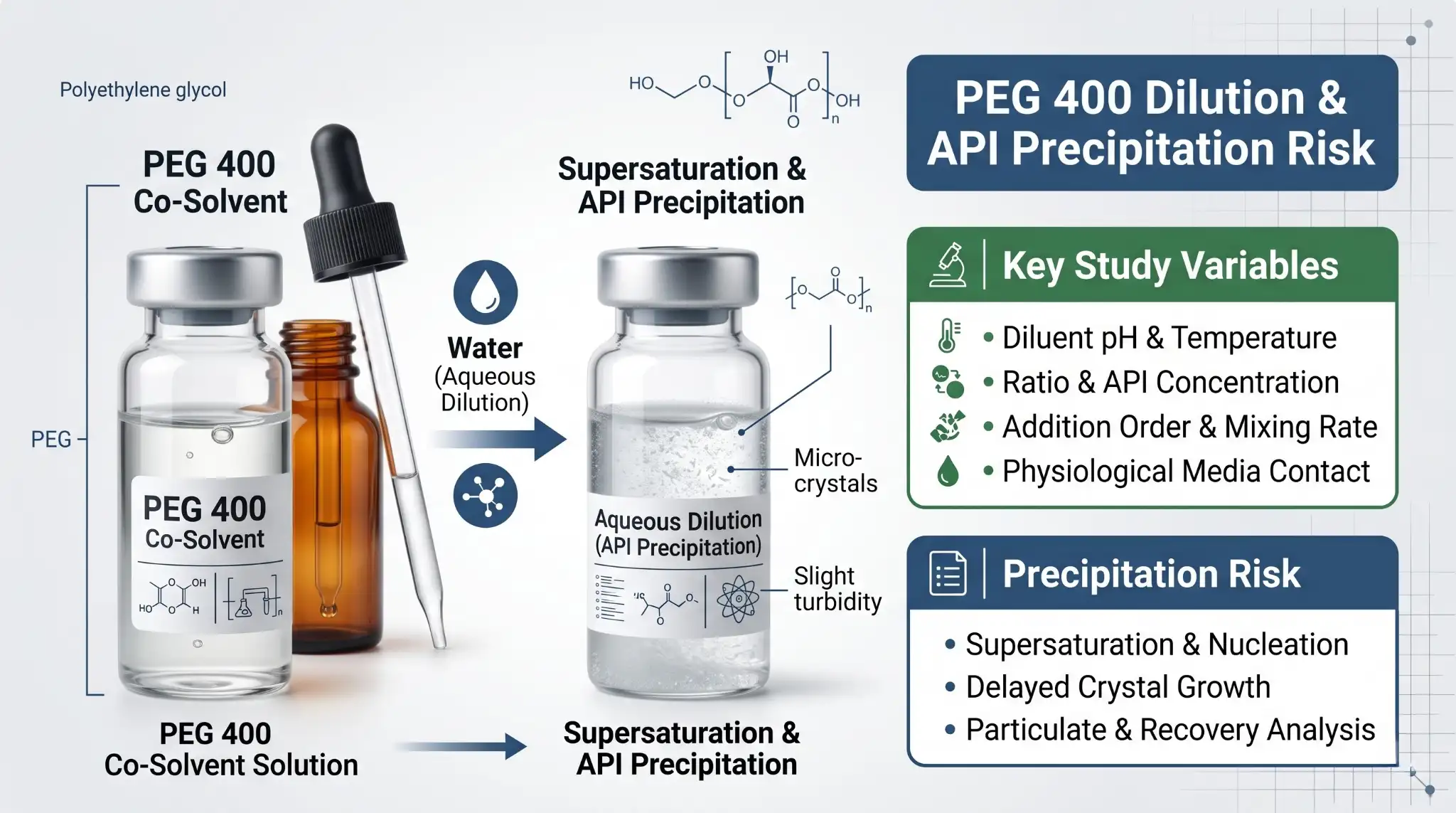
PEG 400 Dilution and API Precipitation Risk
Dilution is one of the most important stress points in a co-solvent formulation. When water or another aqueous diluent is added, the solvent composition changes and the API may no longer remain soluble at its original concentration. This can create supersaturation followed by immediate or delayed nucleation and crystal growth.
Dilution studies should reflect actual product use. Relevant variables include:
- Identity, pH and temperature of the diluent
- Final dilution ratio and API concentration
- Order and rate of addition
- Mixing intensity and holding time
- Contact with physiological media, when applicable
- Visible and subvisible particulate formation
- Drug concentration after dilution and standing
A clear diluted solution may still precipitate later. Assessment should include suitable observation intervals and quantitative drug recovery. Persistent precipitation may require a different formulation or administration strategy.
Effect of pH and API Ionization in PEG 400 Systems
For ionizable APIs, pH adjustment and co-solvency may work together. Changing pH can increase the fraction of ionized drug, while PEG 400 modifies the solvent environment. The combined effect can improve solubility, but it may also make performance more sensitive to buffer capacity and dilution.
Apparent pKa and ionization in a mixed solvent can differ from behaviour in water. Testing should use the actual PEG 400 concentration, buffer type and buffer strength because these variables may change solubility and compatibility.
During dilution, the pH or solvent composition can shift the API toward its less soluble form. Monitoring pH alongside assay, appearance and particulate formation helps determine whether ionization changes contribute to precipitation. No pH range should be adopted without API-specific data and consideration of the intended route.
Excipient and Packaging Compatibility
A PEG 400 formulation usually contains several functional components. Each can influence drug solubility, chemical stability, microbial protection or packaging performance.
| Formulation factor | What to evaluate | Potential risk | Suggested study |
|---|---|---|---|
| Buffers and pH adjusters | pH control and interaction with the API | pH drift, salt formation or precipitation | Compatibility and stability studies |
| Surfactants and solubilizers | Complementary or competing solubilization | Reduced efficiency or physical change | Combination-solubility screening |
| Preservatives | Solubility and availability in the vehicle | Reduced antimicrobial effectiveness | Preservative-effectiveness testing |
| Antioxidants and chelators | Compatibility and oxidation control | New impurities or inadequate protection | Forced-degradation and compatibility studies |
| Process-contact materials | Adsorption, extraction and material resistance | Potency loss or contamination | Equipment-contact assessment |
| Primary packaging and closures | Sorption, permeability and leachables | Drug loss, impurity formation or seal failure | Container-closure compatibility study |
Compatibility should be demonstrated in the complete formulation because binary studies do not reproduce every finished-product interaction.
Chemical and Physical Stability Considerations
Chemical and physical stability represent different failure modes and should be assessed separately. Chemical evaluation typically covers API assay, degradation products and sensitivity to heat, light, oxygen, water and formulation pH. Hydrolysis may be important for moisture-sensitive drugs, while oxidation can be critical for APIs with vulnerable functional groups.
Polyether excipients may contain or develop trace peroxide-related impurities under certain conditions. Their relevance depends on API sensitivity, excipient specification and storage exposure. Risk-based testing is more appropriate than treating PEG 400 as inherently unstable. When justified, antioxidants, chelators, reduced oxygen exposure or protective packaging may be investigated and qualified.
Physical stability testing examines precipitation, crystallization, haze, colour change, phase separation and viscosity drift. Temperature cycling can reveal reversible or irreversible physical changes that may not appear at a single storage condition. The formulation should also be assessed after realistic handling and dilution because storage stability alone does not demonstrate in-use performance.
Our Other Product
PEG 600 (Polyethylene Glycol 600 | Macrogol 600)Stability Testing for PEG 400 Co-Solvent Systems
A stability program should reflect the dosage form, market, packaging and identified formulation risks.
Common test parameters include:
- API assay and degradation-product profile
- Appearance, colour and clarity
- Visible and subvisible particles, where applicable
- Evidence of precipitation or crystallization
- pH and buffer performance
- Viscosity and flow behaviour
- Water content, when relevant
- Performance after preparation or administration dilution
- Container-closure compatibility
- Microbial quality or preservative effectiveness, where required
- Long-term and accelerated storage behaviour
- Freeze-thaw, temperature cycling, light or in-use testing when justified
Methods and acceptance criteria should be formulation-specific. A clear product may still degrade chemically, while a stable assay does not rule out physical precipitation.
 Call Us Now!
Pharcogol 400 for Pharmaceutical Formulation Development
Pharcos Speciality Ltd supplies PEG 400 (Polyethylene Glycol 400 | Macrogol 400) under the Pharcogol 400 product line. This low-molecular-weight liquid polyethylene glycol is miscible with water and many organic solvents and may be evaluated as a solvent or solubilizing excipient for poorly water-soluble drugs. Suitability must be confirmed for the API, dosage form and intended market.
Formulation, quality and procurement teams can contact Pharcos Speciality Ltd to discuss the applicable grade and current product specification. Depending on availability and requirements, buyers should request relevant documentation such as a Certificate of Analysis, Technical Data Sheet, Safety Data Sheet and pharmacopeial or regulatory support documents. Product specifications and samples should be reviewed before formulation qualification.
About Pharcos Speciality Ltd
Pharcos Speciality Ltd serves pharmaceutical and formulation businesses with specialty excipients designed for varied product-development needs. Its portfolio includes polyethylene glycols and other functional ingredients used across pharmaceutical, personal-care and related applications. The company works with formulation, quality and procurement teams seeking suitable grades, product specifications and technical documentation for their intended applications. For current information about Pharcogol 400, available grades and documentation, customers should consult Pharcos Speciality Ltd directly.
Conclusion
PEG 400 can provide meaningful solubility improvement for certain poorly water-soluble APIs, but initial dissolution does not establish formulation success. The selected system must withstand dilution, pH shifts, temperature changes and storage while remaining chemically stable, physically clear and compatible with excipients, equipment and packaging. API-specific screening, stability-indicating analysis and route-appropriate evaluation are therefore essential.
Frequently Asked Questions About PEG 400 Co-Solvent Systems

Dr. Avinash Dubey (R&D Head)
Dr. Avinash Dubey is a PhD in Organic Chemistry with a distinguished career spanning more than four decades. As the head of R&D at Pharcos, he focuses on the development of novel molecules for a wide array of industrial sectors, blending long-standing experience with a passion for innovation.

Mr. Ankit Shah (Managing Director)
Mr. Ankit Shah has led Pharcos Speciality for over three decades, establishing it as a pioneer in specialty chemicals. He currently directs the company’s strategic expansion into the APIs, Excipient and Speciality Surfactants markets, upholding a steadfast commitment to "Make in India" and world-class manufacturing quality and new product development.