
Emulsifiers and Dispersants for Pesticide Formulation: EC, SC and Adjuvant Systems Explained




AI Summary
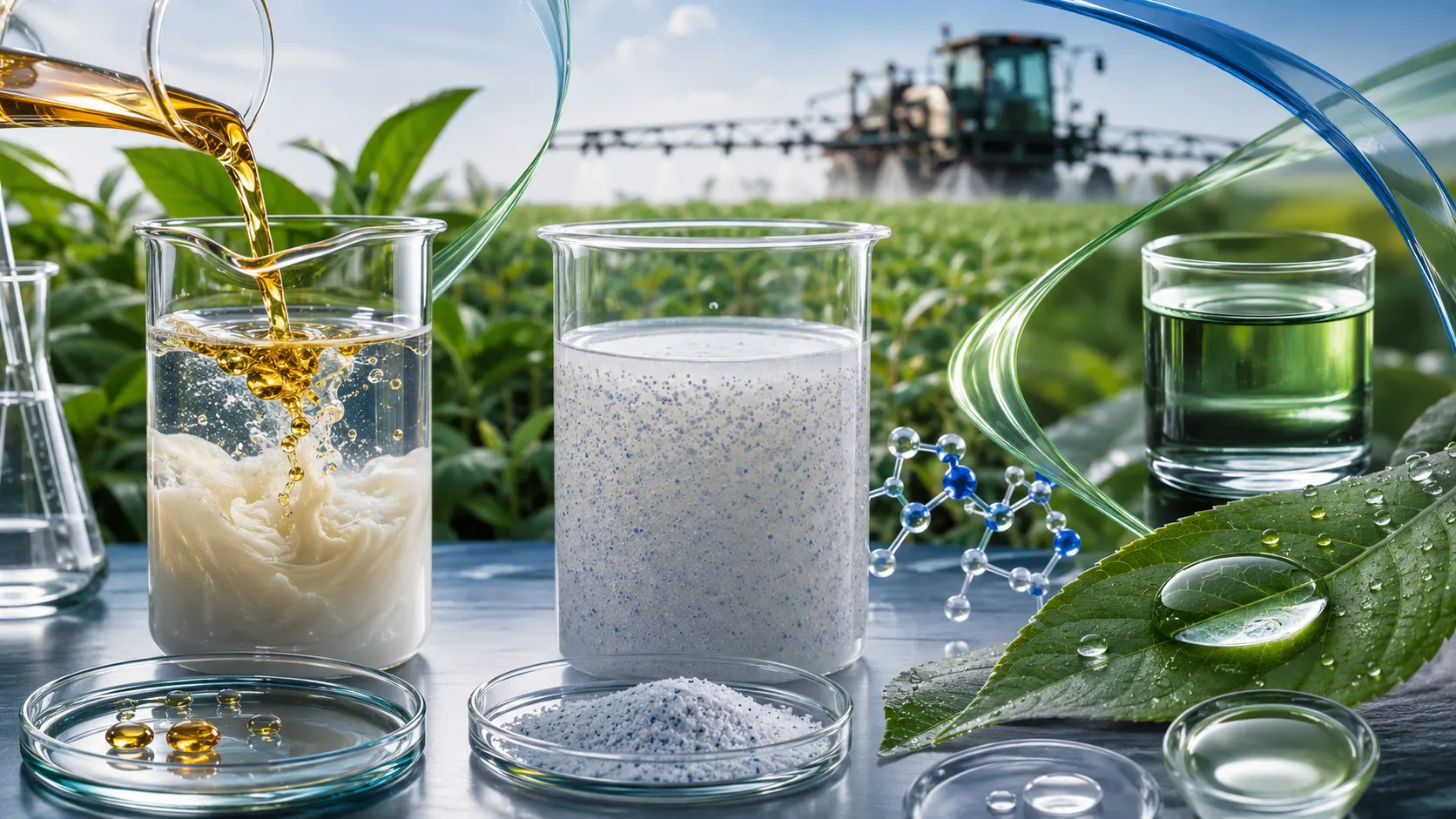
Crop protection products depend on precise formulation science to keep active ingredients stable, evenly dispersed and effective from the point of manufacture through storage and final field application. Emulsifiable concentrates rely on emulsifier blends, commonly styrenated phenol ethoxylates combined with calcium dodecylbenzene sulfonate, to form stable emulsions when diluted in the spray tank. Suspension concentrates depend on high HLB ethoxylates as wetting and dispersing agents to keep finely milled solid particles evenly suspended and prevent sedimentation. Tank mix adjuvants, including polysorbates and castor oil ethoxylates, improve spray solution properties such as droplet formation, leaf adhesion and foliar uptake. This guide explains how each of these formulation types works, compares emulsifier and dispersant selection across EC and SC systems, and outlines how Pharcos Speciality Ltd supports pesticide formulators with emulsifiers and dispersants manufactured in India.
 WhatsApp Now
Why Formulation Chemistry Determines Pesticide Efficacy
An active ingredient alone rarely makes a usable crop protection product. Most pesticide active ingredients must be formulated into a stable, deliverable product, whether an emulsifiable concentrate that becomes a stable emulsion when diluted in the spray tank, a suspension concentrate that keeps insoluble solid particles evenly dispersed, or another formulation type entirely. The emulsifiers, dispersants and adjuvants used in this formulation process directly determine whether the finished product remains stable on the shelf, mixes properly in the spray tank, and ultimately delivers the active ingredient effectively onto the target crop or pest.
Emulsifier Systems for Emulsifiable Concentrate Formulations
Emulsifiable concentrates, commonly abbreviated as EC formulations, dissolve the active ingredient in an organic solvent and rely on an emulsifier system to form a stable emulsion once diluted with water in the spray tank.
Key components of EC emulsifier systems:
- Styrenated phenol ethoxylates: used at a range of ethoxylation levels, these provide the primary emulsifying performance needed to form a robust, stable emulsion when the concentrate is diluted.
- Calcium dodecylbenzene sulfonate: commonly blended with styrenated phenol ethoxylates to complete the emulsifier system.
- Water hardness tolerance: the specific ratio between the ethoxylate and the sulfonate component is a key factor determining tolerance to hard water, which directly affects field performance since spray water quality varies widely by region and source.
- Emulsion stability: a well designed EC emulsifier system needs to maintain a stable emulsion throughout the typical spray tank holding period, without breaking or separating before application is complete.
Dispersants for Suspension Concentrate Formulations
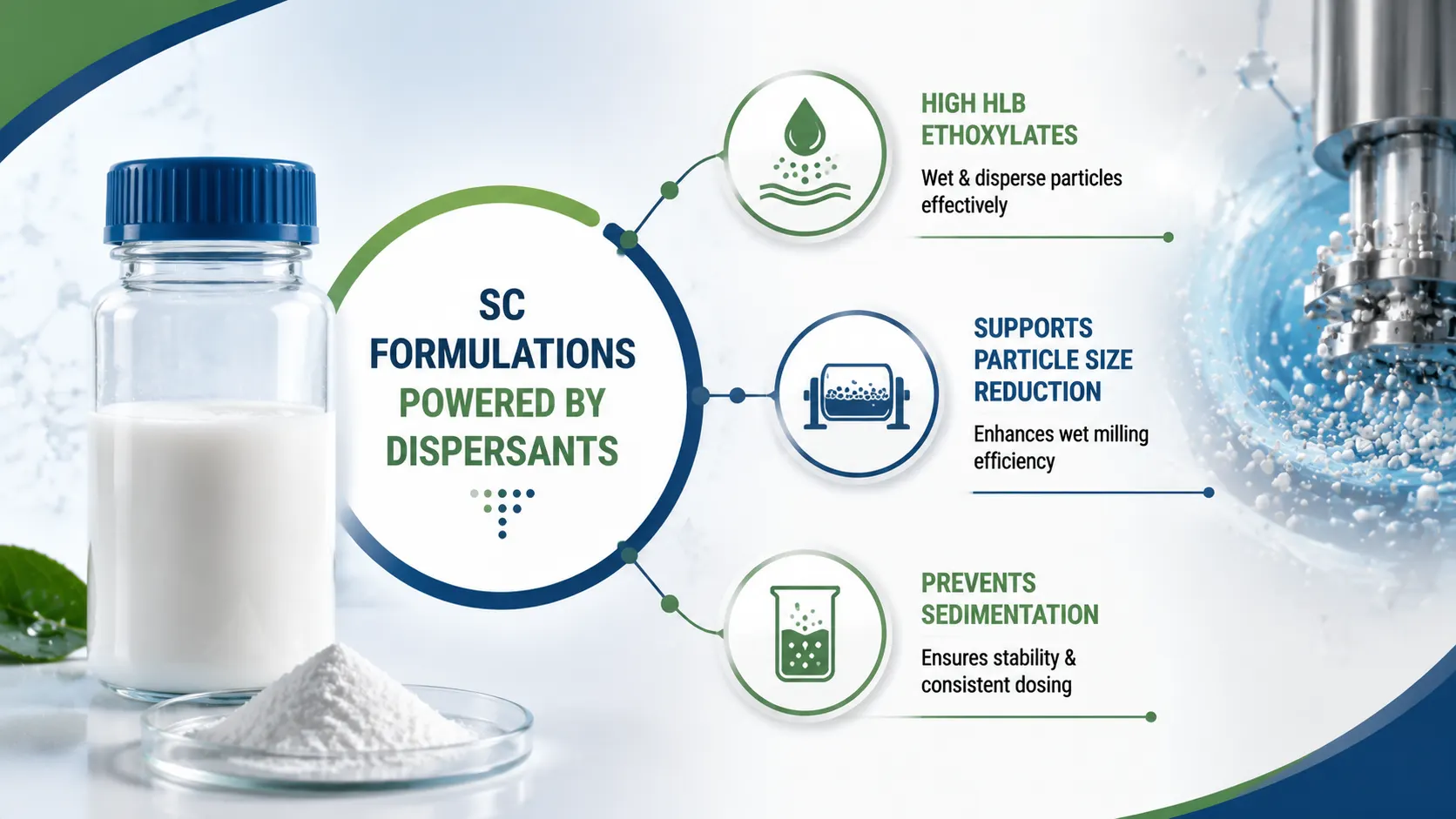
Suspension concentrate formulations, abbreviated as SC, suspend a finely milled solid active ingredient in a liquid carrier and depend on dispersant chemistry to prevent particle settling and agglomeration.
- High HLB ethoxylates: ethoxylates with a high Hydrophilic Lipophilic Balance value function as wetting and dispersing agents in SC formulations, supporting effective particle size reduction during milling and preventing sedimentation during storage.
- Particle size reduction support: effective dispersants improve the efficiency of the wet milling process used to reduce active ingredient particle size, which directly affects formulation stability and biological performance.
- Preventing sedimentation: a well dispersed SC formulation resists settling over its shelf life, which is essential for accurate, consistent active ingredient dosing when the product is shaken and diluted for application.
Our Other Product
Hydroxypropyl Methylcellulose (Pharmaceutical HPMC)Tank Mix Adjuvants for Improved Spray Performance
Beyond the base formulation, many pesticide applications benefit from tank mix adjuvants added directly to the spray solution to improve application performance.
- Polysorbates: used as tank mix adjuvants, products such as Polysorbate 80 help improve spray solution properties relevant to application performance.
- Castor oil ethoxylates: also used as tank mix adjuvants, contributing to improved spray characteristics when added to the spray solution.
- Performance benefits: effective adjuvants can improve spray droplet size distribution, support better leaf adhesion, and enhance foliar uptake, all of which contribute to improved field efficacy and, in many cases, rainfastness of the applied product.
Formulation Stability and Active Ingredient Compatibility
Pesticide formulation chemistry must work reliably across a very wide range of active ingredients, each with distinct physical and chemical properties.
- Physical and chemical stability: emulsifier and dispersant systems need to provide long term physical and chemical stability across EC, SC and wettable powder formulation types, supporting shelf life claims made on product labels.
- Active ingredient compatibility: formulation chemistry must be tested and confirmed compatible with the specific active ingredient and solvent system being used, since compatibility can vary significantly between different active ingredient chemistries.
- Solvent system considerations: the solvent system used in an EC formulation interacts directly with emulsifier selection, meaning emulsifier system design typically needs to be evaluated alongside the specific solvent chosen for a given active ingredient.
Comparing EC and SC Formulation Requirements
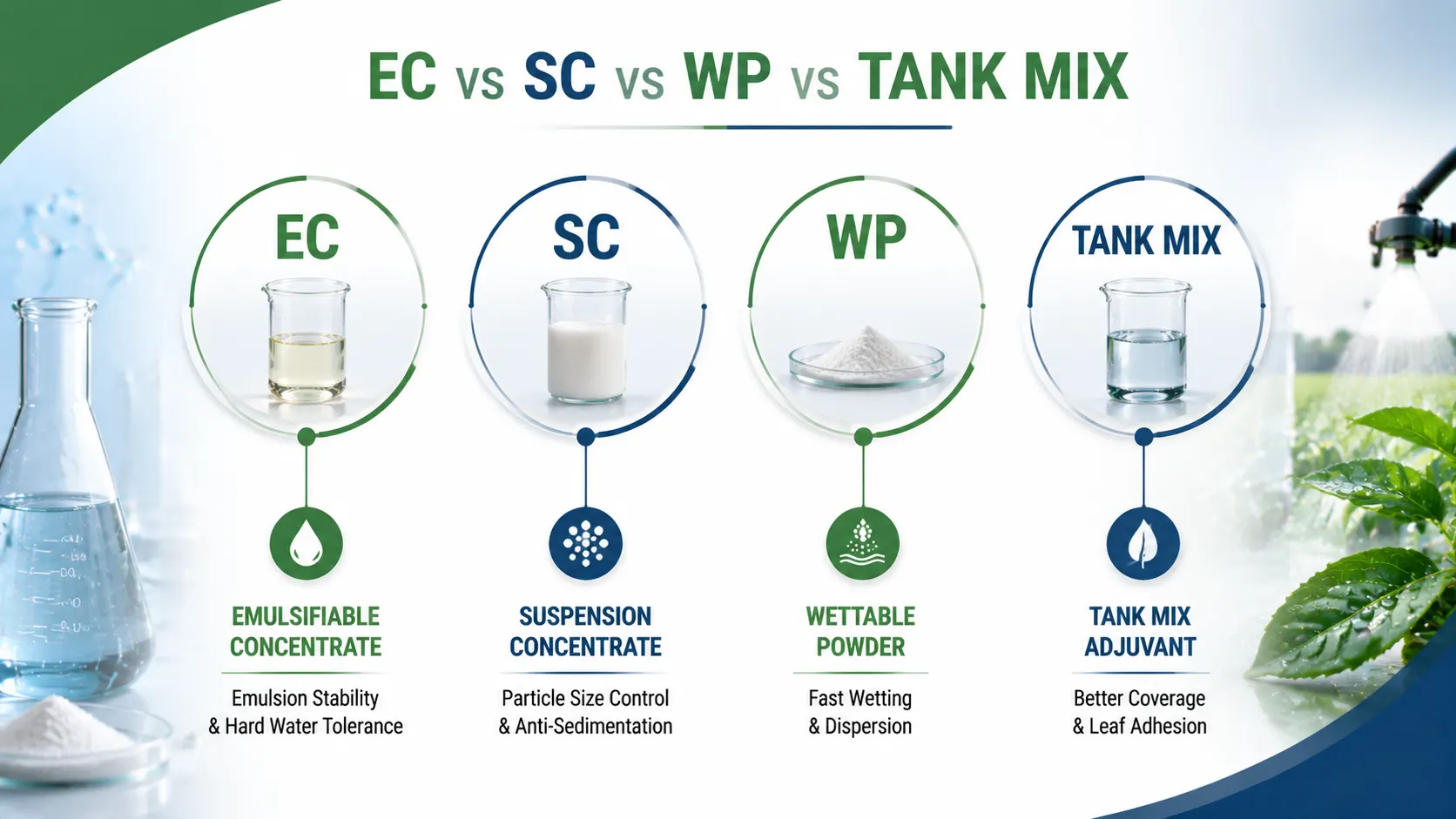
| Formulation Type | Primary Chemistry | Key Formulation Challenge |
|---|---|---|
| Emulsifiable Concentrate (EC) | Styrenated phenol ethoxylates with calcium dodecylbenzene sulfonate | Stable emulsion formation on dilution, hard water tolerance |
| Suspension Concentrate (SC) | High HLB ethoxylates | Particle size reduction, prevention of sedimentation |
| Wettable Powder (WP) | Wetting and dispersing agents suited to dry formulation | Rapid wetting and dispersion when mixed with water |
| Tank Mix Adjuvant | Polysorbates, castor oil ethoxylates | Spray droplet formation, leaf adhesion, foliar uptake |
Regulatory and Quality Standards in Pesticide Formulation
Pesticide formulation development operates within a well established international framework of quality and safety standards.
- International specification guidance: the Food and Agriculture Organization and the World Health Organization jointly publish specifications and guidance for pesticide formulation quality, referenced globally by formulators and regulatory authorities.
- Analytical methods: the Collaborative International Pesticides Analytical Council publishes widely used analytical methods for evaluating pesticide formulation properties, including emulsion stability and suspension characteristics.
- National registration requirements: pesticide products intended for sale in a given market must typically be registered with the relevant national regulatory authority, which reviews both the active ingredient and the finished formulation as part of the registration process.
Formulators developing new EC, SC or adjuvant products should confirm current registration and specification requirements applicable to their target market before finalizing a formulation.
Why Choose Pharcos Speciality for Pesticide Formulation Chemicals
Pharcos Speciality Ltd manufactures specialty emulsifiers and dispersants for pesticide formulation, supporting EC, SC and adjuvant tank mix applications.
What Pharcos offers pesticide formulators:
- EC emulsifier systems: Styrenated Phenol Ethoxylates at 15 to 25 moles combined with calcium dodecylbenzene sulfonate, providing robust emulsifier systems with the water hardness tolerance and emulsion stability EC formulations require.
- SC dispersant range: high HLB ethoxylate grades, including Ceteareth 30 and Ceteareth 80, serving as wetting and dispersing agents that improve particle size reduction and prevent sedimentation in suspension concentrate formulations.
- Tank mix adjuvant options: Polysorbates and Castor Oil Ethoxylates that improve spray solution properties for enhanced foliar uptake when used as tank mix adjuvants.
- Formulation stability expertise: emulsifier systems providing long term physical and chemical stability across EC, SC and wettable powder formulations.
- Active ingredient compatibility testing: products tested for compatibility with a wide range of pesticide active ingredients and common solvent systems.
- Spray performance optimization: adjuvant chemistry that improves spray droplet size distribution, leaf adhesion and rainfastness for better field efficacy.
Pesticide formulators evaluating an emulsifier or dispersant manufacturer in India can contact the Pharcos technical team to discuss specific active ingredient and solvent system requirements, request samples, and review recommended emulsifier ratios for EC, SC or adjuvant formulations.
 Call Us Now!
Conclusion
Behind every effective crop protection product is a formulation system engineered to keep the active ingredient stable, evenly dispersed and ready to perform from manufacture through field application. Emulsifiable concentrates depend on carefully balanced styrenated phenol ethoxylate and sulfonate emulsifier systems to form stable emulsions in the spray tank, suspension concentrates rely on high HLB dispersants to prevent sedimentation, and tank mix adjuvants fine tune final spray performance for improved foliar uptake. For pesticide formulators, getting this chemistry right is central to both product shelf stability and field level efficacy.
Pharcos Speciality Ltd supplies emulsifiers, dispersants and adjuvants manufactured in India for pesticide formulation, backed by active ingredient compatibility testing and technical support to help formulators build stable, effective EC, SC and adjuvant products.
Our Other Product
Polyethylene Glycol (Pharmaceutical Grade PEG)Frequently Asked Questions

Dr. Avinash Dubey (R&D Head)
Dr. Avinash Dubey is a PhD in Organic Chemistry with a distinguished career spanning more than four decades. As the head of R&D at Pharcos, he focuses on the development of novel molecules for a wide array of industrial sectors, blending long-standing experience with a passion for innovation.

Mr. Ankit Shah (Managing Director)
Mr. Ankit Shah has led Pharcos Speciality for over three decades, establishing it as a pioneer in specialty chemicals. He currently directs the company’s strategic expansion into the APIs, Excipient and Speciality Surfactants markets, upholding a steadfast commitment to "Make in India" and world-class manufacturing quality and new product development.