
Surfactants, Demulsifiers and Emulsifiers for the Oil and Gas Industry: Upstream to Downstream Applications




AI Summary
Oil and gas operations, from drilling and production through processing and transport, depend on a defined set of specialty chemicals to manage emulsions, protect equipment from corrosion and scale, and keep hydrocarbons flowing under demanding downhole and pipeline conditions. Demulsifiers break water in oil emulsions formed during production, supporting effective desalting and dehydration. Corrosion and scale inhibitors protect oil lines, gas lines and water injection systems from degradation and mineral deposit buildup. Flow assurance chemicals, including pour point depressants and oxygen or hydrogen sulfide scavengers, keep hydrocarbons flowing in cold conditions and mitigate corrosion and safety hazards from dissolved gases. Primary and secondary emulsifiers support stable drilling fluid systems. This guide explains how each of these chemical categories functions across upstream and downstream oil and gas operations, and outlines how Pharcos Speciality Ltd supports oil and gas operators with high performance chemicals manufactured in India.
Why Specialty Chemicals Are Critical to Oil and Gas Operations
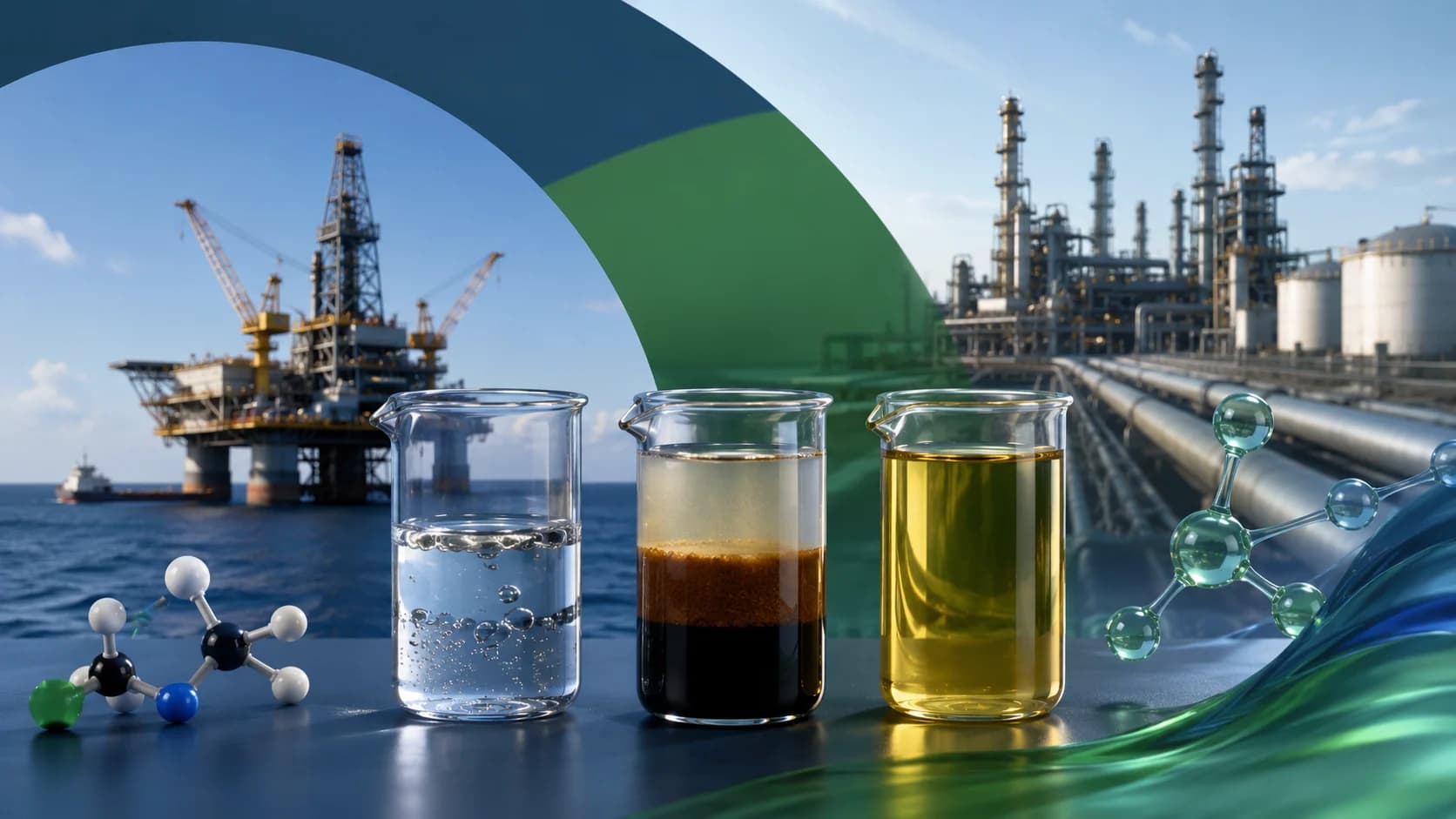
Oil and gas operations move hydrocarbons through an extended chain of processes, from the reservoir through drilling and production, into gathering and processing infrastructure, and ultimately into pipelines and storage. At nearly every stage, water, dissolved gases, scale forming minerals and temperature extremes threaten equipment integrity and process efficiency. Specialty chemicals, including demulsifiers, corrosion and scale inhibitors, flow assurance additives and drilling fluid emulsifiers, are engineered specifically to manage these challenges under the extreme downhole, surface and pipeline conditions typical of oilfield operations.
 WhatsApp Now
Demulsifiers and Desalting Chemicals
Produced crude oil naturally carries dispersed water, often stabilized into a tight emulsion by natural surfactants present in the crude itself, which must be broken before the oil can be processed or transported.
Key functions of demulsifiers and desalting chemicals:
- Emulsion breaking: demulsifiers, sometimes referred to as molecule breakers, work by destabilizing the water in oil emulsion, allowing dispersed water droplets to coalesce and separate from the oil phase.
- Desalting support: effective demulsification is a prerequisite for successful crude oil desalting, protecting downstream processing infrastructure from the corrosion and fouling associated with residual salts.
- Downstream protection: by efficiently separating water from oil, demulsifiers directly protect downstream processing equipment from the corrosion and fouling that untreated emulsions would otherwise cause.
Corrosion and Scale Inhibitors
Oil and gas infrastructure, including oil lines, gas lines and water injection systems, is continuously exposed to conditions that promote both corrosion and mineral scale formation.
- Corrosion inhibitors: high performance corrosion inhibitors are engineered for oil lines, gas lines, water injection systems and acid corrosion environments, forming protective films that reduce metal degradation over time.
- Scale inhibitors: effective scale inhibitors prevent the buildup of mineral deposits, such as calcium carbonate or barium sulfate scale, that can restrict flow and damage equipment if left unmanaged.
- Combined protection strategy: because corrosion and scale often occur together in the same production or injection system, inhibitor programs are frequently designed to address both risks as part of an integrated treatment strategy.
Flow Assurance: Pour Point Depressants and Gas Scavengers
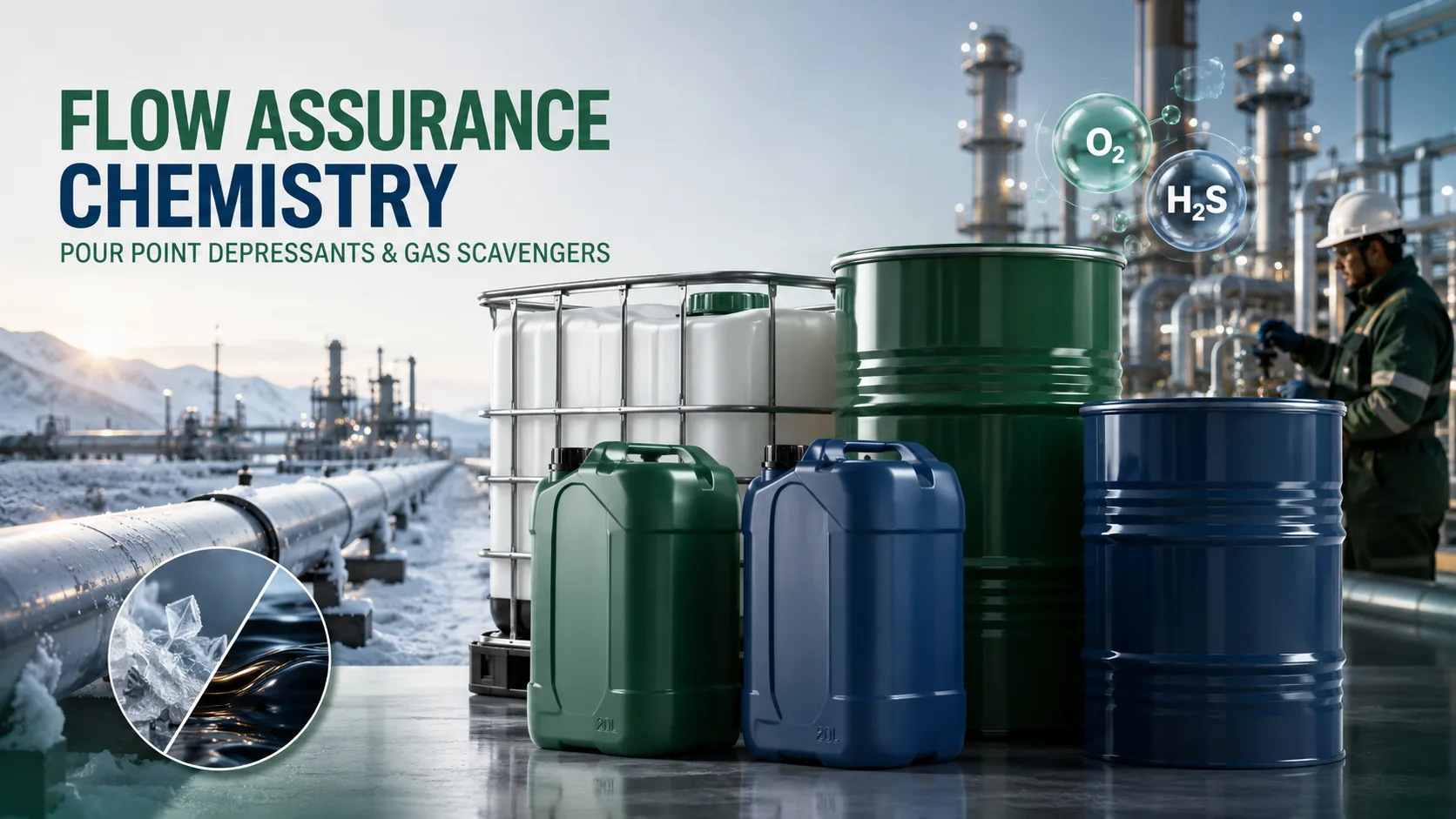
Flow assurance chemistry addresses the practical challenge of keeping hydrocarbons moving efficiently and safely through production and transport systems under varying temperature and gas composition conditions.
- Pour point depressants: these function as viscosity improvers, helping maintain crude oil flowability in cold conditions where paraffin wax crystallization would otherwise increase viscosity and restrict flow.
- Oxygen scavengers: used to remove dissolved oxygen from produced or injection water, mitigating localized corrosion that dissolved oxygen can accelerate.
- Hydrogen sulfide scavengers: used to reduce hydrogen sulfide levels in produced fluids and gas streams, addressing both corrosion risk and the significant safety hazard hydrogen sulfide gas presents to personnel.
- Operational significance: effective flow assurance chemistry directly supports safe, continuous production, particularly in cold climate operations or fields with challenging fluid compositions.
Our Other Product
Hydroxypropyl Methylcellulose (Pharmaceutical HPMC)Emulsifiers and Deoilers for Drilling Fluid Systems
Drilling operations rely on carefully engineered fluid systems, and emulsifier chemistry plays a central role in maintaining the stability of these fluids under downhole conditions.
- Primary and secondary emulsifiers: these are essential for stable drilling fluid preparation, supporting the fluid properties needed for effective hole cleaning, lubrication and formation stability during drilling.
- Deoilers: effective deoiler chemistry supports separation applications across diverse oilfield processes, helping manage produced water quality and oil in water content before discharge or reinjection.
- System stability under downhole conditions: drilling fluid emulsifier systems must remain stable across the pressure and temperature conditions encountered at depth, making thermal and chemical stability a key selection criterion.
Operating Conditions and Thermal Stability Requirements
Oilfield chemicals are frequently required to perform reliably under conditions far more demanding than typical industrial chemical applications.
- High temperature stability: industrial ethoxylates and specialty chemicals used in oilfield applications are commonly required to remain stable at temperatures exceeding 150 degrees C, reflecting the elevated downhole temperatures encountered in many production environments.
- Bulk supply logistics: oilfield chemical programs typically require large scale, continuous supply, delivered through formats such as ISO tanks, flexi bags and drums, to support uninterrupted operations.
- Application specific formulation: because reservoir characteristics, produced water chemistry and operating temperature vary significantly between fields, oilfield chemical programs are frequently customized to the specific conditions of a given operation.
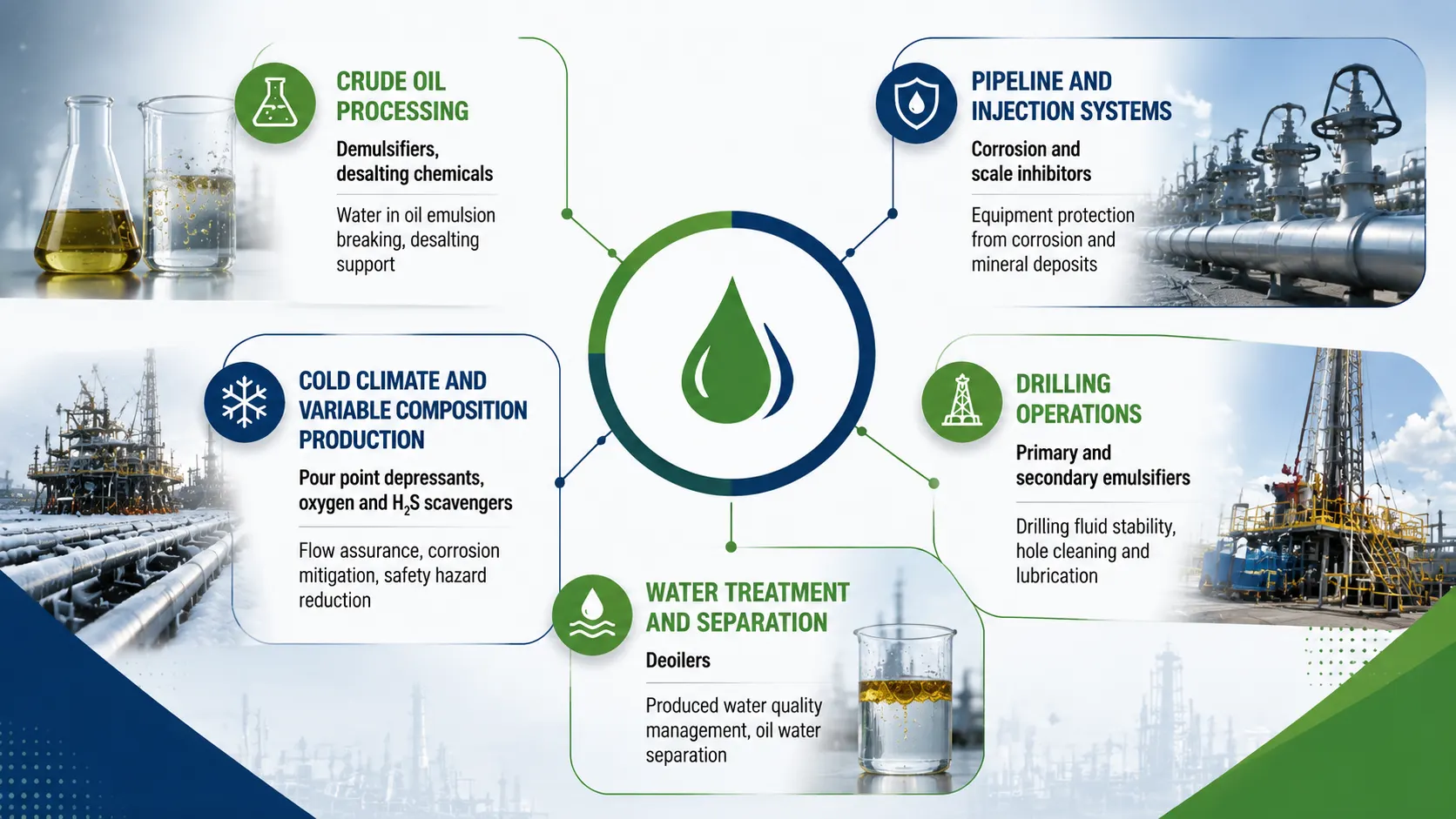
Comparing Oil and Gas Chemical Categories by Application
| Application Area | Chemical Category | Primary Function |
|---|---|---|
| Crude Oil Processing | Demulsifiers, desalting chemicals | Water in oil emulsion breaking, desalting support |
| Pipeline and Injection Systems | Corrosion and scale inhibitors | Equipment protection from corrosion and mineral deposits |
| Cold Climate and Variable Composition Production | Pour point depressants, oxygen and H2S scavengers | Flow assurance, corrosion mitigation, safety hazard reduction |
| Drilling Operations | Primary and secondary emulsifiers | Drilling fluid stability, hole cleaning and lubrication |
| Water Treatment and Separation | Deoilers | Produced water quality management, oil water separation |
Why Choose Pharcos Speciality for Oil and Gas Chemicals
Pharcos Speciality Ltd supplies specialized surfactants and chemical intermediates for the oil and gas industry, supporting drilling fluid formulation, enhanced oil recovery, well stimulation and production chemical systems.
What Pharcos offers oil and gas operators:
- Comprehensive oilfield solutions: demulsifiers, sometimes referred to as molecule breakers, corrosion inhibitors and desalting chemicals tailored for demanding upstream and downstream conditions.
- Flow assurance and treatment chemistry: highly effective scale inhibitors, deoilers, pour point depressants functioning as viscosity improvers, and targeted oxygen and hydrogen sulfide scavengers.
- Drilling and emulsification support: reliable supply of primary and secondary emulsifiers specifically customized for drilling fluid stabilization and superior downhole performance.
- High temperature stability: industrial ethoxylates stable at temperatures exceeding 150 degrees C, supported by thermal stability data and product recommendations matched to specific operating conditions.
- Bulk supply capability: supply in bulk quantities including ISO tanks, flexi bags and drums, with production capacity supporting continuous supply for large scale oilfield chemical programs.
Oil and gas operators evaluating a specialty chemical manufacturer or supplier in India can contact the Pharcos technical team to discuss specific reservoir and operating conditions, request thermal stability data, and review chemical recommendations for demulsification, corrosion protection, flow assurance or drilling fluid applications.
 Call Us Now!
Conclusion
Reliable oil and gas operations depend on a coordinated set of specialty chemicals working together across the production and processing chain, from breaking stubborn water in oil emulsions and protecting infrastructure from corrosion and scale, to keeping hydrocarbons flowing through cold conditions and stabilizing drilling fluids at depth. Because reservoir characteristics, produced water chemistry and operating temperatures vary significantly from field to field, effective oilfield chemical programs are rarely one size fits all, making experienced technical support as valuable as the chemistry itself.
Pharcos Speciality Ltd supplies demulsifiers, corrosion and scale inhibitors, flow assurance chemicals and drilling fluid emulsifiers manufactured in India, backed by thermal stability data and technical expertise to help oil and gas operators identify the right chemical program for their specific upstream or downstream operating conditions.
Our Other Product
Polyethylene Glycol (Pharmaceutical Grade PEG)Frequently Asked Questions

Dr. Avinash Dubey (R&D Head)
Dr. Avinash Dubey is a PhD in Organic Chemistry with a distinguished career spanning more than four decades. As the head of R&D at Pharcos, he focuses on the development of novel molecules for a wide array of industrial sectors, blending long-standing experience with a passion for innovation.

Mr. Ankit Shah (Managing Director)
Mr. Ankit Shah has led Pharcos Speciality for over three decades, establishing it as a pioneer in specialty chemicals. He currently directs the company’s strategic expansion into the APIs, Excipient and Speciality Surfactants markets, upholding a steadfast commitment to "Make in India" and world-class manufacturing quality and new product development.