
Emulsifiers for Polishes and Wax Formulations: Floor, Automotive and Shoe Polish Applications




AI Summary
Polish and wax products, whether a floor finish, an automotive spray wax or a shoe polish, all depend on the same underlying chemistry challenge: dispersing wax, which is naturally water repellent, into a stable, evenly applied emulsion that delivers shine, protection and durability. Emulsifier selection determines whether that wax emulsion remains stable through manufacturing, storage and application, and directly shapes the finished product's gloss, leveling and scuff resistance. Different polish categories call for different emulsifier chemistries and HLB combinations, from glyceryl stearate and Ceteareth blends for floor finishes to tallow amine ethoxylates for automotive wax and oleyl cetyl alcohol ethoxylates for shoe polish. This guide explains how wax emulsification works, compares emulsifier selection across major polish categories, and outlines how Pharcos Speciality Ltd supports polish and wax manufacturers with a versatile emulsifier range manufactured in India.
 WhatsApp Now
Why Emulsifier Selection Is Central to Polish and Wax Performance
Waxes, whether natural products such as carnauba wax or synthetic polymer waxes, are inherently hydrophobic and do not disperse in water on their own. To formulate a usable floor polish, automotive wax or shoe polish, the wax must be emulsified, meaning broken into fine, stable droplets suspended evenly throughout an aqueous or solvent based system. The emulsifier system chosen for this task influences nearly every property the end user experiences: how evenly the product spreads, how quickly it dries, how high a gloss it achieves, and how long that shine and protective layer lasts under wear.
Understanding HLB and Wax in Water Emulsion Stability
Emulsifier selection for wax systems is commonly guided by the Hydrophilic Lipophilic Balance, or HLB, system, which describes the relative water loving versus oil loving character of a given surfactant.
Point wise overview of HLB based emulsifier selection:
- Low HLB co emulsifiers: these have a stronger affinity for the oil or wax phase and are typically used in combination with a high HLB emulsifier to achieve a stable emulsion.
- High HLB primary emulsifiers: these have a stronger affinity for water and help disperse the wax phase into fine, stable droplets throughout the aqueous continuous phase.
- Combined systems: most stable wax emulsions rely on a blend of low and high HLB emulsifiers rather than a single emulsifier, since the combination generally produces smaller, more stable emulsion droplets than either component used alone.
- Particle size control: the specific emulsifier blend and concentration used directly affects the final wax particle size in the emulsion, which in turn influences gloss development and film formation when the product is applied and dried.
Emulsifiers for Floor Polish and Floor Finish Formulations
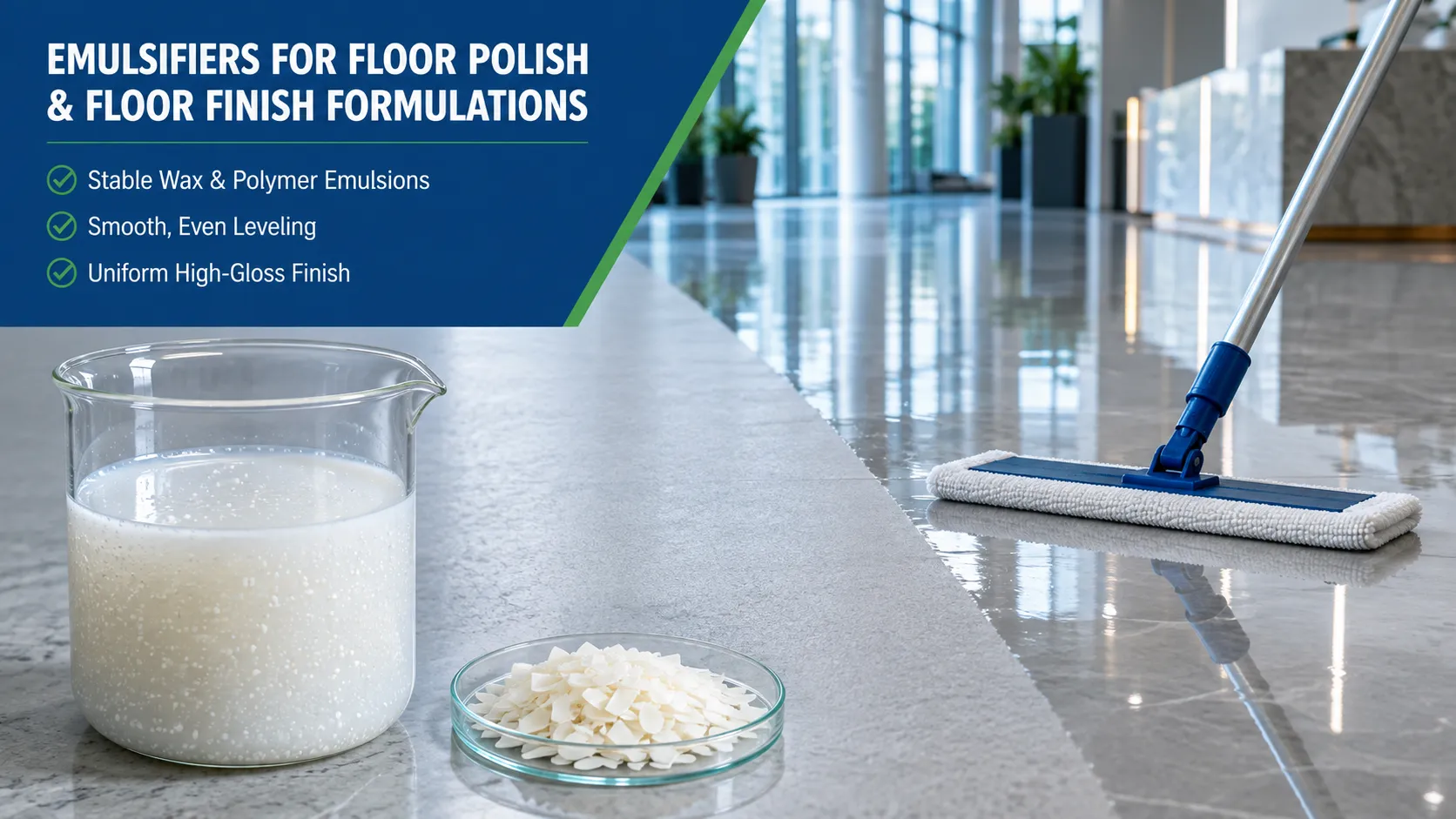
Floor polish and floor finish products require stable polymer and wax emulsions capable of leveling evenly across a floor surface and drying to a uniform, glossy film.
Key emulsifier chemistries for floor finish applications:
- Glyceryl stearate: a widely used emulsifier for creating stable wax and polymer emulsions in floor finish formulations, contributing to good leveling behavior.
- Ceteareth ethoxylate blends: combined with glyceryl stearate or used independently, Ceteareth ethoxylates support stable emulsion formation with the gloss characteristics expected of a premium floor finish product.
- Leveling and gloss: the emulsifier system directly affects how evenly the finish spreads and dries, which in turn determines the final gloss level and surface uniformity of the floor coating.
Emulsifiers for Automotive Wax and Car Care Products
Automotive spray waxes and paste waxes rely on emulsifying carnauba wax and synthetic wax blends into stable formulations suited to easy application and buffing.
- Tallow amine ethoxylates: tallow amine ethoxylates are commonly used to emulsify carnauba and synthetic wax blends in car care spray waxes and paste formulations, supporting stable emulsion formation across the product's shelf life.
- Application performance: a well emulsified automotive wax spreads evenly across the vehicle surface, buffs to a high gloss with reasonable effort, and provides a durable protective layer against environmental exposure.
Our Other Product
Pharmaceutical Grade HPMCEmulsifiers for Shoe Polish Formulations
Shoe polish formulations span both solvent based and water based systems, each requiring emulsifier chemistry suited to their specific base.
- Oleyl cetyl alcohol ethoxylates: provide stable emulsification across both solvent based and water based shoe polish formulations, supporting consistent product performance regardless of formulation type.
- Formulation versatility: because shoe polish formulations vary significantly between traditional solvent based pastes and newer water based creams, emulsifier chemistries capable of performing across both systems offer manufacturers useful formulation flexibility.
Comparing Emulsifier Systems Across Polish Categories
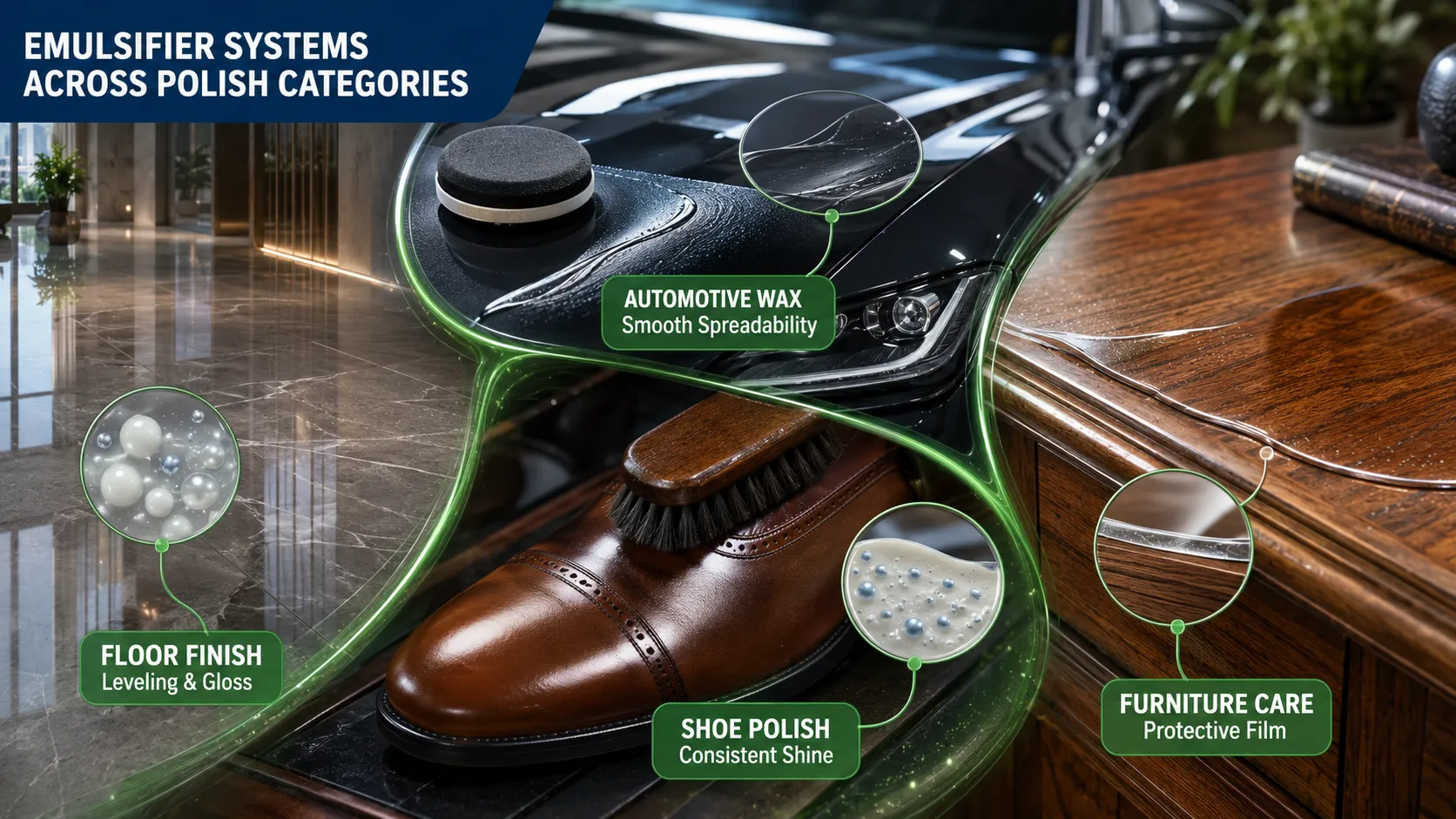
| Polish Category | Primary Emulsifier Chemistry | Key Performance Focus |
|---|---|---|
| Floor Polish and Floor Finish | Glyceryl stearate, Ceteareth blends | Leveling, gloss, uniform drying |
| Automotive Wax | Tallow amine ethoxylates | Wax emulsification, spreadability, buffing performance |
| Shoe Polish (Solvent and Water Based) | Oleyl cetyl alcohol ethoxylates | Cross system stability, consistent shine |
| Furniture Care and General Wax Products | Blended low and high HLB emulsifiers | Application ease, protective film formation |
Achieving Shine, Durability and Ease of Application
The end goal across all polish and wax categories is a consistent set of performance outcomes, each shaped directly by emulsifier selection.
- High gloss: a well emulsified, evenly dispersed wax phase supports the formation of a smooth, reflective film once the product dries or is buffed.
- Scuff resistance: stable emulsions that dry into a uniform film generally provide better resistance to scuffing and wear than unevenly dispersed formulations.
- Long lasting protection: consistent film formation across the treated surface supports more even, longer lasting protective performance.
- Ease of application: emulsion particle size and stability directly affect how smoothly a polish or wax spreads during application, influencing the overall user experience.
Why Choose Pharcos Speciality for Polish and Wax Emulsifiers
Pharcos Speciality Ltd manufactures emulsifiers and wax processing aids for polishes, supporting a wide range of polish formulations, including floor finishes, automotive waxes, shoe polishes and furniture care products.
What Pharcos offers polish and wax manufacturers:
- Wax emulsion expertise: decades of formulation experience in wax in water emulsions with precise particle size and stability control, including Glyceryl Stearate and Ceteareth blends for floor finish applications.
- Automotive wax emulsification: Tallow Amine Ethoxylates for emulsifying carnauba and synthetic waxes in car care spray waxes and pastes.
- Shoe polish stability: Oleyl Cetyl Alcohol Ethoxylates supporting stable emulsification across both solvent based and water based shoe polish formulations.
- Versatile emulsifier range: a portfolio spanning low HLB co emulsifiers to high HLB primary emulsifiers, supporting complete emulsifier systems for any wax type, including combinations such as low HLB grades paired with high HLB Ceteareth or amine ethoxylate grades.
- Formulation support: technical assistance optimizing HLB ratios and emulsifier combinations for specific wax blends and target performance outcomes.
Polish and wax manufacturers evaluating an emulsifier manufacturer or supplier in India can contact the Pharcos technical team to discuss wax blend requirements, request samples, and review formulation guidance for floor, automotive or shoe polish applications.
 Call Us Now!
Conclusion
Whether the finished product is a floor finish, an automotive wax or a shoe polish, the underlying formulation challenge is the same: turning a naturally water repellent wax into a stable, evenly applied emulsion capable of delivering consistent shine, protection and durability. Emulsifier selection, guided by HLB principles and tailored to the specific wax blend and application method, is the single most important formulation decision shaping that outcome. As polish and wax manufacturers continue to refine formulations for gloss, scuff resistance and ease of application, working with an experienced emulsifier supplier makes a measurable difference in finished product quality.
Pharcos Speciality Ltd offers a versatile range of emulsifiers manufactured in India for the polish and wax industry, backed by formulation support to help identify the right HLB combination and emulsifier system for a specific wax type and target product performance.
Our Other Product
Pharmaceutical Grade Polyethylene Glycol (PEG)Frequently Asked Questions

Dr. Avinash Dubey (R&D Head)
Dr. Avinash Dubey is a PhD in Organic Chemistry with a distinguished career spanning more than four decades. As the head of R&D at Pharcos, he focuses on the development of novel molecules for a wide array of industrial sectors, blending long-standing experience with a passion for innovation.

Mr. Ankit Shah (Managing Director)
Mr. Ankit Shah has led Pharcos Speciality for over three decades, establishing it as a pioneer in specialty chemicals. He currently directs the company’s strategic expansion into the APIs, Excipient and Speciality Surfactants markets, upholding a steadfast commitment to "Make in India" and world-class manufacturing quality and new product development.