
Hydroxypropyl Methylcellulose (HPMC) in Liquid Soap, Handwash and Cleansing Products: Benefits and Applications




AI Summary
Hydroxypropyl Methylcellulose, known as HPMC or Hypromellose, is a nonionic cellulose ether widely used as a rheology modifier in liquid soap, handwash and cleansing product formulations. When dispersed and hydrated in water, HPMC polymer chains expand and interact to form a three dimensional network that thickens the formula, giving formulators precise control over viscosity, flow behavior and dispensing performance. Beyond simple thickening, HPMC contributes to richer, more stable foam by interacting favorably with anionic, amphoteric and nonionic surfactant systems, supports smooth, non stringy flow through pumps and dispensers due to its shear thinning behavior, and improves sensory qualities such as skin feel and rinseability. It also helps stabilize complex formulations containing fragrance oils, colorants and botanical extracts, reducing the risk of phase separation during storage. This guide explains the science behind how HPMC functions as a rheology modifier, compares viscosity grades suited to different cleansing product types, and outlines processing best practices for incorporating HPMC into liquid soap, handwash, shower gel and facial cleanser formulations, along with how Pharcos Speciality Ltd can support formulators sourcing this versatile, nonionic cellulose ether.
Introduction to Hydroxypropyl Methylcellulose (HPMC)
What Is HPMC
Hydroxypropyl Methylcellulose, commonly abbreviated as HPMC and listed under the International Nomenclature of Cosmetic Ingredients as Hydroxypropyl Methylcellulose, is a semi synthetic polymer manufactured by chemically modifying natural plant cellulose. During manufacture, cellulose is treated to introduce methyl and hydroxypropyl substituent groups along its backbone, producing a water soluble polymer with the CAS Number 9004 65 3.
Chemical Structure and Nonionic Nature
HPMC carries no electrical charge, which classifies it as a nonionic polymer. This is central to its usefulness in personal care formulation, since a nonionic thickener generally does not interact unpredictably with the anionic, amphoteric or cationic surfactants and conditioning agents commonly found in handwash, liquid soap and shower gel formulas. The polymer dissolves in cold water while remaining insoluble in most organic solvents, and it forms a thermally reversible gel structure that underlies its thickening behavior.
Why Hydroxypropyl Methylcellulose Is Widely Used in Personal Care Formulations
Across cosmetic and personal cleansing categories, HPMC functions as a thickener, rheology modifier, film forming agent and foam stabilizer. Formulation databases such as the European Union CosIng ingredient database list Hydroxypropyl Methylcellulose among recognized cosmetic ingredients, and it is separately approved for food use in the European Union under the E464 designation, reflecting a long, well documented history of use across regulated consumer product categories.
 WhatsApp Now
Why Hydroxypropyl Methylcellulose Rheology Matters in Liquid Soap and Handwash
Importance of Controlled Viscosity
Viscosity is one of the first things a consumer notices about a liquid soap or handwash, often before they even evaluate cleansing performance. A formula that is too thin feels watery and can run off the hand before use, while a formula that is too thick can be difficult to dispense evenly.
Consumer Perception of Product Texture
Texture strongly influences perceived quality and value. Rich, controlled viscosity is commonly associated by consumers with a more premium, effective cleansing product, even when the underlying surfactant system is otherwise similar across price tiers.
Flow Characteristics During Dispensing
Handwash and liquid soap products are almost always dispensed through pumps, and the way a formula flows through a pump nozzle, whether it drips, strings or dispenses in a clean, controlled dose, depends heavily on the rheology profile built into the formulation.
Impact on Product Stability
Beyond consumer facing texture, viscosity plays a functional role in keeping a formulation stable during storage, helping to suspend insoluble additives, slow settling of any dispersed particles, and reduce the risk of separation between the aqueous and surfactant phases over the product shelf life.
How HPMC Functions as a Rheology Modifier
Mechanism of Water Hydration
When HPMC powder is added to water, individual polymer particles begin to absorb water molecules at their surface. As hydration proceeds, water penetrates further into each particle, gradually converting the dry polymer into a swollen, hydrated state.
Polymer Chain Expansion
As hydration continues, the HPMC polymer chains uncoil and expand within the aqueous phase. This expansion increases the effective volume each polymer chain occupies in solution, which is a primary driver of the viscosity increase observed as HPMC dissolves.
Formation of a Three Dimensional Network
At sufficient concentration, hydrated and expanded HPMC chains begin to overlap and interact with one another, forming a loosely connected, three dimensional network throughout the aqueous phase. This network structure is what gives HPMC solutions their characteristic body and resistance to flow.
Viscosity Development Process
Viscosity development in HPMC is a time dependent process. Immediate viscosity readings taken right after dispersion will typically be lower than the final viscosity reached once the polymer is fully hydrated, which is an important consideration during both formulation development and manufacturing scale up.
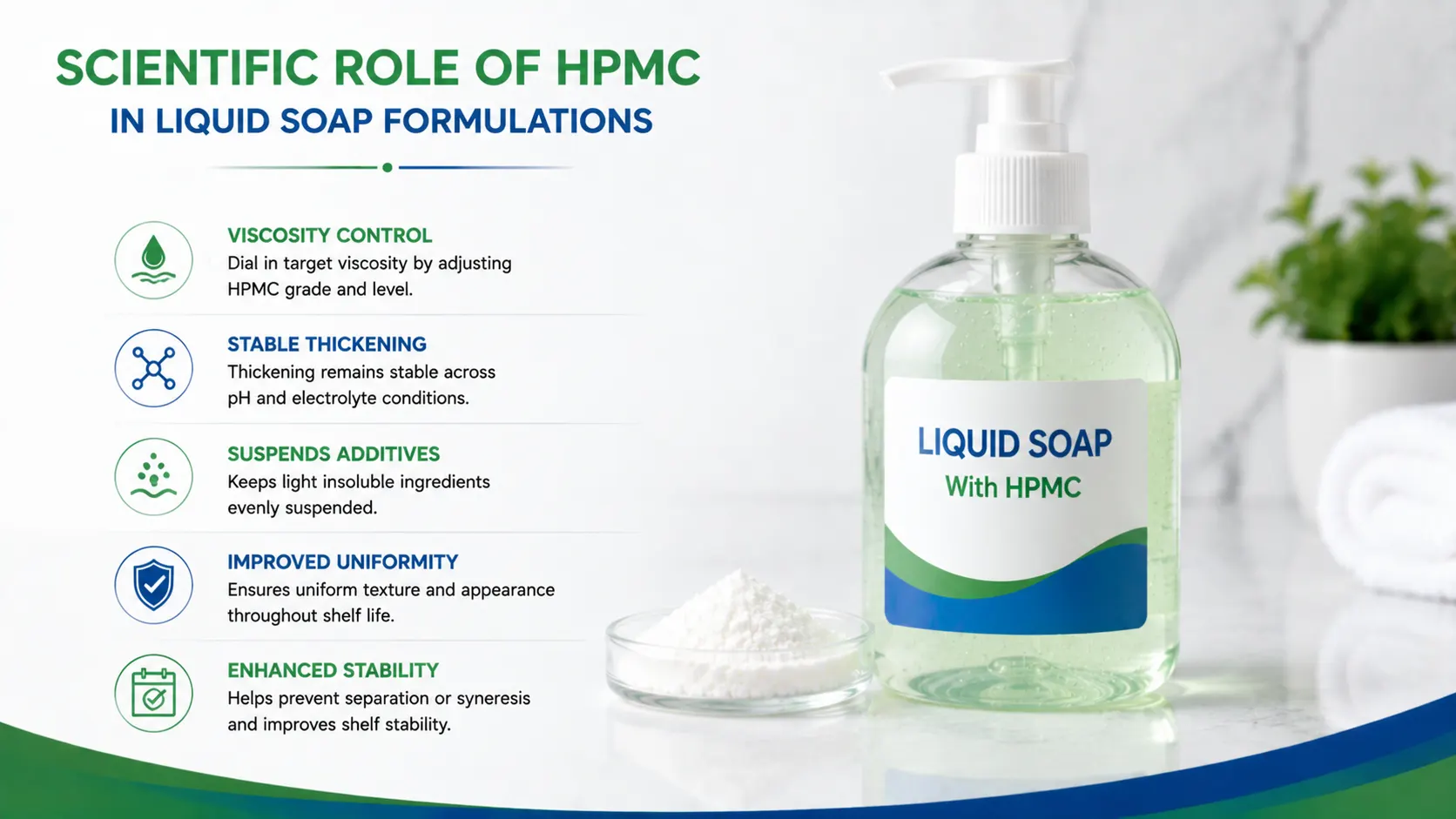
Scientific Role of Hydroxypropyl Methylcellulose in Liquid Soap Formulations
Point wise functional roles of HPMC in liquid soap:
- Viscosity control: HPMC allows formulators to dial in a target viscosity range simply by adjusting grade and use level, without relying solely on salt or surfactant concentration to build body.
- Thickening mechanism: the polymer network described above provides thickening that remains relatively stable across a range of pH and electrolyte conditions compared to some purely salt thickened surfactant systems.
- Suspension of insoluble ingredients: the three dimensional network can help keep light insoluble additives, such as certain exfoliating particles or pearlizing agents, evenly suspended rather than settling to the bottom of the container.
- Improved product uniformity: consistent hydration and network formation supports a uniform appearance and texture across the full batch and across the product shelf life.
- Enhanced shelf stability: by contributing to a stable rheology profile, HPMC helps reduce the risk of visible phase separation or syneresis, where liquid separates out from a thickened gel structure, during storage.
How HPMC Enhances Foam Performance
Difference Between Foam Volume and Foam Stability
Foam volume refers to how much foam is generated during use, while foam stability refers to how long that foam persists before collapsing. A handwash can generate impressive initial foam volume that collapses quickly, or a more modest foam volume that persists through the full washing motion, and these are distinct performance attributes that formulators manage separately.
Interaction with Surfactants
HPMC interacts with the surfactant micelles in a formulation in a way that can reinforce the thin liquid films forming the walls of each foam bubble, contributing to foam that resists collapse for longer during use.
Richer and Creamier Foam Formation
Because HPMC increases the viscosity of the continuous aqueous phase surrounding surfactant micelles, foam bubbles tend to drain more slowly, which is commonly associated with a richer, creamier foam texture rather than a thin, quickly collapsing lather.
Improved Consumer Experience
A more stable, creamier foam is widely perceived by consumers as a sign of a higher performing, more luxurious cleansing product, making foam enhancement one of the most commercially valuable functions HPMC performs in handwash and liquid soap formulations.
Our Other Product
HPMC 50 cpsAchieving Smooth Flow Without Stringiness with Hydroxypropyl Methylcellulose
Newtonian vs Non Newtonian Flow
A Newtonian fluid, such as water, has a viscosity that stays constant regardless of the force or shear applied to it. Most HPMC thickened cleansing formulations are non Newtonian, meaning their viscosity changes depending on how much shear or force is applied during dispensing, pouring or rubbing on the skin.
Shear Thinning Behavior of HPMC
HPMC solutions typically display shear thinning behavior, meaning viscosity decreases as shear rate increases. In practical terms, this means the product can feel relatively thick and stable sitting in the bottle, yet flow smoothly and evenly when force is applied during pumping or dispensing, then return to a thicker resting state once that force is removed.
Controlled Dispensing from Pumps
This shear thinning profile is a major reason HPMC is well suited to pump dispensed handwash and liquid soap formats, since it supports a clean, controlled dose without the long, stringy trailing sometimes seen with poorly optimized thickening systems.
Improved Spreadability During Hand Washing
Once dispensed, the same shear thinning behavior allows the product to spread easily and evenly across wet hands during the washing motion, rather than sitting as a thick, hard to distribute mass.
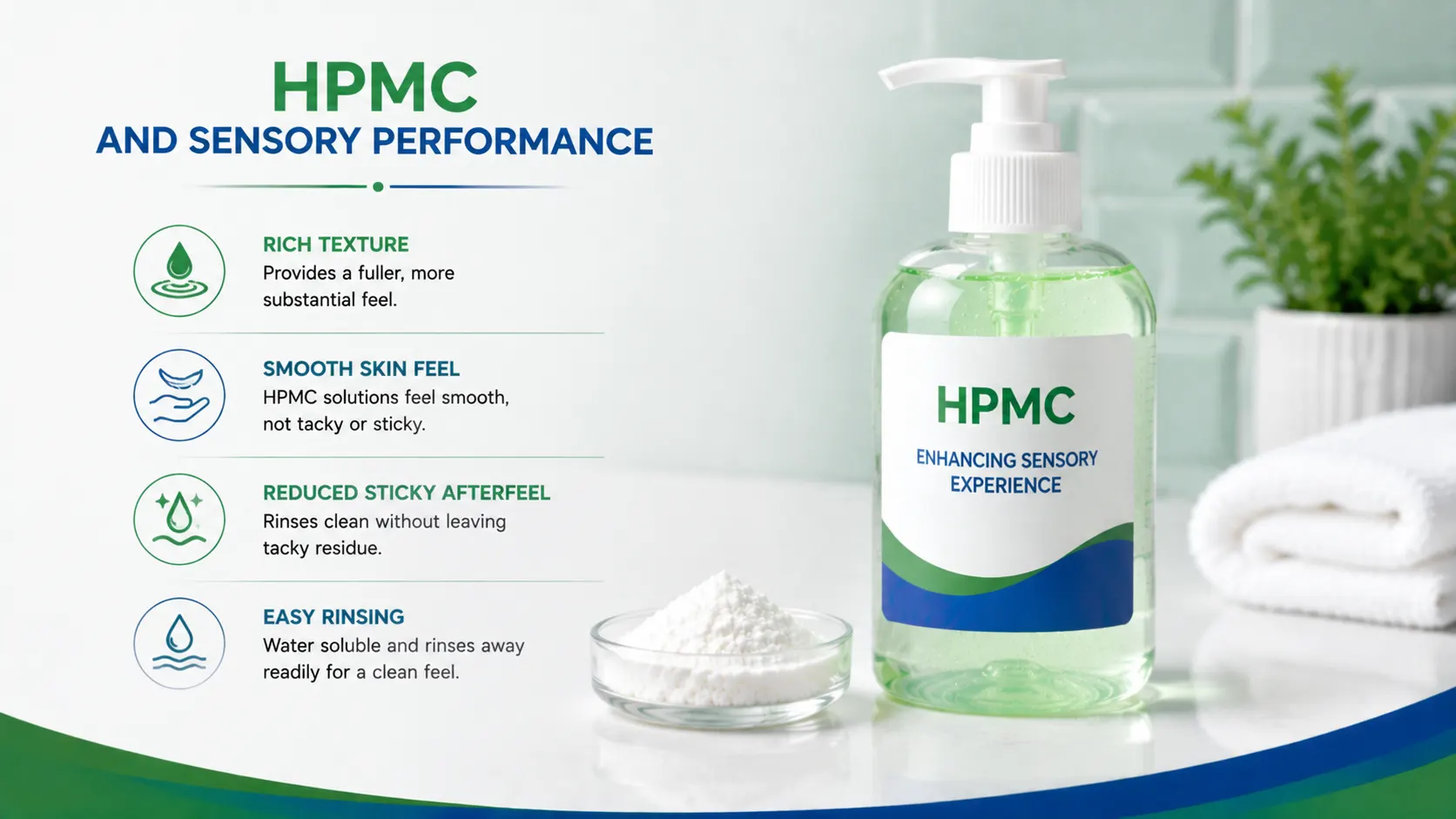
HPMC and Sensory Performance
Key sensory contributions of HPMC in cleansing formulations:
- Rich texture: a well hydrated HPMC network contributes to a fuller, more substantial in hand feel compared to a thin, low viscosity formula.
- Smooth skin feel: HPMC solutions are generally described as smooth rather than tacky or sticky, supporting a pleasant application experience.
- Reduced sticky afterfeel: because HPMC rinses cleanly from the skin surface, it does not typically leave the tacky residue sometimes associated with other film forming thickeners.
- Easy rinsing characteristics: the water solubility that defines HPMC also means it rinses away readily with water, supporting a clean, non greasy after wash feel.
Stabilizing Complex Handwash Formulations with HPMC
Modern handwash and liquid soap products are rarely simple surfactant and water blends. They often contain fragrance oils, colorants, humectants, preservatives and botanical extracts, all of which need to remain evenly distributed and visually consistent throughout the product shelf life.
How HPMC contributes to formulation stability:
- Preventing phase separation: the thickened continuous phase created by HPMC slows the movement of dispersed droplets and particles, reducing the likelihood of visible separation between layers over time.
- Stabilizing fragrance oils: fragrance oils that are not fully water soluble can be more evenly dispersed and held in suspension within an HPMC thickened base, reducing the risk of oily droplets rising to the surface.
- Supporting colour uniformity: a stable, evenly thickened base helps keep dispersed or partially soluble colorants uniformly distributed, avoiding streaking or settling.
- Maintaining consistent appearance during storage: together, these stabilizing effects help a finished handwash or liquid soap maintain its intended appearance and texture from the point of manufacture through to end use by the consumer.
Compatibility of HPMC with Common Handwash Ingredients
Because HPMC is nonionic, it is broadly compatible with the wide range of ingredient types used in modern cleansing formulations.
| Ingredient Category | Examples | Compatibility Notes |
|---|---|---|
| Anionic Surfactants | Sodium Laureth Sulfate (SLES), Sodium Lauryl Sulfate (SLS) | Generally compatible; HPMC does not carry a charge that would interact unfavorably with anionic surfactant micelles |
| Amphoteric Surfactants | Cocamidopropyl Betaine | Commonly used alongside HPMC in mild handwash and body wash systems |
| Nonionic Surfactants | Various ethoxylated surfactants | Compatible, since both share a nonionic character |
| Humectants | Glycerin, Propylene Glycol | Generally compatible and often used together to balance moisture feel with viscosity |
| Preservatives | Broad spectrum cosmetic preservatives | HPMC does not typically interfere with preservative efficacy when used within standard concentration ranges |
| Skin Conditioning Agents | Panthenol, botanical oils, emollients | Compatible, with HPMC often helping to disperse and stabilize these additives within the aqueous phase |
| Botanical Extracts | Aloe vera, herbal extracts | Broadly compatible, supporting formulators developing herbal and naturally positioned cleansing products |
As with any formulation, compatibility should be confirmed through small scale trials, particularly in complex systems combining multiple actives, since interactions can still occur between ingredients other than HPMC itself, such as between certain electrolytes and specific surfactant blends.
Selecting the Right HPMC Viscosity Grade
HPMC is available across a wide viscosity range, and matching the grade to the target product type is central to achieving the desired texture and dispensing performance.
| Viscosity Tier | Approximate Viscosity | Typical Application |
|---|---|---|
| Low Viscosity | Approximately HPMC 4000 cps | Lightweight liquid cleansers requiring gentle body without heavy thickening |
| Medium Viscosity | Approximately HPMC 15000 cps | Standard liquid handwash requiring balanced flow and dispensing performance |
| High Viscosity | Approximately HPMC 100000 cps | Premium cleansing products requiring richer texture and stronger suspension capability |
| Very High Viscosity | Approximately HPMC 200000 cps | Specialty formulations requiring maximum body, stability and suspension performance |
These viscosity tiers correspond to HPMC grades available from the Pharcocel range manufactured by Pharcos Speciality Ltd, giving formulators a defined set of options to trial when developing or reformulating a liquid soap, handwash or cleansing product. As a general starting point, lower viscosity grades are used sparingly for light bodied cleansers, while higher viscosity grades are used at lower concentrations to achieve significant thickening and suspension performance without requiring large use levels.
Processing Guidelines for Incorporating HPMC
Correct processing is essential to achieving full, consistent viscosity development and avoiding common manufacturing defects.
Point wise processing guidance:
- Proper dispersion techniques: HPMC powder should be added slowly and evenly into the aqueous phase under moderate agitation, avoiding dumping the full quantity in at once, which can cause localized clumping.
- Hydration process: allow sufficient time for the dispersed HPMC to fully hydrate before evaluating final viscosity, since viscosity continues to build for a period after initial dispersion.
- Mixing sequence: in many formulations, dispersing HPMC into water before introducing surfactants and other actives helps achieve more even hydration than adding HPMC into an already thickened or surfactant rich phase.
- Temperature considerations: HPMC generally hydrates well in cold to room temperature water; using water that is too warm during initial dispersion can slow hydration or, in some cases, contribute to clumping.
- Preventing lump formation: pre wetting HPMC powder in a small amount of glycerin or propylene glycol before adding it to the main water phase is a widely used technique to separate individual polymer particles and reduce the risk of lump formation during dispersion.
Performance Benefits During Manufacturing
Beyond the finished product, correctly selected and processed HPMC delivers measurable benefits at the manufacturing stage itself.
- Easier batch to batch consistency: a well characterized HPMC grade with a defined, tested viscosity specification supports more predictable, repeatable thickening results across production batches.
- Better process control: because HPMC viscosity behavior is well documented and grade dependent, process teams can plan mixing times and equipment settings with greater confidence.
- Improved filling operations: a formulation with well controlled, shear thinning rheology generally fills more consistently on high speed filling lines, reducing dosing variability caused by inconsistent flow behavior.
- Reduced product defects: proper HPMC selection and processing reduces the incidence of common defects such as visible lumps, inconsistent viscosity between batches, or unexpected thinning or thickening during storage.
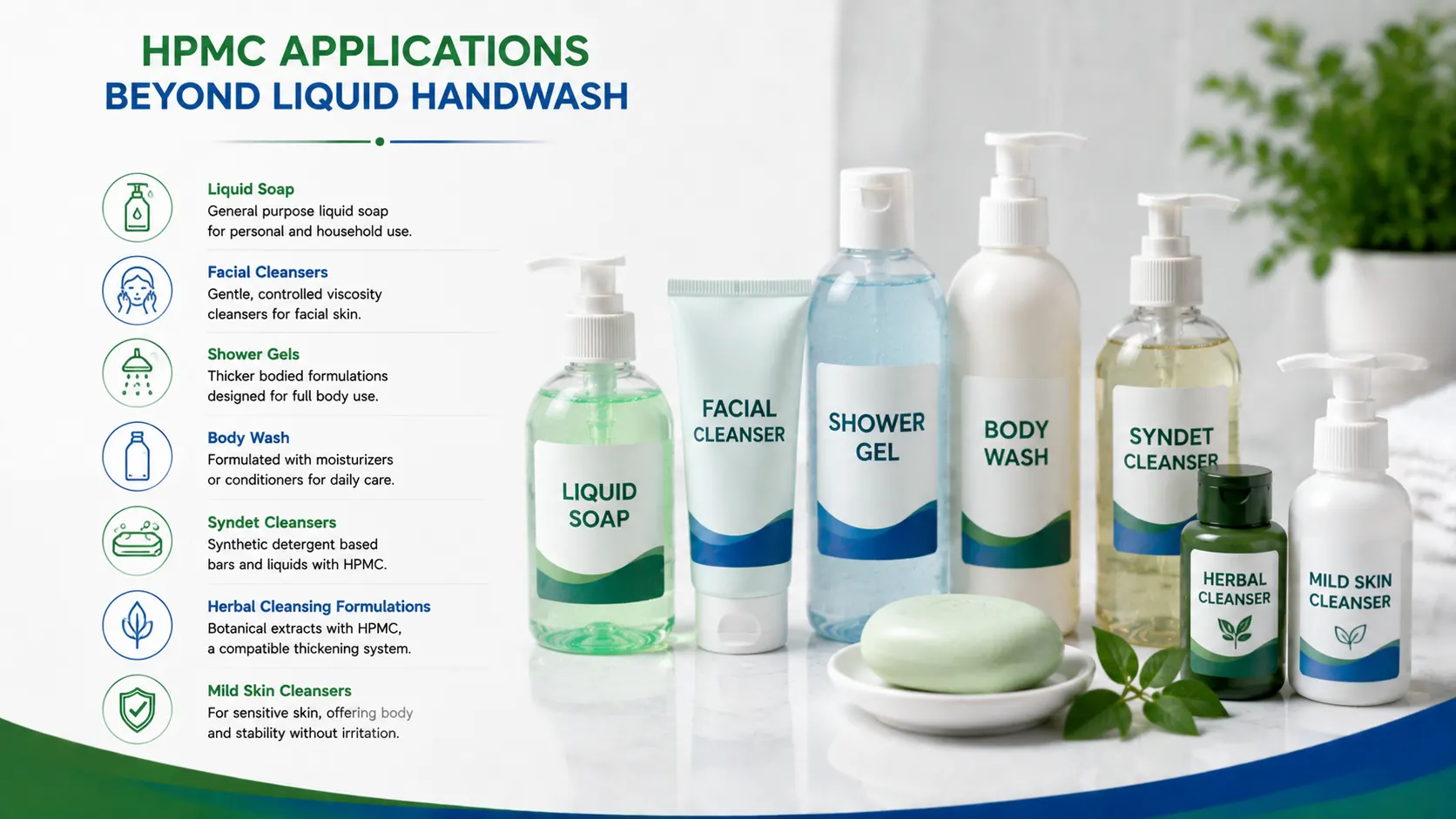
HPMC Applications Beyond Liquid Handwash
The same rheology modifying and stabilizing properties that make HPMC valuable in handwash extend naturally to a wider range of cleansing product categories.
- Liquid Soap: general purpose liquid soap formulations for household and personal use.
- Facial Cleansers: gentle, controlled viscosity cleansers formulated for use on facial skin.
- Shower Gels: thicker bodied formulations designed for full body use in the shower.
- Body Wash: similar to shower gel, often formulated with additional moisturizing or conditioning agents alongside HPMC based thickening.
- Syndet Cleansers: synthetic detergent based cleansing bars and liquids that rely on rheology modifiers such as HPMC for texture and stability.
- Herbal Cleansing Formulations: naturally positioned products combining botanical extracts with HPMC as a compatible, plant derived thickening system.
- Mild Skin Cleansers: formulations designed for sensitive skin, where HPMC contributes body and stability without introducing harsh or irritating thickening agents.
Factors to Consider When Selecting HPMC
- Desired viscosity: match the HPMC grade to the target finished product viscosity, keeping in mind that final use level and other formulation components also influence the result.
- Product transparency: HPMC solutions are generally clear to slightly hazy, which is an important consideration for formulators targeting a fully transparent finished product.
- Surfactant system: while HPMC is broadly compatible across surfactant types, the overall surfactant blend and electrolyte content can still influence final viscosity and should be evaluated together with the chosen HPMC grade.
- Processing conditions: available mixing equipment, batch size and processing temperature should be factored into grade and concentration selection to ensure full, consistent hydration at production scale.
- Storage stability: consider how the finished formulation, including HPMC concentration and grade, will perform across the intended shelf life and storage conditions, including temperature variation during shipping and retail storage.
- End use requirements: the intended use case, such as a lightweight facial cleanser versus a rich, premium body wash, should guide both the viscosity tier selected and the target use concentration.
Future Trends in HPMC Based Cleansing Formulations
- Sulfate free cleansers: as more brands move away from sulfate based surfactants, nonionic thickeners such as HPMC are gaining renewed formulator interest for their broad compatibility with milder, sulfate free surfactant systems.
- Mild, skin friendly formulations: growing consumer demand for gentle, low irritation cleansing products supports continued use of HPMC, given its established safety profile and non sensitizing character in personal care applications.
- Plant based personal care: because HPMC is derived from natural cellulose, it fits naturally within plant based and naturally positioned product narratives, complementing herbal and botanical formulation trends.
- High performance rheology modifiers: ongoing formulation research continues to explore how HPMC can be combined with complementary thickeners to fine tune viscosity, foam and sensory performance for increasingly specific product positioning.
- Sustainable formulation development: as brands prioritize ingredient traceability and sustainable sourcing, cellulose derived thickeners such as HPMC, sourced from renewable plant material, are increasingly positioned as a sustainability conscious alternative within broader formulation strategies.
Our Other Product
HPMC 15 cpsHow Pharcos Speciality Can Help?
Pharcos Speciality Ltd manufactures Hydroxypropyl Methylcellulose under its Pharcocel brand, covering a wide viscosity range that includes grades suited to the rheology modification needs of liquid soap, handwash and cleansing product formulators.
How Pharcos supports personal care and cleansing product formulators:
- Full viscosity range availability: Pharcocel grades spanning the low, medium, high and very high viscosity tiers discussed in this guide, from approximately HPMC 4000 cps through to approximately HPMC 200000 cps, giving formulators a defined starting point for trials across different cleansing product types.
- Consistent, well documented quality: every Pharcocel batch is manufactured under WHO GMP certified conditions with full Certificate of Analysis and Material Safety Data Sheet documentation, supporting reliable, repeatable thickening performance batch after batch.
- Nonionic, broadly compatible chemistry: Pharcocel HPMC is nonionic and demonstrates broad compatibility with common surfactants, humectants, preservatives and botanical extracts used across handwash, liquid soap, shower gel and facial cleanser formulations.
- Technical formulation support: the Pharcos technical team is available to help formulators select an appropriate viscosity grade and use level for a specific cleansing product type, and to advise on processing considerations such as dispersion technique and hydration time.
- Reliable supply for scale up: with dedicated manufacturing facilities and established export capability, Pharcos supports both small scale formulation trials and full commercial bulk requirements as a project moves from development into production.
Formulators developing or reformulating a liquid soap, handwash, shower gel or facial cleanser can contact the Pharcos technical team to discuss grade selection, request samples, and review compatibility guidance for their specific surfactant system.
 Call Us Now!
Why HPMC Continues to Be a Preferred Rheology Modifier for Liquid Soap, Handwash and Cleansing Products
Hydroxypropyl Methylcellulose combines a rare set of advantages for cleansing product formulators: nonionic chemistry that plays well with virtually every common surfactant system, shear thinning rheology that supports both smooth dispensing and satisfying in hand texture, foam stabilizing behavior that improves consumer perceived product quality, and a well documented safety and regulatory history across cosmetic, personal care and food applications. Few single ingredients can influence texture, foam, stability and sensory performance simultaneously in the way HPMC does within a liquid soap or handwash formulation.
Key Considerations for Selecting the Appropriate HPMC Grade
Getting the most from HPMC comes down to matching viscosity grade to the intended product type and use level, understanding its compatibility with the specific surfactant and additive system in use, and following correct dispersion and hydration practices during manufacturing. For formulators seeking a reliable, well documented source of HPMC across this viscosity range, Pharcos Speciality Ltd, through its Pharcocel range, offers both the grade breadth and technical support needed to bring a new or reformulated liquid soap, handwash or cleansing product from concept through to commercial production.
Frequently Asked Questions

Dr. Avinash Dubey (R&D Head)
Dr. Avinash Dubey is a PhD in Organic Chemistry with a distinguished career spanning more than four decades. As the head of R&D at Pharcos, he focuses on the development of novel molecules for a wide array of industrial sectors, blending long-standing experience with a passion for innovation.

Mr. Ankit Shah (Managing Director)
Mr. Ankit Shah has led Pharcos Speciality for over three decades, establishing it as a pioneer in specialty chemicals. He currently directs the company’s strategic expansion into the APIs, Excipient and Speciality Surfactants markets, upholding a steadfast commitment to "Make in India" and world-class manufacturing quality and new product development.