
Hydroxypropyl Methylcellulose (Hypromellose) in Food Industry: Applications, Benefits and Safety




AI Summary
Hydroxypropyl Methylcellulose, known as HPMC or Hypromellose, is a plant derived, nonionic cellulose ether recognized globally as a multifunctional food additive under the code E464. Unlike most hydrocolloids, HPMC displays reverse thermal gelation, meaning it dissolves in cold water to form a smooth solution and then forms a gel when heated, reverting back to a liquid on cooling. This unusual property makes HPMC valuable across a wide span of food categories. In bakery products, it improves dough handling, retains moisture, extends shelf life and supports gluten free structure. In plant based meat alternatives, it acts as a binder that mimics the juiciness and fibrous texture of animal fat and muscle. In dairy and frozen desserts, it enables fat reduction while preserving creaminess. In sauces, gravies and ready to eat meals, it provides thickening and freeze thaw stability without the thinning sometimes seen in starch based systems. Food grade HPMC is approved by major regulatory bodies including the United States Food and Drug Administration, which recognizes it as Generally Recognized As Safe and lists it under 21 CFR 172.874, and the European Food Safety Authority, which includes it in the European Union list of approved food additives as E464. This guide explains how HPMC functions across bakery, meat alternative, dairy, sauce and processed food applications, compares it with traditional stabilizers and emulsifiers, and outlines how Pharcos Speciality Ltd supports food manufacturers sourcing HPMC through its Pharcocel range, manufactured in India to internationally recognized quality standards.
Introduction to Hydroxypropyl Methylcellulose as a Food Ingredient
Hydroxypropyl Methylcellulose is a semi synthetic polymer produced by chemically modifying natural plant cellulose with methyl and hydroxypropyl substituent groups. In food applications, this chemistry gives HPMC a combination of properties rarely found together in a single ingredient: it thickens, stabilizes, emulsifies, retains moisture, forms flexible films and, most distinctively, gels when heated rather than when cooled.
This last property, known as reverse or thermal gelation, sets HPMC apart from starches and many traditional gums, which typically lose viscosity as temperature rises. Because HPMC solutions actually gain structure during baking, frying or hot processing, and then return to a fluid state on cooling, it performs a genuinely different function in a formulation compared to conventional thickeners, which is why it has become widely used across bakery, plant based meat, dairy and processed food categories.
Regulatory recognition of HPMC as a food ingredient is well established. It carries the food additive code E464 under European Union food regulations, is classified as Generally Recognized As Safe by the United States Food and Drug Administration, and is separately listed for pharmaceutical grade compliance under USP NF, EP, BP and IP monographs, reflecting decades of documented use across both food and pharmaceutical categories.
 WhatsApp Now
Hydroxypropyl Methylcellulose in the Bakery Industry
Bakery formulation is one of the largest and most established application areas for food grade HPMC, spanning bread, laminated pastry, cakes and gluten free products.
HPMC in Bread Production: Improving Softness and Shelf Life
In bread and other yeast leavened products, HPMC helps retain gas produced during fermentation and baking, supporting a higher, more even loaf volume. Once baked, HPMC continues to hold moisture within the crumb structure, which keeps bread feeling softer for longer and slows the staling process that leads to firm, dry texture over time.
How HPMC Enhances Puff Pastries and Croissants
In laminated doughs such as puff pastry and croissant dough, HPMC helps control moisture migration between the fat layers and the dough layers during lamination and baking, supporting the light, flaky layered structure these products are known for.
The Science Behind Better Dough Handling with Hydroxypropyl Methylcellulose (Hypromellose)
HPMC modifies dough rheology by increasing water binding capacity and contributing a degree of elasticity to the dough matrix, particularly valuable in formulations that lack sufficient natural gluten structure, making dough easier to sheet, shape and handle during processing.
Why Hydroxypropyl Methylcellulose (Hypromellose) Is Essential for Modern Bakery Formulations
As bakery manufacturers work to reduce fat, extend shelf life and meet gluten free demand simultaneously, HPMC has become a practical single ingredient solution that addresses several of these formulation goals at once, rather than requiring a separate additive for each function.
Moisture Retention in Bakery Products Using HPMC
Because HPMC binds water within its polymer network, baked goods formulated with HPMC generally lose moisture more slowly during storage compared to formulations without a water retention agent, directly supporting a softer eating experience over the product shelf life.
Extending Bakery Shelf Life with Food Grade HPMC
By combining moisture retention with gas retention during baking, HPMC contributes to bakery products that stay fresher, softer and more visually appealing for longer, which is one of the most commercially valuable benefits it offers to commercial bakery operations managing distribution timelines.
Fat Reduction in Cakes and Muffins Using Hydroxypropyl Methylcellulose (Hypromellose)
HPMC can replace part of the fat in cake and muffin formulations while helping maintain a moist, tender crumb, since its water binding and thermal gelation properties partially replicate the moisture retention and structural role that fat would otherwise play.
How HPMC Prevents Dryness in Baked Goods
The combination of water retention during storage and gas retention during baking means HPMC formulated products are less prone to the dry, crumbly texture that often develops in reduced fat or extended shelf life bakery products.
Hydroxypropyl Methylcellulose (Hypromellose) vs Traditional Emulsifiers in Baking
Traditional emulsifiers used in baking primarily improve fat and water interaction and support aeration, while HPMC contributes water binding, gas retention and thermal gel structure. Many modern bakery formulations use HPMC alongside, rather than instead of, traditional emulsifiers, since the two ingredient types address different aspects of dough and crumb performance.
Clean Label Baking: Can HPMC Help?
Because HPMC is derived entirely from plant cellulose and carries a simple, recognizable additive designation, it is often viewed favorably compared to some synthetic emulsifiers in formulations positioned toward simpler, more transparent ingredient lists, though final label claims should always be confirmed against the specific regulatory definitions applicable in the target market.
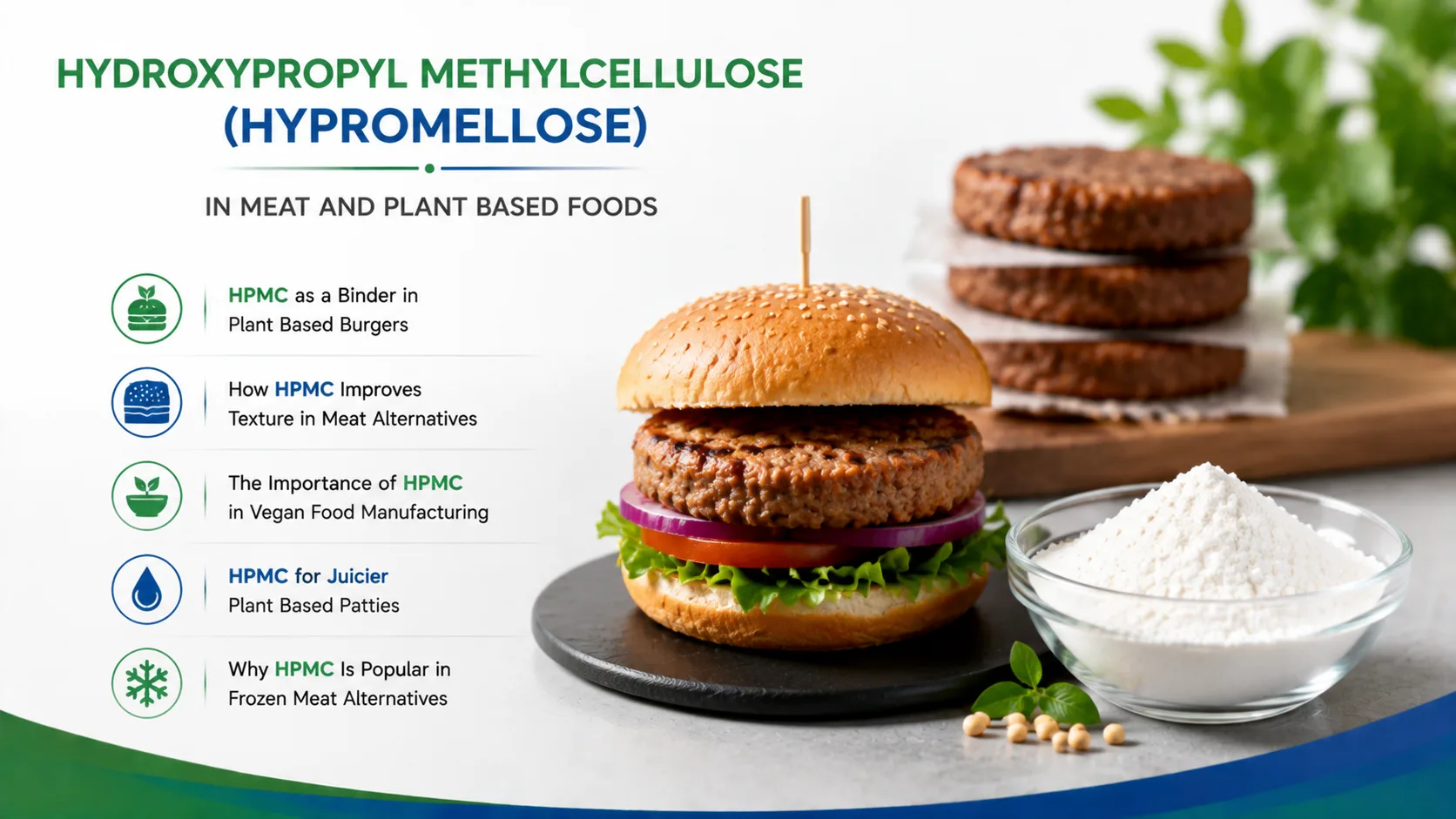
Hydroxypropyl Methylcellulose (Hypromellose) in Meat and Plant Based Foods
HPMC as a Binder in Plant Based Burgers
In plant based burger and patty formulations, HPMC functions as a binder that holds plant proteins, fats and other ingredients together, supporting a cohesive patty that maintains its shape through cooking, flipping and handling.
How HPMC Improves Texture in Meat Alternatives
The reverse thermal gelation property is particularly valuable in meat alternatives, since HPMC forms a gel structure as the product is cooked, mimicking the way animal proteins set during cooking, which contributes to a firmer, more meat like bite.
The Importance of HPMC in Vegan Food Manufacturing
Because HPMC is entirely plant derived, contains no animal ingredients and functions similarly to gelatin in several respects without requiring animal sourcing, it has become a foundational ingredient for vegan and vegetarian food manufacturers developing structured plant based products.
HPMC for Juicier Plant Based Patties
By binding water and fat within its gel network during cooking, HPMC helps plant based patties retain juiciness that would otherwise be lost as moisture evaporates during grilling or frying, directly supporting a more satisfying eating experience.
Why HPMC Is Popular in Frozen Meat Alternatives
HPMC also contributes to freeze thaw stability, helping frozen plant based products maintain their texture and moisture content through the freezing, storage and reheating cycle typical of retail frozen food distribution.
Hydroxypropyl Methylcellulose (Hypromellose) in Dairy and Desserts
HPMC in Ice Cream: Improving Creaminess with Less Fat
In ice cream and frozen dessert formulations, HPMC helps control ice crystal formation during freezing and storage, contributing to a smoother, creamier mouthfeel even in reduced fat formulations where fat would traditionally provide much of that creamy sensation.
How HPMC Stabilizes Dairy and Non Dairy Desserts
HPMC helps stabilize the overall structure of dairy and non dairy dessert formulations, reducing the risk of syneresis, where liquid separates out from a gel or emulsion structure, during storage and temperature fluctuation.
HPMC Applications in Yogurt and Dairy Alternatives
In yogurt and plant based dairy alternatives, HPMC can contribute body and mouthfeel, helping products, particularly lower fat or plant based formulations, achieve a texture closer to that of full fat conventional dairy products.
Using HPMC in Whipped Toppings and Cream Fillings
HPMC supports foam stability in whipped toppings, helping the whipped structure hold its shape for longer, and contributes body and stability to cream fillings used in bakery and confectionery applications.
Benefits of HPMC in Frozen Desserts
Across frozen dessert categories generally, HPMC's combination of ice crystal control, freeze thaw stability and creamy mouthfeel enhancement makes it a practical tool for formulators balancing indulgent texture against fat and calorie reduction targets.
Hydroxypropyl Methylcellulose (Hypromellose) in Sauces and Processed Foods
HPMC as a Thickener for Sauces and Gravies
In pourable and spoonable sauces, gravies and dressings, HPMC provides thickening that remains more stable through cooking and hot fill processing than some starch based thickening systems, which can thin out under heat and shear.
How HPMC Prevents Ingredient Separation
By increasing the viscosity of the continuous aqueous phase, HPMC helps keep dispersed oils, particulates and other ingredients evenly distributed throughout a sauce or processed food formulation, reducing visible separation during storage.
Improving Mouthfeel in Processed Foods with HPMC
Beyond simple thickening, HPMC contributes a smoother, richer mouthfeel to processed food formulations, supporting a more satisfying sensory experience even in lower fat or reformulated recipes.
HPMC for Ready to Eat Meals
In ready to eat and ready to heat meal components, HPMC's freeze thaw stability and thermal gelation behavior help sauces, fillings and coatings maintain consistent texture through the freezing, retail storage and reheating cycle these products typically undergo.
Stabilizers vs HPMC: What Is the Difference
Traditional food stabilizers often rely on a single mechanism, such as simple viscosity building or ionic gelation, which can be sensitive to pH, salt content or temperature. HPMC, by contrast, works through a distinct thermal gelation mechanism that is largely independent of pH and remains functional across a broad range of processing and storage temperatures, which is why it is frequently used alongside, or as an alternative to, single function stabilizers in more demanding formulations.
Industry Specific HPMC Applications
| Industry or Product Category | Role of Hydroxypropyl Methylcellulose (Hypromellose) |
|---|---|
| HPMC for Commercial Bakeries | Moisture retention, shelf life extension and dough handling improvement at production scale |
| HPMC in Snack Food Manufacturing | Binding and texture enhancement in extruded and baked snack formulations |
| HPMC for Instant Food Products | Thickening and rehydration support in instant sauces, soups and convenience mixes |
| HPMC in Gluten Free Product Development | Structural replacement for gluten, supporting gas retention, crumb structure and reduced crumbliness |
| HPMC for Ready to Cook Foods | Texture and moisture stability through packaging, storage and final cooking by the consumer |
| HPMC in Confectionery Applications | Lubricity, spreadability and clean flavor release in glazes, icings and coatings |
| HPMC for Functional Foods | Compatible carrier and stabilizing agent for formulations incorporating functional or fortified ingredients |
Our Other Product
Polyethylene Glycol (PEG)HPMC vs Traditional Emulsifiers and Stabilizers
| Attribute | HPMC - Hydroxypropyl Methylcellulose (Hypromellose) | Traditional Emulsifiers and Starch Based Stabilizers |
|---|---|---|
| Gelation Behavior | Gels on heating, reverts to liquid on cooling (reverse thermal gelation) | Many starch systems thin out under heat and shear |
| Source | Plant derived cellulose | Varies; may be plant, animal or synthetic derived depending on the specific ingredient |
| pH Sensitivity | Comparatively stable across a broad pH range | Some stabilizers are sensitive to pH shifts |
| Freeze Thaw Stability | Generally strong, supporting frozen food applications | Can vary significantly by ingredient type |
| Functional Range | Thickener, stabilizer, emulsifier, film former and water retention agent in a single ingredient | Often specialized to a single primary function |
| Label Positioning | Recognized food additive (E464), plant based, allergen free | Depends on specific ingredient and sourcing |
This comparison does not suggest HPMC universally replaces traditional emulsifiers or stabilizers. In many formulations, particularly bakery products, HPMC is used alongside conventional emulsifiers, with each ingredient addressing a different aspect of dough, batter or finished product performance.
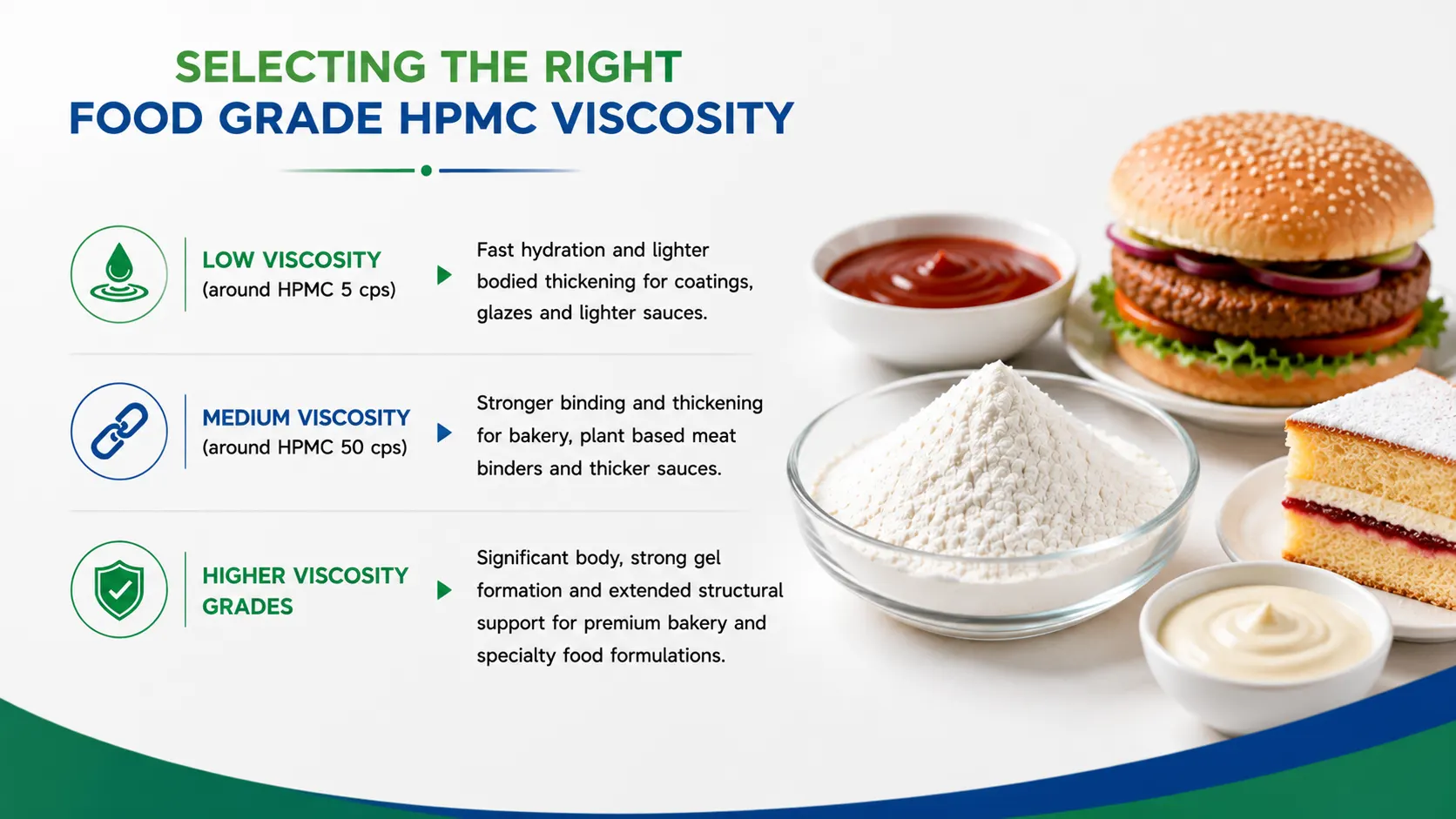
Selecting the Right Food Grade HPMC Viscosity
| Viscosity Tier | Hydroxypropyl Methylcellulose (Hypromellose) Application Focus |
|---|---|
| Low Viscosity (around HPMC 5 cps) | Applications requiring fast hydration and lighter bodied thickening, such as coatings, glazes and lighter sauces |
| Medium Viscosity (around HPMC 50 cps) | Applications requiring stronger binding and thickening performance, such as bakery formulations, plant based meat binders and thicker sauces |
| Higher Viscosity Grades | Applications requiring significant body, strong gel formation and extended structural support, such as premium bakery systems and specialty processed food formulations |
Selection should also account for the substitution type of the HPMC grade, since the ratio of methoxy to hydroxypropoxy substitution affects thermal gel initiation temperature and gel strength, both of which are important variables in bakery and plant based meat applications where the temperature at which gelation begins directly affects product structure during processing.
Food Safety and Regulatory Compliance of HPMC
| Regulatory Body or Standard | Status of HPMC |
|---|---|
| United States Food and Drug Administration | Classified as Generally Recognized As Safe and listed under 21 CFR 172.874 for food use |
| European Food Safety Authority and European Union Food Additive Regulation | Approved as food additive E464 |
| Joint FAO WHO Expert Committee on Food Additives (JECFA) | Evaluated and recognized within international food additive safety assessments |
| China National Standard GB 2760 | Approved for use in specified food categories under China's national food additive use standard |
| Indian Food Safety and Standards Authority (FSSAI) | Relevant for food grade compliance and certification within the Indian market |
| Pharmacopeial Monographs (USP NF, EP, BP, IP) | Applicable where HPMC is additionally used in pharmaceutical or nutraceutical grade applications |
HPMC is widely described in food science literature as non metabolized and non absorbed within the digestive system, passing through largely intact, which underpins its long standing classification as safe for food use across these regulatory frameworks. As with any food additive, manufacturers should confirm current permitted use levels and labeling requirements for their specific product category and target market before finalizing a formulation.
Food Grade HPMC Manufacturer in India: Why Choose Pharcos Speciality
Pharcos Speciality Ltd manufactures Hydroxypropyl Methylcellulose under its Pharcocel brand at its GMP certified facilities in Gujarat, India, supplying both pharmaceutical and food related HPMC grades to manufacturers, distributors and industrial buyers.
Bulk HPMC Supplier for Food Applications
Pharcos supplies HPMC across a defined viscosity range to bulk buyers, chemical distributors and industrial manufacturers, supporting food producers who need dependable, large scale raw material sourcing for continuous production schedules.
Premium HPMC for Bakery Manufacturers
With controlled viscosity consistency across production batches, Pharcocel HPMC supports the moisture retention, dough handling and shelf life extension benefits that commercial bakery manufacturers rely on for consistent finished product quality.
Custom HPMC Grades for Food Formulations
The Pharcos in house research and development function works on purity optimization and formulation specific requirements, giving food manufacturers a resource to consult when a standard viscosity grade needs adjustment for a specific application.
Export Quality HPMC for Global Food Brands
Pharcos maintains an established export network spanning North America, Europe, the Middle East, Southeast Asia and Africa, supplying international manufacturers and distributors seeking a reliable, well documented HPMC source manufactured in India.
Additional reasons food manufacturers choose Pharcos:
- Documented compliance: Pharcocel HPMC is manufactured to meet USP NF, EP, BP and IP monographs, and the broader Pharcocel range is described as compliant with food additive designation E464, Generally Recognized As Safe status under United States regulations, and Food Chemicals Codex purity requirements, alongside ISO 22000, HACCP, Kosher and Halal certifications.
- Consistent, well documented quality: every batch is produced under WHO GMP certified conditions with full Certificate of Analysis and Material Safety Data Sheet documentation.
- Technical formulation support: the Pharcos technical team is available to help food manufacturers select an appropriate viscosity grade and use level for a specific bakery, plant based meat, dairy or sauce application.
Food manufacturers evaluating a food grade HPMC manufacturer in India, or seeking a bulk HPMC supplier for a new or reformulated product line, can contact the Pharcos technical team to confirm current food grade documentation for a specific Pharcocel grade and discuss samples, specifications and export requirements for their target market.
 Call Us Now!
Conclusion
Hydroxypropyl Methylcellulose has earned a lasting place in modern food manufacturing because it does something few single ingredients can: it thickens, stabilizes, binds, retains moisture and forms a structural gel on heating, all from one plant derived, allergen free, nonionic polymer. Across bakery products, plant based meat alternatives, dairy and frozen desserts, and sauces and processed foods, this combination of properties translates into real formulation advantages, from softer, longer lasting bread to juicier plant based patties to creamier reduced fat ice cream. Regulatory recognition across major markets, including Generally Recognized As Safe status in the United States and E464 approval in the European Union, further supports HPMC's role as a dependable, well understood ingredient for food manufacturers navigating clean label, gluten free and plant based product development.
For food manufacturers sourcing HPMC at commercial scale, working with an established, well documented manufacturer matters as much as the ingredient chemistry itself. Pharcos Speciality Ltd, through its Pharcocel range, offers food and pharmaceutical grade HPMC manufactured in India with full regulatory documentation, technical formulation support and export capability to global markets. The Pharcos team is available to help identify the right HPMC grade for your next bakery, plant based, dairy or processed food formulation project.
Our Other Product
Cosmetic Raw Materials (Emulsifiers, Surfactants, Emollients)Frequently Asked Questions on HPMC for Food

Dr. Avinash Dubey (R&D Head)
Dr. Avinash Dubey is a PhD in Organic Chemistry with a distinguished career spanning more than four decades. As the head of R&D at Pharcos, he focuses on the development of novel molecules for a wide array of industrial sectors, blending long-standing experience with a passion for innovation.

Mr. Ankit Shah (Managing Director)
Mr. Ankit Shah has led Pharcos Speciality for over three decades, establishing it as a pioneer in specialty chemicals. He currently directs the company’s strategic expansion into the APIs, Excipient and Speciality Surfactants markets, upholding a steadfast commitment to "Make in India" and world-class manufacturing quality and new product development.