
Hydroxypropyl Methylcellulose (Hypromellose) Applications with Different Pharmaceutical HPMC Grades




AI Summary
Hydroxypropyl Methylcellulose, widely known as HPMC or Hypromellose, is a semi synthetic cellulose ether derived from natural plant cellulose and is one of the most widely used excipients in pharmaceutical formulation today. Because HPMC is produced across a wide range of viscosity grades, from around 3 centipoise up to 200000 centipoise, a single polymer family can perform very different functions depending on which grade is selected. Low viscosity grades are used for film coating, tablet pellet coating and taste masking. Medium viscosity grades act as tablet binders in wet granulation, dry granulation and direct compression. High viscosity grades function as hydrophilic matrix formers for controlled and sustained release tablets. HPMC also plays a role as a thickener in oral suspensions, topical gels, creams and syrups, as a viscosity enhancing agent in ophthalmic formulations such as artificial tears, and as a vegetarian alternative to gelatin in capsule shells. Selecting the correct viscosity grade and substitution type, commonly referred to by USP designations such as Type 2208 or Type 2910, is central to achieving the desired formulation performance. This guide explains each major HPMC application area, compares viscosity grades, references pharmacopeial standards including USP NF, EP, BP and IP, and outlines how Pharcos Speciality Ltd supports formulators through its Pharcocel range of more than 20 pharmaceutical grade HPMC products manufactured in India.
Introduction to HPMC and Hypromellose
What Is Hydroxypropyl Methylcellulose (Hypromellose)
Hydroxypropyl Methylcellulose, known by its pharmacopeial name Hypromellose and commonly abbreviated as HPMC, is a semi synthetic polymer manufactured by chemically modifying natural cellulose, most often sourced from wood pulp or cotton linter. During manufacture, methyl and hydroxypropyl groups are introduced along the cellulose backbone, replacing some of the hydroxyl groups. The ratio of these two substituent groups, along with the length of the polymer chain, determines the viscosity, solubility and gelling behavior of the finished HPMC grade.
Why HPMC Is One of the Most Versatile Pharmaceutical Excipients
Few excipients can move across as many formulation categories as HPMC. The same base chemistry, produced at different viscosity levels, is used in:
- Film coating systems for tablets and pellets
- Binders for wet granulation, dry granulation and direct compression
- Hydrophilic matrix formers for controlled and extended release tablets
- Thickeners and stabilizers for suspensions, gels, creams, ointments and emulsions
- Viscosity enhancing agents in ophthalmic solutions
- Capsule shell material as a vegetarian alternative to gelatin
This range of functionality comes from a single underlying property: HPMC dissolves in cold water to form a clear, viscous solution and forms a thermally reversible gel on heating, while remaining chemically inert and nonionic, meaning it does not carry an electrical charge and generally does not interact with ionic active pharmaceutical ingredients.
Importance of Selecting the Correct Hydroxypropyl Methylcellulose Viscosity Grade
Because HPMC grades span nearly five orders of magnitude in viscosity, choosing the wrong grade can significantly affect formulation outcomes. A film coating grade used at the wrong viscosity may coat unevenly or dissolve too quickly, while a controlled release grade selected with too low a viscosity may fail to sustain the intended drug release profile. Viscosity grade selection also interacts with the USP substitution type, since Type 2208 grades (higher hydroxypropoxy, lower methoxy content) form stronger gels suited to controlled release, while Type 2910 grades (lower hydroxypropoxy, higher methoxy content) are optimized for film formation and binding.
Overview of the Pharcocel Pharmaceutical Grade HPMC Portfolio
Pharcos Speciality Ltd manufactures Pharcocel, a portfolio of more than 20 pharmaceutical grade HPMC products spanning viscosities from 3 centipoise to 200000 centipoise, compliant with USP NF, EP, BP and IP monographs. The range covers E series and EW series grades for film coating and binding, and KC Premium, KW CR and BW series grades for controlled release and thickening applications, giving formulators a single source for nearly every HPMC based application discussed in this guide.
 Call Us Now!
Film Coating Applications of Low Viscosity HPMC Grades
Low viscosity HPMC, typically in the 3 to 6 centipoise range, is the standard choice for aqueous film coating of tablets and pellets.
Hydroxypropyl Methylcellulose Key film coating applications and benefits:
- Tablet coating: low viscosity HPMC forms a smooth, continuous film around the tablet core, protecting the active ingredient from moisture and oxygen while improving swallowability.
- Pellet coating: the same low viscosity grades are used to coat multiparticulate pellets in capsule based controlled release products, where uniform, thin film deposition is essential.
- Taste masking: a thin HPMC film can mask the bitter or unpleasant taste of certain active ingredients without significantly affecting the overall release profile.
- Moisture protection: HPMC films act as a barrier that reduces moisture ingress, supporting the stability and shelf life of moisture sensitive formulations.
- Improved tablet appearance: film coating gives tablets a smooth, glossy, uniform finish and allows color and branding to be applied consistently across a batch.
- Faster coating process: low viscosity grades dissolve quickly in water, allowing higher solids content coating suspensions that spray and dry faster during pan coating operations.
Suitable grades: low viscosity, Type 2910 grades such as Pharcocel E3, E5 and E6 (HPMC 3 cps, HPMC 5 cps, and HPMC 6 cps centipoise respectively) are recommended for aqueous film coating systems, since they dissolve readily in water and provide smooth, uniform film formation. For coating systems based on organic solvent blends such as ethanol or isopropanol, slightly higher viscosity grades such as E15 and E50 are generally more suitable due to their solubility profile in mixed solvent systems.
Hydroxypropyl Methylcellulose Tablet Binding Applications
HPMC is one of the most widely used binders in solid oral dosage manufacturing, valued for producing tablets with good hardness while keeping friability low.
HPMC across granulation and compression methods:
- Wet granulation: medium viscosity grades, typically in the 15 to 50 centipoise range, are dissolved in the granulating liquid to bind fine powder particles into uniform granules with good flow properties.
- Dry granulation: low to medium viscosity grades, generally 5 to 15 centipoise, are used as dry binders during roller compaction, where the HPMC is blended directly with the powder mixture before compaction.
- Direct compression: fine particle, low viscosity HPMC can be added directly to the powder blend, allowing tablets to be compressed without a separate granulation step.
- Improved hardness: HPMC binder systems generally support strong interparticle bonding, contributing to tablets that withstand handling, packaging and transport without capping or chipping.
- Reduced friability: properly selected HPMC binder grades reduce the tendency of tablets to shed fine particles or edges during coating and packaging operations, helping formulations meet pharmacopeial friability limits.
Suitable grades: Pharcocel E15 and E50 are the standard medium viscosity binder grades, with E15 to E50 preferred for wet granulation and E5 to E15 more common as dry binders in dry granulation.
Controlled Release Drug Delivery Applications of Hydroxypropyl Methylcellulose
High viscosity HPMC grades are central to hydrophilic matrix based controlled release technology, one of the most established approaches to extended release oral dosage forms.
How HPMC supports controlled release:
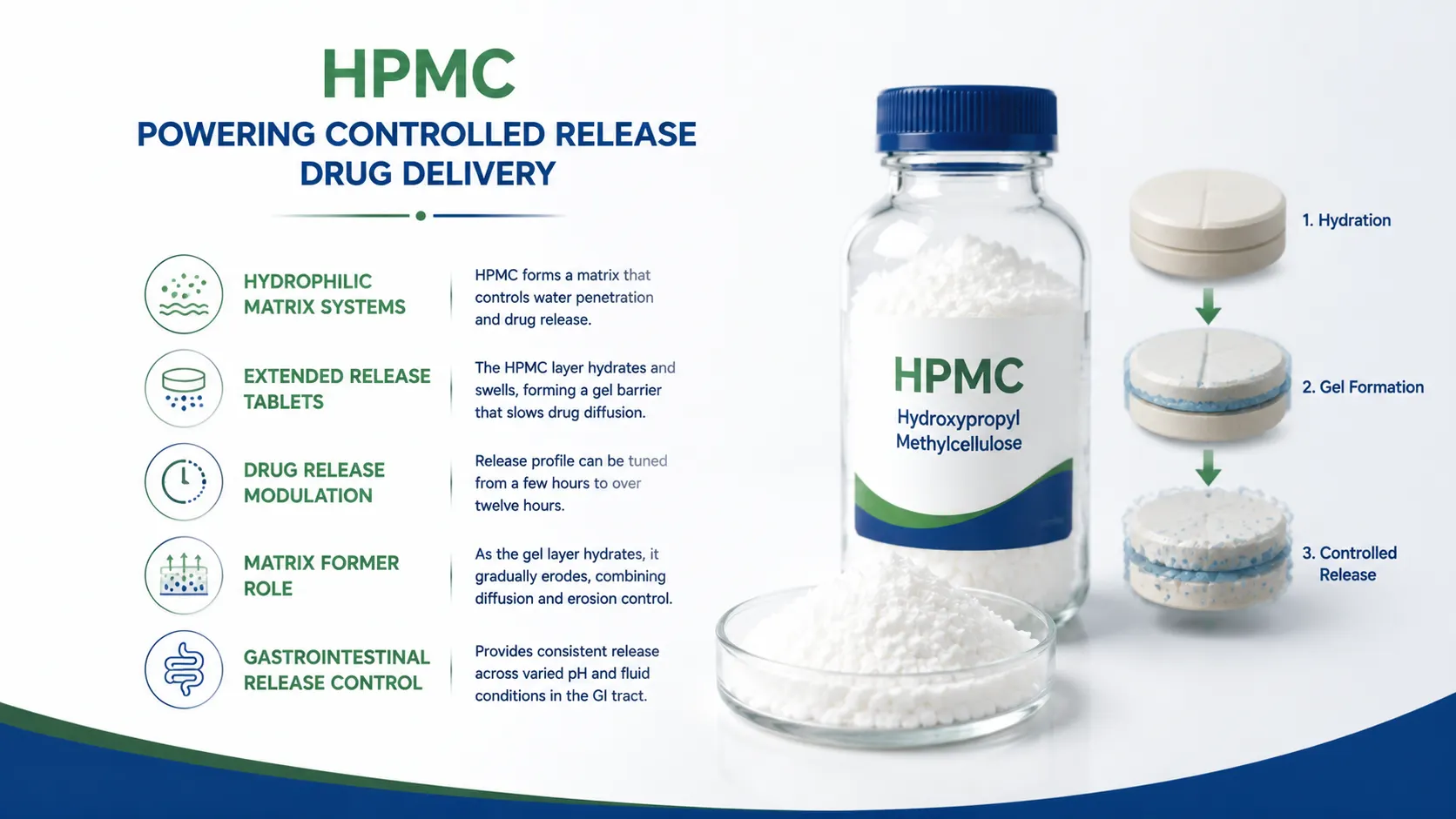
- Hydrophilic matrix systems: when a high viscosity HPMC grade is compressed together with the active ingredient into a tablet, it forms a matrix that controls how quickly water penetrates and the drug is released.
- Extended release tablets: as the tablet contacts gastrointestinal fluid, the outer layer of HPMC hydrates and swells, forming a gel layer that slows drug diffusion out of the tablet core.
- Drug release modulation: by adjusting the viscosity grade, the proportion of HPMC in the formulation and the substitution type, formulators can tune the release profile from a few hours to over twelve hours.
- Matrix former role: as the gel layer continues to hydrate, it gradually erodes from the outer surface, combining diffusion controlled and erosion controlled release mechanisms within a single tablet.
- Gastrointestinal release control: this dual mechanism allows HPMC based matrix tablets to provide relatively consistent release rates across the variable pH and fluid conditions found through the gastrointestinal tract.
Suitable grades: premium controlled release grades such as Pharcocel HPMC 4000, HPMC 15000, HPMC 100000 and HPMC 200000 Premium, along with the KW CR series (HPMC 100 CR, HPMC 4000 CR, HPMC 15000 CR, HPMC 100000 CR and HPMC 200000 CR), are Type 2208 grades specifically developed for controlled release matrix systems, offering the higher gel strength required to sustain drug release over extended periods.
Our Other Product
Pharmaceutical Grade Polyethylene Glycol (PEG)Hydroxypropyl Methylcellulose Thickening and Suspension Applications
Beyond solid dosage forms, HPMC is a widely used viscosity enhancing agent across liquid and semisolid pharmaceutical products.
Common thickening and suspension applications of HPMC
- Oral suspensions: HPMC helps keep insoluble drug particles evenly dispersed, slowing sedimentation and supporting uniform dosing from the first to the last spoonful.
- Topical gels: HPMC forms clear, smooth gels used as carriers for topical active ingredients, with viscosity tuned to the desired spreadability.
- Creams and ointments: medium to high viscosity HPMC contributes body and stability to semisolid formulations, helping maintain a consistent texture through the product shelf life.
- Syrups: HPMC can adjust mouthfeel and pourability in oral liquid formulations without contributing sweetness or taste of its own.
- Emulsions: HPMC acts as a stabilizing thickener in oil in water emulsions, helping resist phase separation during storage.
- Viscosity enhancement: across all these formats, HPMC allows formulators to precisely target a specific viscosity range simply by selecting the appropriate grade and concentration.
Suitable grades: Pharcocel E50 and the KC Premium series are commonly used for thickening and stabilizing applications, since their higher viscosity in solution provides body without requiring high use levels.
HPMC Applications in Ophthalmic Formulations
Low viscosity HPMC grades play an important role in eye care formulations, where gentle, non irritating viscosity enhancement is required.
Key benefits in ophthalmic use:
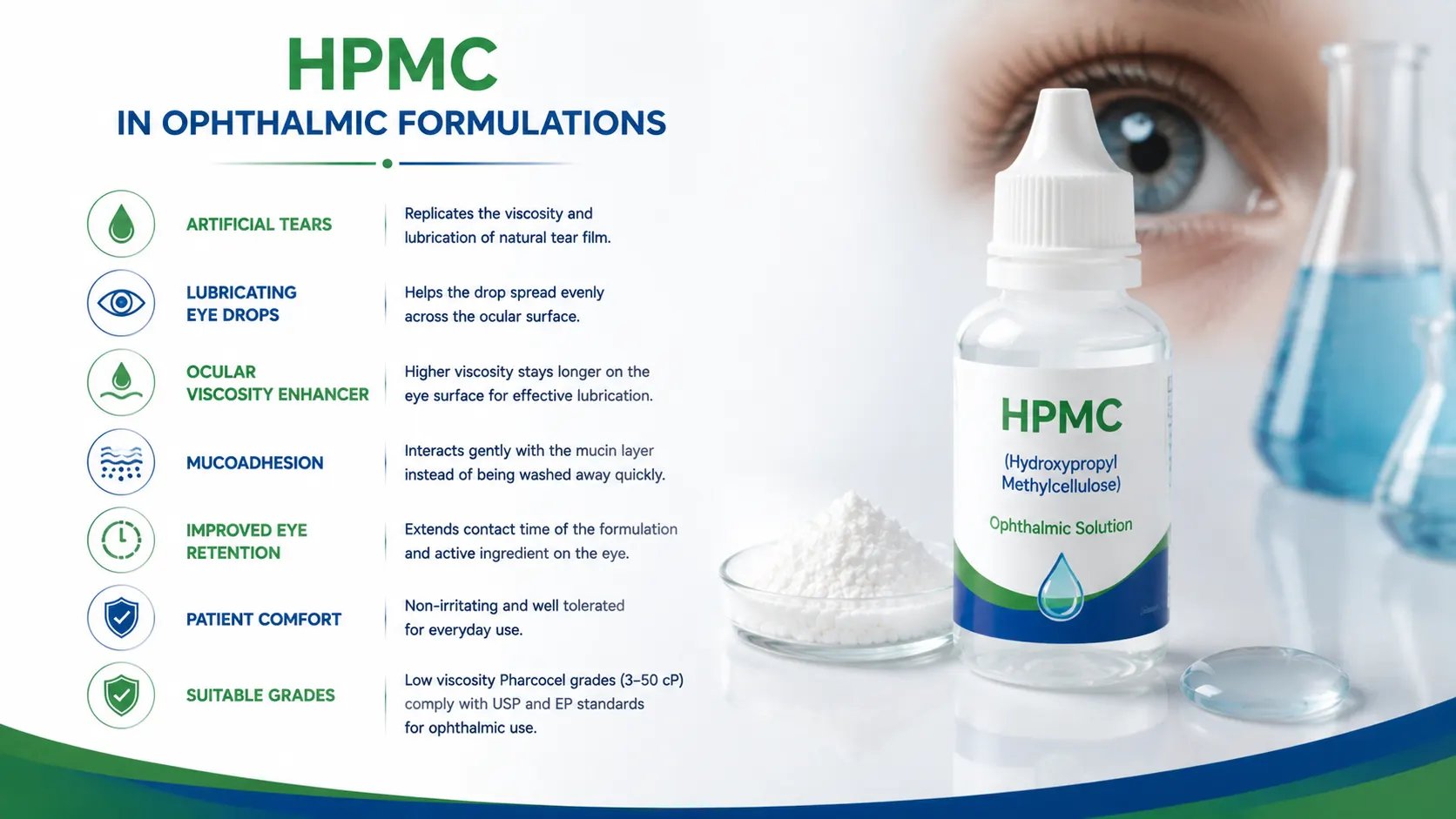
- Artificial tears: HPMC is used to replicate the viscosity and lubricating qualities of natural tear film in dry eye relief products.
- Lubricating eye drops: by increasing the viscosity of the formulation, HPMC helps the drop spread evenly across the ocular surface on application.
- Ocular viscosity enhancer: a higher viscosity formulation stays on the eye surface longer than a purely aqueous solution, supporting more effective lubrication.
- Mucoadhesion: HPMC has mild mucoadhesive properties, allowing it to interact gently with the mucin layer of the eye rather than being rapidly washed away.
- Improved eye retention: this combination of viscosity and mucoadhesion extends the contact time of the formulation, and by extension any therapeutic active ingredient included in the drop, on the eye surface.
- Patient comfort: HPMC based ophthalmic solutions are generally regarded as non irritating and well tolerated for regular, everyday use.
Suitable grades: low viscosity Pharcocel grades in the 3 to 50 centipoise range are used as the viscosity enhancing and lubricating agent in artificial tear and lubricating eye drop formulations, complying with USP and EP standards for ophthalmic use.
HPMC Applications in Capsule Manufacturing
HPMC has become the leading plant based alternative to gelatin for hard capsule shells, a shift driven by both formulation performance and consumer preference.
Why HPMC works well for capsule shells:
- Vegetarian capsules: HPMC is derived entirely from plant cellulose, making it suitable for vegetarian, vegan, Halal and Kosher certified capsule products.
- Moisture stability: HPMC capsules generally maintain their physical integrity across a wider humidity range than gelatin capsules, which can become brittle in very dry conditions.
- Film integrity: the film forming properties that make HPMC useful for tablet coating also give HPMC capsule shells consistent wall thickness and mechanical strength.
- Alternative to gelatin: unlike gelatin, which is derived from animal collagen, HPMC contains no animal derived material, addressing both dietary and religious restrictions.
- Plant based formulations: this makes HPMC capsules a natural fit for nutraceutical, Ayurvedic and herbal products marketed to health conscious consumers.
Suitable grades: the E series grades, which are 100 percent plant based and non GMO, are the typical starting point for HPMC capsule shell formulations.
Hydroxypropyl Methylcellulose in Modified and Sustained Drug Release
Building on the controlled release discussion above, this section looks specifically at the mechanism by which HPMC matrix tablets achieve sustained release performance.
The release mechanism, step by step:
- Matrix tablets: the active ingredient is uniformly distributed within a compressed tablet containing a high viscosity HPMC matrix former.
- Controlled hydration: on contact with gastrointestinal fluid, water gradually penetrates the outer surface of the tablet.
- Swelling mechanism: as HPMC absorbs water, it swells substantially, increasing the tablet diameter and creating a viscous gel layer at the surface.
- Gel layer formation: this gel layer acts as a diffusion barrier, slowing the rate at which dissolved drug molecules can migrate out of the tablet core.
- Release kinetics: drug release proceeds through a combination of diffusion through the gel layer and gradual erosion of the outer gel as it becomes fully hydrated, producing release profiles that can be tuned from several hours to more than half a day.
- Patient compliance: because a single sustained release tablet can replace multiple doses of an immediate release product, HPMC matrix systems support simpler, less frequent dosing schedules that are generally associated with better patient adherence.
How to Select the Right HPMC Grade for Your Formulation
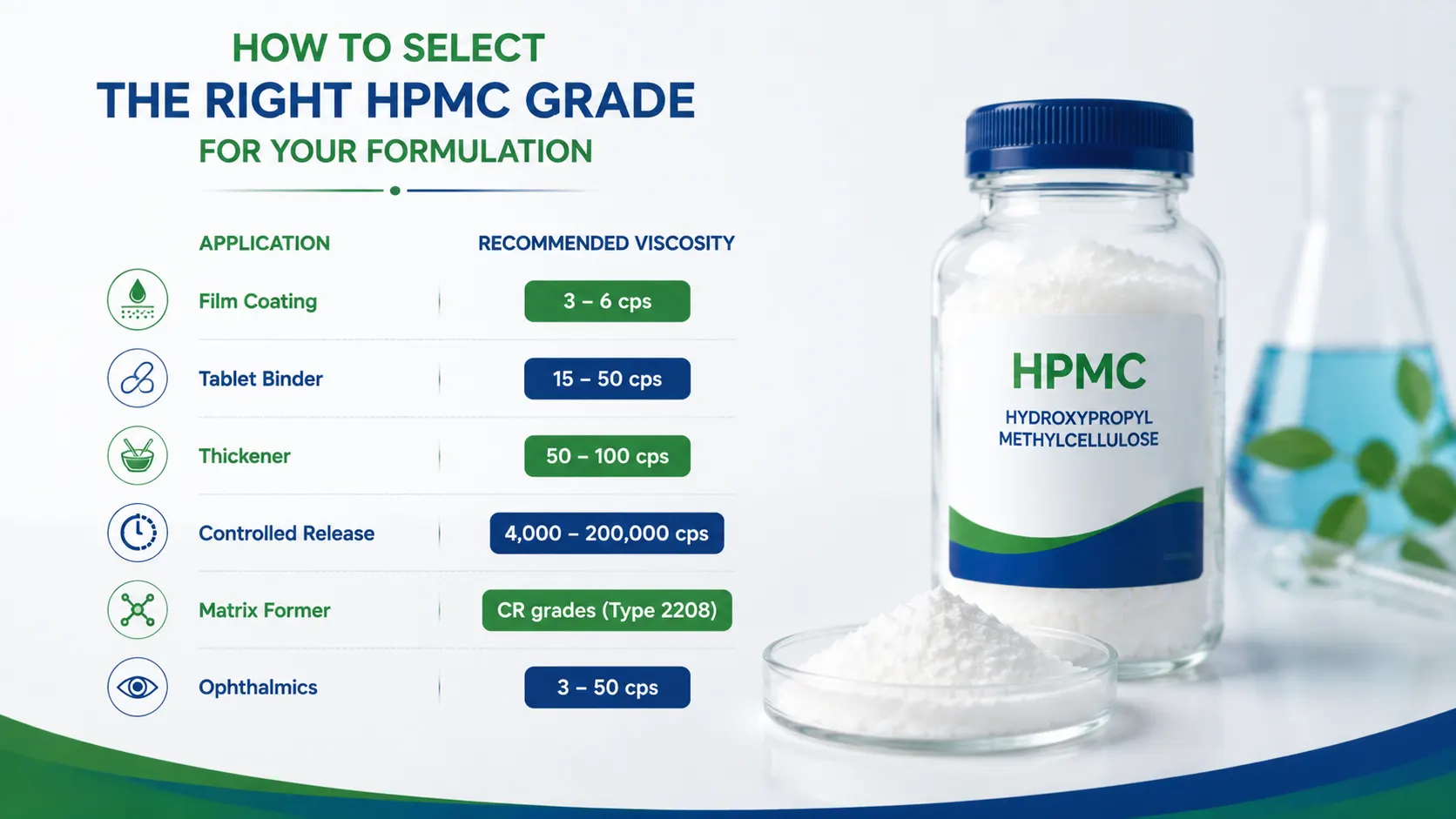
Selecting an HPMC grade comes down to two decisions: the target viscosity range and the appropriate USP substitution type for the intended function.
| Application | Recommended Hydroxypropyl Methylcellulose Viscosity |
|---|---|
| Film Coating | 3 to 6 cps |
| Tablet Binder | 15 to 50 cps |
| Thickener | 50 to 100 cps |
| Controlled Release | 4000 to 200000 cps |
| Matrix Former | CR grades (Type 2208) |
| Ophthalmics | 3 to 50 cps |
These recommendations align with the Pharcocel portfolio guidance for film coating, binding, thickening, controlled release and ophthalmic formulations. As a general rule, lower viscosity grades are chosen when fast dissolution or thin film formation is the priority, while higher viscosity grades are chosen when the goal is gel strength, matrix formation or sustained thickening. Alongside viscosity, formulators should also confirm the substitution type required for their application, since Type 2208 and Type 2910 grades are not directly interchangeable despite having overlapping viscosity ranges.
Complete Pharcocel HPMC Grade Reference Table
| Product | USP Substitution Type | Primary Applications | Compliance |
|---|---|---|---|
| Pharcocel E3 (3 cps) | 2910 | Film Coating, Binder | USP NF, EP, BP, IP |
| Pharcocel E5 (5 cps) | 2910 | Film Coating, Binder | USP NF, EP, BP, IP |
| Pharcocel E6 (6 cps) | 2910 | Film Coating, Binder | USP NF, EP, BP, IP |
| Pharcocel E15 (15 cps) | 2910 | Binder, Film Coating | USP NF, EP, BP, IP |
| Pharcocel E50 (50 cps) | 2910 | Binder, Thickener | USP NF, EP, BP, IP |
| Pharcocel EW3 (3 cps) | 2910 | Film Coating, Binder | USP NF, EP, BP, IP |
| Pharcocel EW5 (5 cps) | 2910 | Film Coating, Binder | USP NF, EP, BP, IP |
| Pharcocel EW6 (6 cps) | 2910 | Film Coating, Binder | USP NF, EP, BP, IP |
| Pharcocel EW15 (15 cps) | 2910 | Binder, Viscosity Modifier | USP NF, EP, BP, IP |
| Pharcocel EW50 (50 cps) | 2910 | Binder, Thickener | USP NF, EP, BP, IP |
| Pharcocel KC 4000 Premium | 2208 | Controlled Release, Matrix Former | USP NF, EP, BP, IP |
| Pharcocel KC 15000 Premium | 2208 | Controlled Release, Thickener | USP NF, EP, BP, IP |
| Pharcocel KC 100000 Premium | 2208 | Controlled Release, Thickener | USP NF, EP, BP, IP |
| Pharcocel KC 200000 Premium | 2208 | Controlled Release, Thickener | USP NF, EP, BP, IP |
| Pharcocel KW 100 CR | 2208 | Controlled Release, Matrix Former | USP NF, EP, BP, IP |
| Pharcocel KW 4000 CR | 2208 | Controlled Release, Matrix Former | USP NF, EP, BP, IP |
| Pharcocel KW 15000 CR | 2208 | Controlled Release, Matrix Former | USP NF, EP, BP, IP |
| Pharcocel KW 100000 CR | 2208 | Controlled Release, Matrix Former | USP NF, EP, BP, IP |
| Pharcocel KW 200000 CR | 2208 | Controlled Release, Matrix Former | USP NF, EP, BP, IP |
| Pharcocel BW 4000 | 2208 | Controlled Release, Thickener | USP NF, EP, BP, IP |
Pharmacopeial Standards, Food Compliance and Regulatory Status
| Standard or Status | Relevance to HPMC |
|---|---|
| USP NF | United States Pharmacopeia and National Formulary monograph for Hypromellose, covering identification, viscosity, substitution type and purity |
| EP (Ph. Eur.) | European Pharmacopoeia monograph for Hypromellose, aligned closely with BP requirements |
| BP | British Pharmacopoeia monograph, administered by the Medicines and Healthcare products Regulatory Agency, United Kingdom |
| IP | Indian Pharmacopoeia monograph, published by the Indian Pharmacopoeia Commission under the Ministry of Health and Family Welfare, Government of India |
| USP Type 2208 vs Type 2910 | Type 2208 (higher hydroxypropoxy, lower methoxy) forms stronger gels and is used for controlled release matrices; Type 2910 (lower hydroxypropoxy, higher methoxy) is optimized for film formation and binding |
| EU Food Additive E464 | HPMC is approved for food use in the European Union under the E464 designation |
| US FDA GRAS Status | HPMC is Generally Recognized As Safe by the US FDA for approved food uses |
| Food Chemicals Codex (FCC) | HPMC intended for food applications is expected to comply with FCC purity standards |
Because HPMC spans both pharmaceutical and food uses, buyers should confirm which specific monograph and certification set, such as ISO 22000, HACCP, Kosher or Halal certification, is required for their target application before finalizing a grade.
Documentation, Quality Control and Stability Data
For regulated pharmaceutical use, the documentation package behind an HPMC grade is as important as its physical specification. A qualified pharmaceutical grade HPMC manufacturer should be able to provide:
- Drug Master File (DMF) support for regulatory submissions in markets such as the United States.
- Certificate of Suitability (CEP) where applicable for European regulatory filings.
- Certificate of Analysis (CoA) confirming batch specific results against the applicable pharmacopeial monograph.
- Method validation data, including specificity, linearity, accuracy, precision, detection limits and quantitation limits for critical quality attributes, generated as per USP and ICH guidelines.
- Stability studies conducted following International Council for Harmonisation (ICH) stability guidelines, supporting shelf life claims in regulatory dossiers.
- Source traceability, since HPMC can be derived from either wood pulp or cotton linter cellulose, with cotton linter generally offering inherently higher starting purity and wood pulp offering strong batch to batch consistency at large manufacturing scale, both capable of meeting pharmaceutical standards.
Safety, Storage and Handling of HPMC
HPMC has a long history of safe use across pharmaceutical, food and personal care applications, supported by its nonionic, chemically inert nature.
Key safety and handling points:
- HPMC is nonionic and generally does not interact with ionic active pharmaceutical ingredients, including cationic, anionic and protein based actives, and is also compatible with common excipients such as polyethylene glycol, povidone, talc, magnesium stearate and lactose.
- Storage: HPMC should be stored in a cool, dry place away from moisture and direct sunlight, at temperatures generally below 30 degree C, with containers resealed tightly after opening to prevent moisture absorption, since HPMC is hygroscopic and moisture uptake can affect viscosity and performance.
- Shelf life: pharmaceutical grade HPMC typically carries a shelf life of approximately 3 to 5 years when stored under recommended conditions, though the specific certificate of analysis and retest date should always be confirmed with the supplier.
- HPMC intended for food applications should additionally meet Food Chemicals Codex requirements and relevant regional food safety certifications.
- A current Material Safety Data Sheet should be consulted for detailed handling and safety guidance specific to the grade and supplier.
Our Other Product
Cosmetic Raw Materials (Emulsifiers, Surfactants, Emollients)Why Choose Pharcos Speciality Ltd for HPMC Sourcing
Pharcos Speciality Ltd, based in Gujarat, India, was the first company in India to bring a fully documented, pharmaceutical grade HPMC to market under its Pharcocel brand, and continues to serve as an HPMC manufacturer, Hypromellose supplier and pharmaceutical grade HPMC exporter to companies across global markets.
What sets Pharcocel apart:
- Broad, purpose built portfolio: more than 20 grades spanning film coating, binding, thickening, controlled release, matrix forming and capsule shell applications, covering both Type 2208 and Type 2910 substitution types.
- Full pharmacopeial compliance: every Pharcocel grade is manufactured and tested to meet USP NF, EP, BP and IP standards.
- WHO GMP certified facility: state of the art manufacturing supported by ISO certified quality management and rigorous testing protocols.
- Complete documentation package: DMF, CEP, CoA and method validation data available to support regulatory filings in multiple markets.
- ICH aligned stability data: comprehensive stability testing and reporting to support shelf life claims in formulation dossiers.
- Technical formulation support: an expert team available to help select the correct grade, viscosity and substitution type for a specific formulation challenge, including compatibility guidance for ionic and pH sensitive APIs.
- Source flexibility: grades available from both wood pulp and cotton linter cellulose sources, allowing buyers to choose based on purity requirements and production scale.
- Vegetarian and food grade options: plant based, non GMO E series grades suitable for vegetarian capsule shells, alongside food grade HPMC compliant with E464, FDA GRAS status and Food Chemicals Codex requirements for gluten free baking, sauces, emulsions and edible coatings.
For buyers researching a pharmaceutical grade HPMC manufacturer, Hypromellose supplier or HPMC exporter in India, the Pharcos technical team can provide samples, specification sheets and compatibility data to support formulation trials and regulatory submissions.
 WhatsApp Now
Conclusion
Hydroxypropyl Methylcellulose stands out among pharmaceutical excipients for the sheer breadth of what a single polymer family can achieve, purely by adjusting viscosity grade and substitution type. From fast dissolving low viscosity film coats to high viscosity controlled release matrices, and from ophthalmic lubricants to vegetarian capsule shells, HPMC touches nearly every major dosage form used in modern pharmaceutical manufacturing. Getting the most out of this versatility depends on selecting the right grade for the right application, guided by pharmacopeial standards such as USP NF, EP, BP and IP and by an understanding of how Type 2208 and Type 2910 substitution types perform differently.
For pharmaceutical companies and formulators, working with an established, fully documented HPMC manufacturer removes much of the guesswork from this selection process. Pharcos Speciality Ltd, through its Pharcocel range, offers one of the most complete pharmaceutical grade HPMC portfolios manufactured in India, backed by full regulatory documentation and technical formulation support. The Pharcos team is available to help identify the right Pharcocel grade for your next film coating, tablet binding, controlled release, thickening, ophthalmic or capsule shell formulation.
Frequently Asked Questions

Dr. Avinash Dubey (R&D Head)
Dr. Avinash Dubey is a PhD in Organic Chemistry with a distinguished career spanning more than four decades. As the head of R&D at Pharcos, he focuses on the development of novel molecules for a wide array of industrial sectors, blending long-standing experience with a passion for innovation.

Mr. Ankit Shah (Managing Director)
Mr. Ankit Shah has led Pharcos Speciality for over three decades, establishing it as a pioneer in specialty chemicals. He currently directs the company’s strategic expansion into the APIs, Excipient and Speciality Surfactants markets, upholding a steadfast commitment to "Make in India" and world-class manufacturing quality and new product development.