
PEG 3350 Beyond Laxatives: Its Role in Solid Pharmaceutical Dosage Forms



AI Summary: PEG 3350 in Pharmaceutical Formulations
PEG 3350 is widely associated with osmotic laxatives, but it also performs important functions in tablets, capsules, granules and solid dispersions. Depending on how it is incorporated, this hydrophilic material may act as a binder, water-soluble lubricant, processing aid or matrix-forming excipient. Its influence on granulation, compression, tablet strength and drug release depend on the API, other excipients and manufacturing process.
PEG 3350 Beyond Laxatives in Solid Dosage Forms
Polyethylene glycol 3350 is commonly recognized for its use in laxative powders and solutions. However, this application represents only one part of its pharmaceutical relevance.
A PEG 3350 pharmaceutical excipient may also be evaluated in:
- Compressed tablets
- Hard-capsule fills
- Wet- or melt-granulated products
- Solid dispersions
- Hydrophilic matrices
- Melt-processed systems
Across PEG 3350 solid dosage forms, the material’s function depends on its concentration, method of incorporation, API characteristics, formulation composition and required performance.
When using PEG 3350 in tablets, formulators must distinguish among binding, lubrication, processing and matrix-forming functions. These terms describe separate formulation contributions and should not be used interchangeably.
 WhatsApp Now
PEG 3350 as a Pharmaceutical Excipient
PEG 3350, also known as polyethylene glycol 3350 or Macrogol 3350, is a nominal molecular-weight grade. It contains a distribution of polyethylene glycol chains rather than molecules that all have an exact molecular weight of 3350.
Relevant properties include its solid form, hydrophilic character, water solubility and ability to soften or melt under suitable processing conditions. These characteristics support its evaluation as a binder, lubricant, carrier or matrix component.
Grade identity should be confirmed against the applicable pharmacopeial monograph and supplier specification. A general CAS number does not establish the specific PEG grade, purity or pharmaceutical suitability.
PEG 3350 as a Binder in Tablet Granulation
PEG 3350 may be evaluated as a binder when a formulation requires greater cohesion between powder particles. It can be dissolved or dispersed in a granulating liquid, added to a dry blend before suitable processing or softened during melt granulation.
Potential effects include:
- Formation of cohesive granules
- Greater interparticle bonding
- Changes in granule strength and flow
- Improved compact formation
- Increased tablet hardness
- Reduced friability
Binding must remain balanced. Excessive bonding can produce dense tablets, reduce porosity or delay disintegration. API dose, filler properties, disintegrant selection and granulation conditions should therefore guide the amount and incorporation method.
PEG 3350 in Wet Granulation vs Melt Granulation
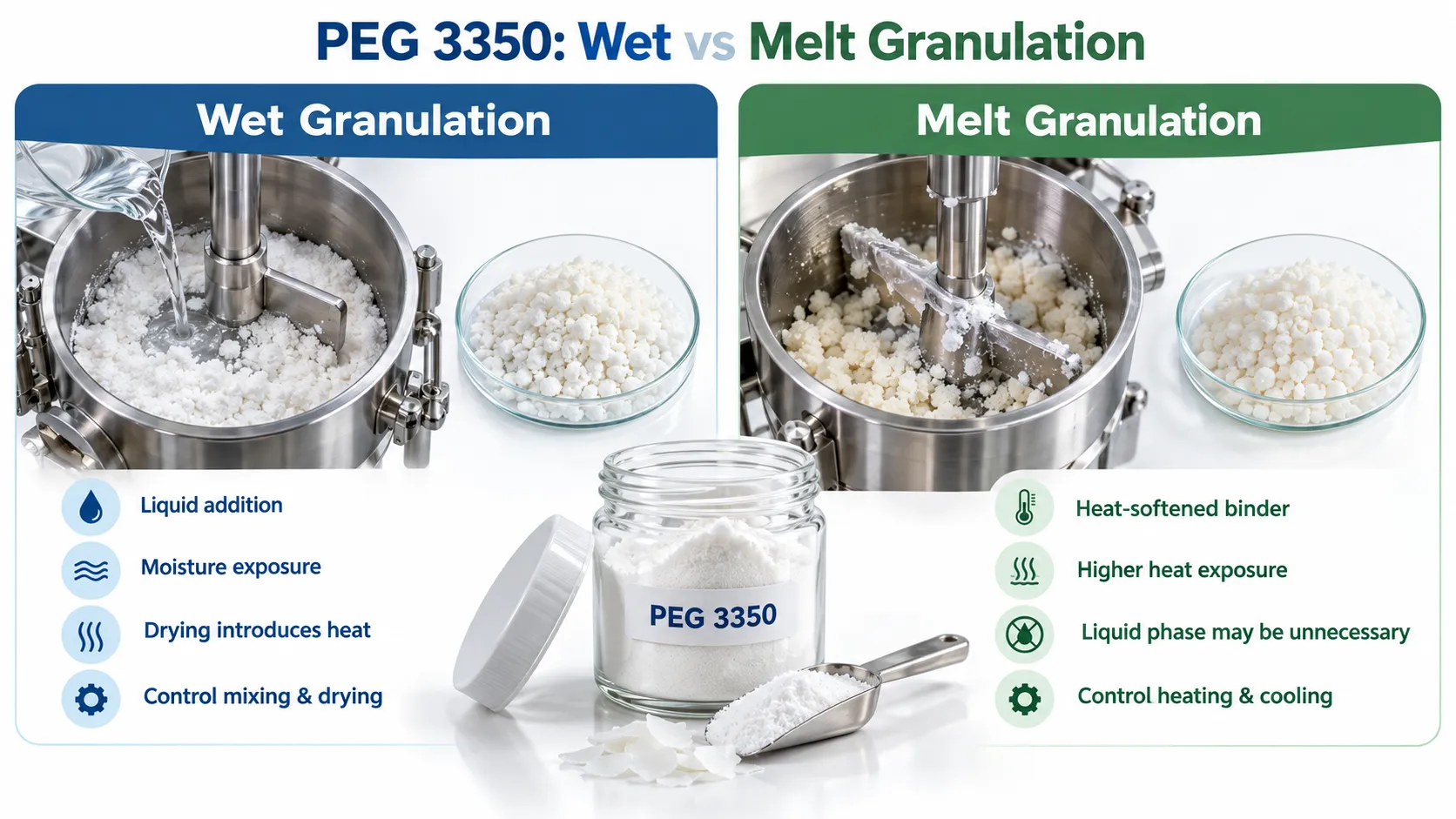
PEG 3350 can be investigated in wet and melt granulation, but the two approaches create different formulation and manufacturing considerations.
| Evaluation Factor | Wet Granulation | Melt Granulation |
|---|---|---|
| Method of incorporation | PEG may be dissolved or dispersed in a granulating liquid | PEG may soften or melt and bind particles |
| Thermal exposure | Usually lower, although drying introduces heat | Greater heat exposure may occur |
| Moisture exposure | Water or another solvent contacts the blend | A liquid granulating phase may not be required |
| Granule formation | Controlled by liquid distribution, mixing and drying | Controlled by molten-binder distribution and cooling |
| Scale-up concern | Addition rate, mixing and drying uniformity | Heating, melt viscosity and solidification |
Wet granulation may support uniform binder distribution through an appropriate granulating liquid. Melt granulation can reduce the need for solvents, but temperature distribution, molten-binder movement and cooling become critical.
The choice should reflect API sensitivity, desired granule characteristics, available equipment and scale-up requirements.
Our Other Product
PEG 1500 (Polyethylene Glycol 1500 | Macrogol 1500)PEG 3350 as a Water-Soluble Tablet Lubricant
PEG 3350 may function as a water-soluble lubricant in selected tablet formulations. In this role, it can help reduce friction between the compact and die wall during compression and ejection.
Its effects should be evaluated through:
- Ejection force
- Compression behaviour
- Punch sticking
- Tablet surface quality
- Hardness and tensile strength
- Friability
- Wetting, disintegration and dissolution
PEG 3350 may not provide the same lubrication efficiency as a conventional hydrophobic lubricant at an equivalent concentration. Differences in particle coating, water interaction and compact structure can affect manufacturing and release performance.
| Consideration | PEG 3350 as a Lubricant | Conventional Hydrophobic Lubricant |
|---|---|---|
| Water interaction | Water-soluble and dissolves with the matrix | Generally insoluble or poorly soluble in water |
| Effect on wetting | May support tablet wetting | May reduce wetting when overmixed |
| Typical required level | May be higher and remains formulation-dependent | Generally used at relatively low levels |
| Mixing sensitivity | Must be evaluated for the selected process | Overmixing may coat particles and affect performance |
| Main development question | Does it reduce friction without weakening tablets? | Does it control ejection without delaying drug release? |
Lubricant selection should consider both production efficiency and finished-tablet quality.
PEG 3350 as a Solid-Dosage Processing Aid
As a processing aid, PEG 3350 may support component distribution during granulation, influence granule flow, modify deformation during compression or affect tablet ejection.
In melt-based processing, it may serve as a melt-processable carrier and influence particle agglomeration, cooling and solidification. Particle size, charging sequence, mixing time and thermal history can change these effects.
During scale-up, manufacturers should monitor whether larger equipment alters material distribution, granule structure or cooling behaviour.
PEG 3350 as a Carrier in Solid Dispersions
PEG 3350 may be studied as a hydrophilic carrier for poorly water-soluble APIs. It can help improve API wetting or distribute the drug within a water-soluble carrier phase.
Development should examine:
- API–carrier miscibility
- Drug loading
- API wetting and distribution
- Residual crystallinity
- Melt- or solvent-based processing
- Thermal and chemical stability
- Phase separation
- Recrystallization during storage
- Dissolution behaviour
The presence of PEG does not prove that an amorphous solid dispersion has formed. Solid-state analysis may be required to determine whether the API remains crystalline, becomes partly amorphous or undergoes another physical change.
Wetting, equilibrium solubility, dissolution rate and bioavailability are different properties. Improved dispersion may affect an in-vitro dissolution result without guaranteeing greater API solubility or in-vivo exposure. Solid-dispersion development must therefore consider processing, carrier compatibility and physical stability.
PEG 3350 and Tablet Compression Strength
PEG 3350 may influence how particles rearrange, deform and bond during compression. Its effects can be observed in tablet hardness, tensile strength, friability, porosity, elastic recovery and ejection behaviour.
Greater bonding may improve mechanical strength but can reduce pore volume. In another formulation, a higher PEG level may soften the compact or alter its deformation characteristics.
Compression studies should examine the relationship among compaction pressure, ejection force, tablet strength and defects such as capping or lamination.
PEG 3350 and Tablet Disintegration and Dissolution
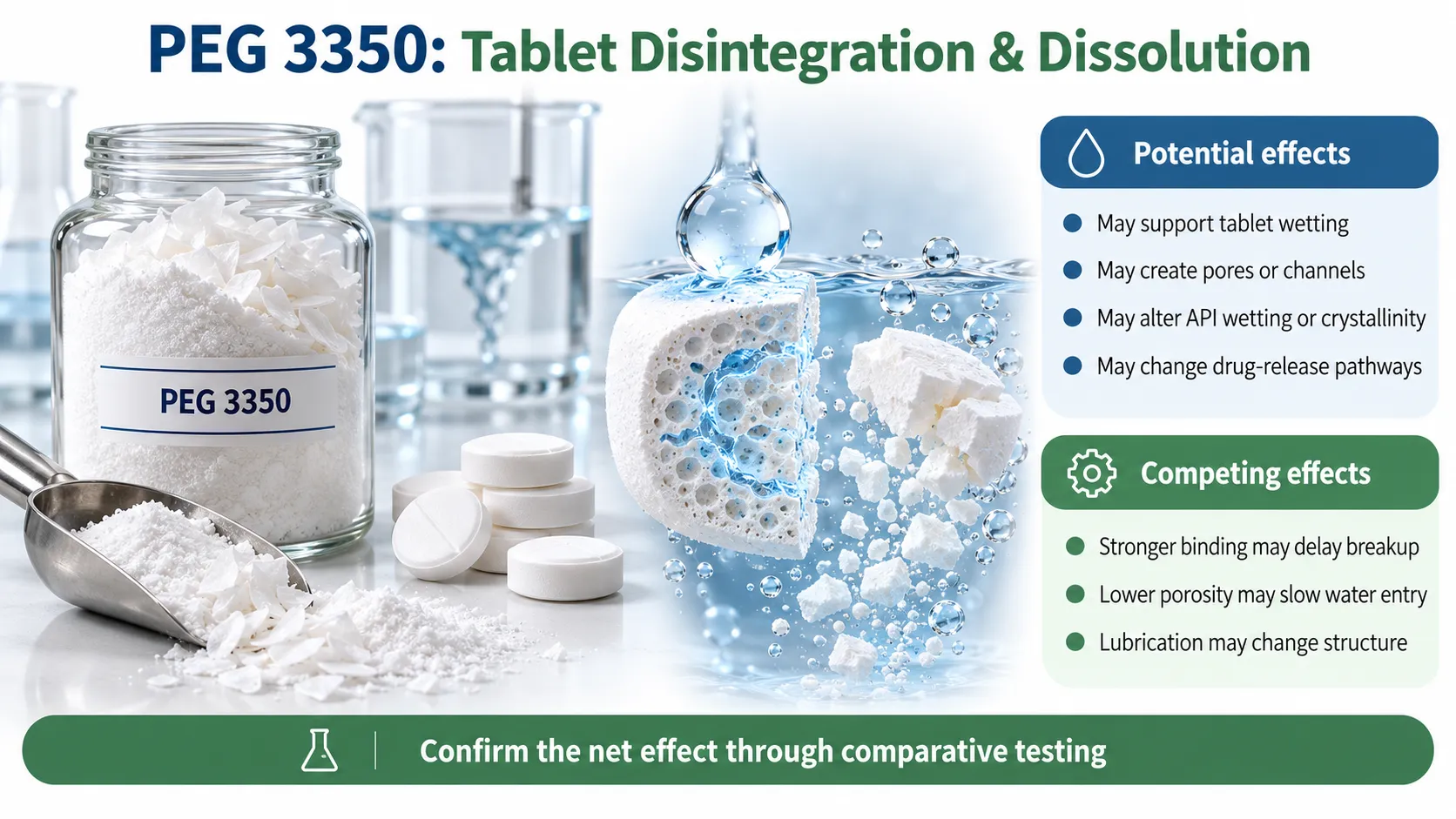
The hydrophilic character of PEG 3350 may support water contact and tablet wetting. As the excipient dissolves, it may also create pores or channels within the compact.
Competing effects can occur:
- Stronger binding may delay tablet breakup.
- Lower porosity may slow water penetration.
- Lubrication may change compact structure.
- A solid dispersion may alter API wetting or crystallinity.
- Dissolution of PEG may change the drug-release pathway.
The net effect must be determined through comparative disintegration and dissolution testing under conditions appropriate to the dosage form.
PEG 3350 as a Matrix-Forming Excipient
PEG 3350 may be incorporated as a matrix component to influence hydration, pore formation, erosion or drug release. Because it is water-soluble, it can dissolve from the tablet and create aqueous pathways through the remaining structure.
PEG 3350 should not automatically be described as a stand-alone controlled-release polymer. Its contribution depends on the API, concentration, co-excipients, tablet structure and dissolution medium.
When combined with other matrix materials, it may modify water penetration or the structure of the matrix during dissolution. Comparative release testing is needed to establish whether this behaviour supports the intended dosage-form design.
Our Other Product
PEG 6000 (Polyethylene Glycol 6000 | Macrogol 6000)PEG 3350 API Compatibility and Stability Considerations
Compatibility assessment should cover the API, fillers, binders, disintegrants, lubricants, surfactants, antioxidants, coatings, matrix polymers and packaging materials.
Relevant considerations include:
- Moisture uptake or migration
- Temperature-related physical changes
- API–polymer interactions
- Phase separation
- API recrystallization
- Changes in tablet structure during storage
- Oxidative impurities and API sensitivity
Research shows that reactive impurities in pharmaceutical excipients can contribute to drug-product instability. Under certain conditions, PEG oxidation may generate peroxide- or carbonyl-related impurities. Current supplier controls, storage conditions and the API’s degradation pathways should therefore inform compatibility studies.
PEG 3350 Selection for Solid Dosage Forms
| Intended Role | Potential Contribution | Main Risk to Evaluate | Relevant Testing |
|---|---|---|---|
| Binder | Granule and tablet cohesion | Excessive hardness or delayed disintegration | Granule strength, hardness, friability and disintegration |
| Water-soluble lubricant | Reduced friction during compression | Inadequate lubrication or altered strength | Ejection-force and compression studies |
| Processing aid | Improved handling or distribution | Process sensitivity | Flow, mixing and scale-up studies |
| Solid-dispersion carrier | Improved wetting or API distribution | Phase separation or recrystallization | Solid-state analysis, dissolution and stability |
| Matrix-forming excipient | Modified hydration or pore formation | Unintended change in drug release | Comparative dissolution and stability studies |
Supplier qualification should confirm:
- Exact PEG grade and applicable monographs
- Molecular-weight or hydroxyl-value requirements
- Physical form, water content and relevant impurities
- Certificate of Analysis and technical documents
- Storage, retest period and change-control information
 Call Us Now!
About Pharcos Speciality Ltd and Its PEG Portfolio
Pharcos Speciality Ltd manufactures pharmaceutical ingredients and speciality chemicals. Its pharmaceutical portfolio includes the Pharcogol polyethylene glycol range, of which PEG 3350 (Polyethylene Glycol 3350 | Macrogol 3350) – Pharcogol 3350 is a part. Customers can contact Pharcos to request technical documentation, current specifications and product samples for evaluation.
PEG 3350 can perform several functions beyond laxative formulations. It may be evaluated as a binder, water-soluble lubricant, processing aid, solid-dispersion carrier or matrix-forming excipient.
Selection should consider its effect on granulation, compression, ejection, tablet strength, disintegration, dissolution, compatibility and stability.
Frequently Asked Questions About PEG 3350
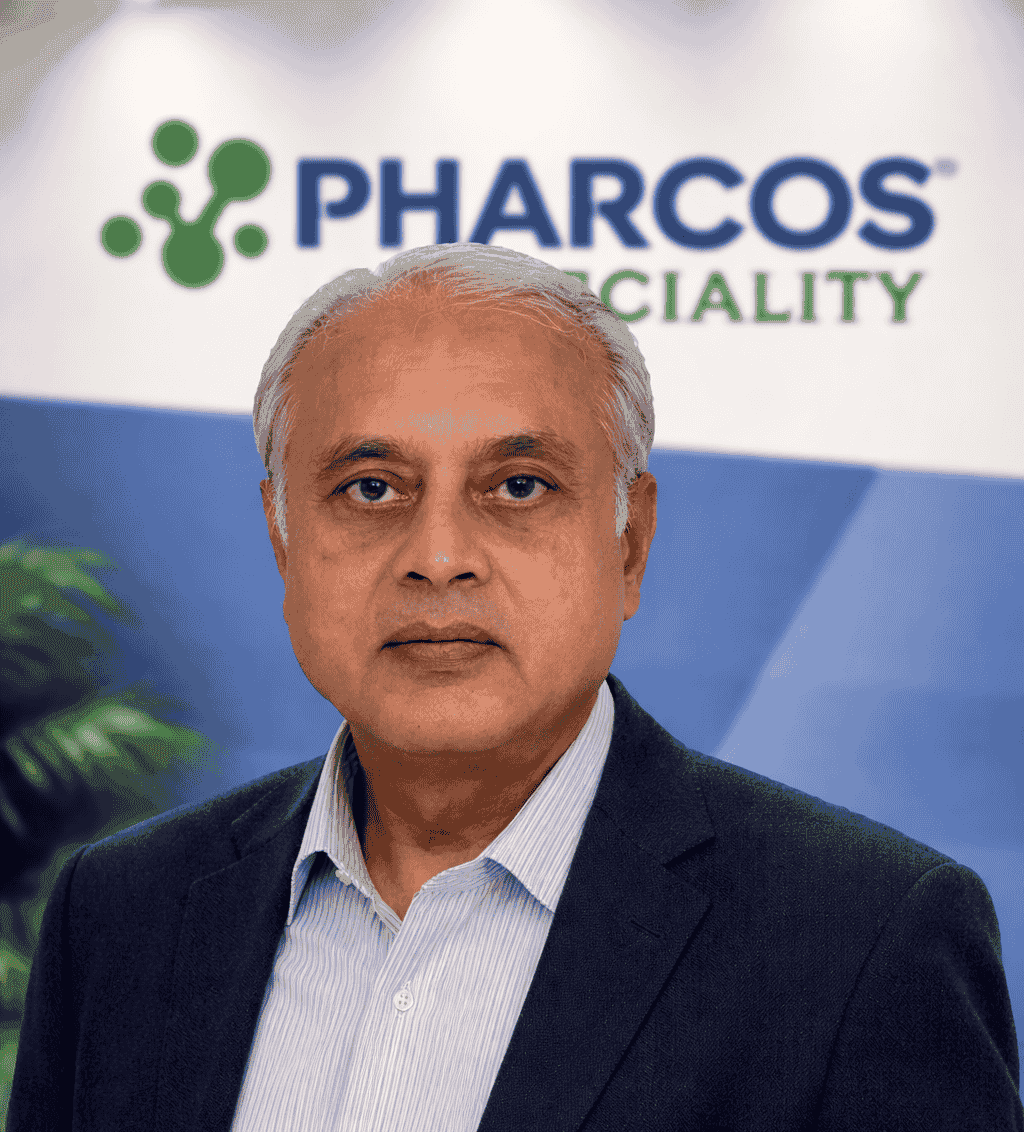
Dr. Avinash Dubey (R&D Head)
Dr. Avinash Dubey is a PhD in Organic Chemistry with a distinguished career spanning more than four decades. As the head of R&D at Pharcos, he focuses on the development of novel molecules for a wide array of industrial sectors, blending long-standing experience with a passion for innovation.

Mr. Ankit Shah (Managing Director)
Mr. Ankit Shah has led Pharcos Speciality for over three decades, establishing it as a pioneer in specialty chemicals. He currently directs the company’s strategic expansion into the APIs, Excipient and Speciality Surfactants markets, upholding a steadfast commitment to "Make in India" and world-class manufacturing quality and new product development.