
PEG-40 Hydrogenated Castor Oil vs Polysorbate 20: Choosing a Solubilizer for Clear Formulations




AI Summary: PEG-40 Hydrogenated Castor Oil vs Polysorbate 20
The PEG-40 hydrogenated castor oil vs Polysorbate 20 decision depends on the oil, complete formulation and development priorities. Both are nonionic solubilizers, but their structures, handling characteristics and performance differ. Formulators should compare them through controlled screening rather than rely on a universal preference. The selected system must balance immediate clarity with processing needs, foaming behaviour, sensory properties, ingredient compatibility and stability under the product’s intended storage and use conditions.
Why Clear Water-Based Formulations Need a Solubilizer
Fragrances and essential oils contain predominantly lipophilic molecules that do not readily mix with water. Without an appropriate surfactant system, they may float, form droplets or separate. A solubilizer accommodates small quantities of these materials within surfactant aggregates, making a transparent or nearly transparent aqueous product possible. An effective fragrance solubilizer comparison therefore examines both initial appearance and resistance to later instability.
Solubilization is not the same as dispersion, which distributes oil droplets but may not prevent later separation. Emulsification creates a visibly dispersed oil-and-water system, often with an opaque or translucent appearance. Solubilization generally holds smaller quantities of oil in structures that minimise visible light scattering.
Surfactant aggregates can change with temperature, dilution or other ingredients. Research confirms that fragrance composition and aggregate structure influence turbidity and viscosity at low fragrance levels.
 WhatsApp Now
PEG-40 Hydrogenated Castor Oil as a Clear-Formulation Solubilizer
PEG-40 hydrogenated castor oil is produced from hydrogenated castor oil through ethoxylation, with an average of 40 ethylene oxide units reflected in its INCI name. It is a nonionic surfactant used as a solubilizing and emulsifying ingredient for perfume oils, actives and other lipophilic materials in cosmetic products.
Its performance as an essential oil solubilizer depends on the selected oil, use level and process. Physical form can vary by grade and temperature, so handling should follow the supplier’s specification.
Polysorbate 20 as a Fragrance and Oil Solubilizer
Polysorbate 20 is a nonionic surfactant based on an ethoxylated sorbitan ester of lauric acid, with an average of 20 ethylene oxide units. It is used to incorporate fragrances and oils into aqueous personal-care products and has emulsifying, cleansing and fragrance-related functions.
Its liquid form may aid handling but does not determine suitability. When Polysorbate 20 is being evaluated as a PEG-40 HCO alternative, both ingredients should be compared for clarity, foam, odour, sensory feel and storage behaviour rather than substituted at the same concentration.
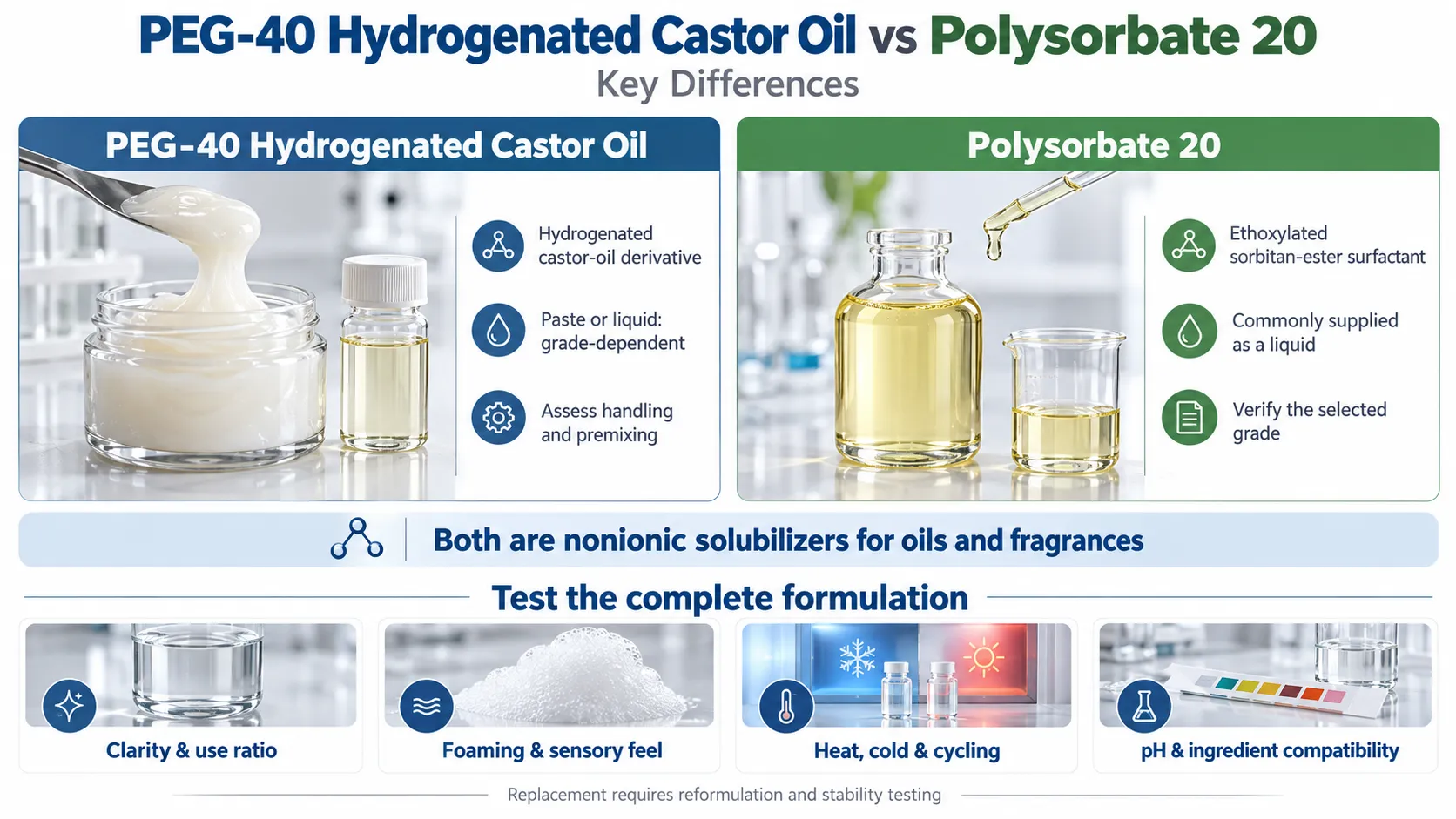
PEG-40 Hydrogenated Castor Oil vs Polysorbate 20: Key Differences
| Comparison factor | PEG-40 Hydrogenated Castor Oil | Polysorbate 20 | What the formulator should check |
|---|---|---|---|
| Ingredient type | Nonionic solubilizer derived from hydrogenated, ethoxylated castor oil | Nonionic ethoxylated sorbitan-ester surfactant | Confirm INCI identity and supplier specification |
| Main formulation role | Solubilizing fragrances, essential oils and lipophilic ingredients | Solubilizing fragrances, essential oils and lipophilic ingredients | Test the actual oil blend |
| Physical form | Grade- and temperature-dependent; Pharcos offers paste and liquid grades | Commonly supplied as a liquid; verify the selected grade | Assess pumping, weighing and premixing |
| Clarity | Depends on oil, ratio and formula conditions | Depends on oil, ratio and formula conditions | Measure turbidity or light transmission |
| Required use level | Must be determined experimentally | Must be determined experimentally | Screen multiple ratios; do not assume parity |
| Foaming and sensory effect | Formulation-dependent | Formulation-dependent | Observe manufacture and consumer-use conditions |
| Temperature response | Requires testing through intended storage range | Requires testing through intended storage range | Conduct heat, cold and cycling studies |
| Compatibility | Influenced by pH, electrolytes, preservatives and surfactant blends | Influenced by pH, electrolytes, preservatives and surfactant blends | Test the complete product |
| Replacement potential | May be evaluated as an alternative in selected systems | May be evaluated as an alternative in selected systems | Reformulate and repeat stability testing |
Their hydrophobic portions and ethoxylated-species distributions differ, affecting how fragrance molecules partition into surfactant structures. HLB may support preliminary screening, but it cannot predict the effect of a complex fragrance, cosolvents, processing or packaging.
Practical Starting Points for Solubilizer Selection
| Development situation | Practical starting approach |
|---|---|
| Fragrance or essential oil in a transparent aqueous product | Screen both ingredients at multiple ratios |
| Preference for an easily handled liquid raw material | Compare liquid Polysorbate 20 with a liquid PEG-40 HCO grade |
| PEG-40 HCO paste grade under consideration | Confirm heating, pumping and premixing requirements |
| Existing Polysorbate 20 formula becoming cloudy | Optimise the ratio and process before changing ingredients |
| Replacing one solubilizer with the other | Reformulate; do not make an automatic one-to-one substitution |
| Oxidation-sensitive oil system | Evaluate the antioxidant, packaging and storage strategy |
Fragrance Solubilizer Comparison for Clear Formulations
Two fragrances used at the same concentration can demand different solubilizer systems. A blend rich in terpenes may behave differently from one containing more polar aromatic materials or solvents. Formulators should assess:
- fragrance composition, polarity and concentration;
- solubilizer-to-fragrance ratio;
- water quality, pH, alcohols and glycols;
- preservatives, electrolytes, colourants and extracts; and
- mixing order, temperature, equilibration time and delayed clarity.
A clear concentrate may cloud after dilution, so testing should reflect actual use conditions.
Our Other Product
PEG 60 Hydrogenated Castor Oil (Paste / Solid | Solubilizers)Choosing an Essential Oil Solubilizer for Water-Based Products
Essential-oil profiles can differ by plant variety, origin, harvest and storage. Light, oxygen, heat and packaging headspace may also cause haze, ringing, oxidation or changes in colour and odour. Screening should therefore use the intended commercial oil and evaluate the antioxidant strategy, container and storage conditions.
Solubilizer-to-Oil Ratio Screening for Fragrances and Essential Oils
Use a controlled screening matrix:
- Prepare several oil-to-solubilizer combinations using consistent batch sizes.
- Premix the oil and solubilizer where appropriate.
- Add the aqueous phase at a controlled rate, mixing speed and temperature.
- Allow equal equilibration time before comparing samples.
- Record immediate and delayed clarity.
- Evaluate dilution behaviour, foam, odour, colour and skin or hair sensory effects where applicable.
- Repeat promising trials in the complete formula, including preservative and colour system.
The lowest clear level is not automatically optimum; another ratio may deliver lower foam or better temperature and sensory performance.
Solubilizer Processing and Order-of-Addition Considerations
Order of addition determines how the oil contacts the surfactant before dilution. Premixing may help, while formulas containing polymers or temperature-sensitive materials may need another sequence.
Mixing must provide uniformity without excessive aeration. Temperature affects viscosity and handling, while uncontrolled heating may damage fragrances. Scale-up trials should confirm impeller choice, addition rate and cooling profile.
Solubilizer Compatibility with pH, Electrolytes and Preservatives
Nonionic classification does not ensure universal compatibility. Salts, extracts, charged polymers, high solids and extreme pH can change aggregate behaviour, clarity or fragrance stability.
Preservatives, chelating agents, alcohols, glycols, colourants and other surfactants may support or disturb solubilization. Assess them at their intended concentrations and addition order.
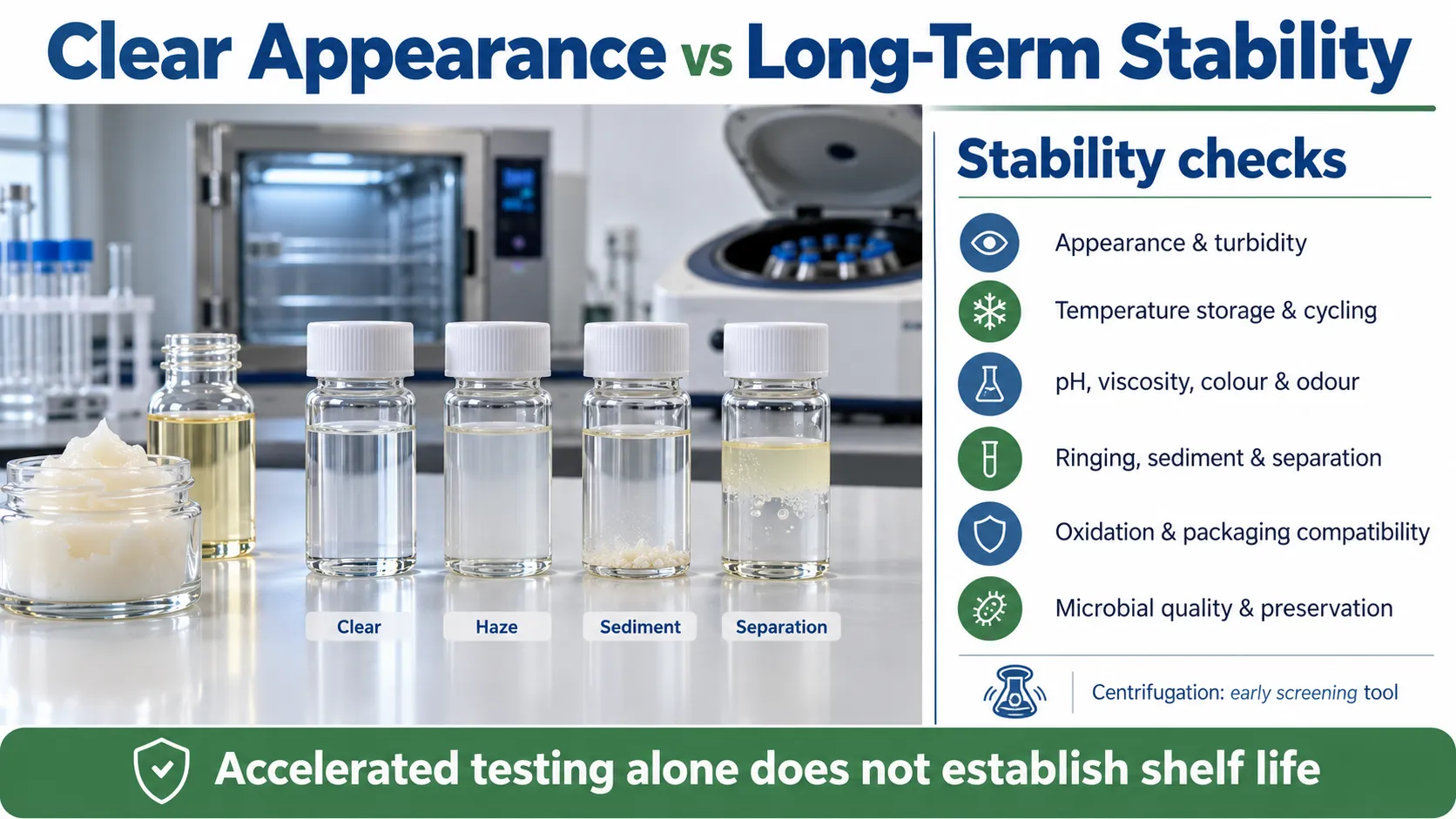
Clear Formulation Appearance vs Long-Term Stability
A transparent sample may later develop haze, sediment, ringing or separation. Temperature can alter aggregate size, oxidation may change colour and odour, and packaging may interact with the formula.
A practical stability programme may include:
- initial appearance, turbidity or light-transmission measurement;
- room, elevated and low-temperature storage or cycling;
- centrifugation as an early screening tool;
- pH, viscosity, colour and odour monitoring;
- checks for ringing, sediment or separation;
- oxidation and packaging compatibility; and
- microbiological quality and preservative-efficacy testing where applicable.
Accelerated tests reveal risks but do not establish shelf life alone. Water-based cosmetics also require microbiological controls because poor storage or weakened preservation can increase contamination risk.
Our Other Product
PEG 7 Hydrogenated Castor Oil (Liquid | Emulsifiers)When to Evaluate PEG-40 HCO as an Alternative Solubilizer
A formulator may evaluate PEG-40 HCO when reassessing clarity, use level, foaming, odour, sensory feel, processing or grade availability. Changing the solubilizer alters the surfactant balance, so the revised formulation requires ratio optimisation, process confirmation and stability testing.
About Pharcos Speciality Ltd and Its Solubilizer Portfolio
Pharcos Speciality Ltd manufactures pharmaceutical ingredients, excipients and speciality chemicals. Its portfolio includes solubilizers, surfactants and other ingredients for personal care and additional formulation markets. Pharcos HCO 40 forms part of its solubilizer offering.
 Call Us Now!
Choosing Between PEG-40 HCO and Polysorbate 20
The choice between PEG-40 hydrogenated castor oil and Polysorbate 20 should be based on evidence from the actual fragrance or essential oil in the complete formulation. Clarity, ratio, processing, compatibility, foam, sensory properties and long-term stability all matter. Neither ingredient provides a universal solution, and changing between them requires reformulation rather than direct substitution.
For current Pharcos HCO 40 specifications, paste or liquid grade availability, technical documents, samples and formulation or commercial enquiries, contact Pharcos Speciality Ltd.
PEG-40 HCO vs Polysorbate 20: Frequently Asked Questions

Dr. Avinash Dubey (R&D Head)
Dr. Avinash Dubey is a PhD in Organic Chemistry with a distinguished career spanning more than four decades. As the head of R&D at Pharcos, he focuses on the development of novel molecules for a wide array of industrial sectors, blending long-standing experience with a passion for innovation.

Mr. Ankit Shah (Managing Director)
Mr. Ankit Shah has led Pharcos Speciality for over three decades, establishing it as a pioneer in specialty chemicals. He currently directs the company’s strategic expansion into the APIs, Excipient and Speciality Surfactants markets, upholding a steadfast commitment to "Make in India" and world-class manufacturing quality and new product development.