
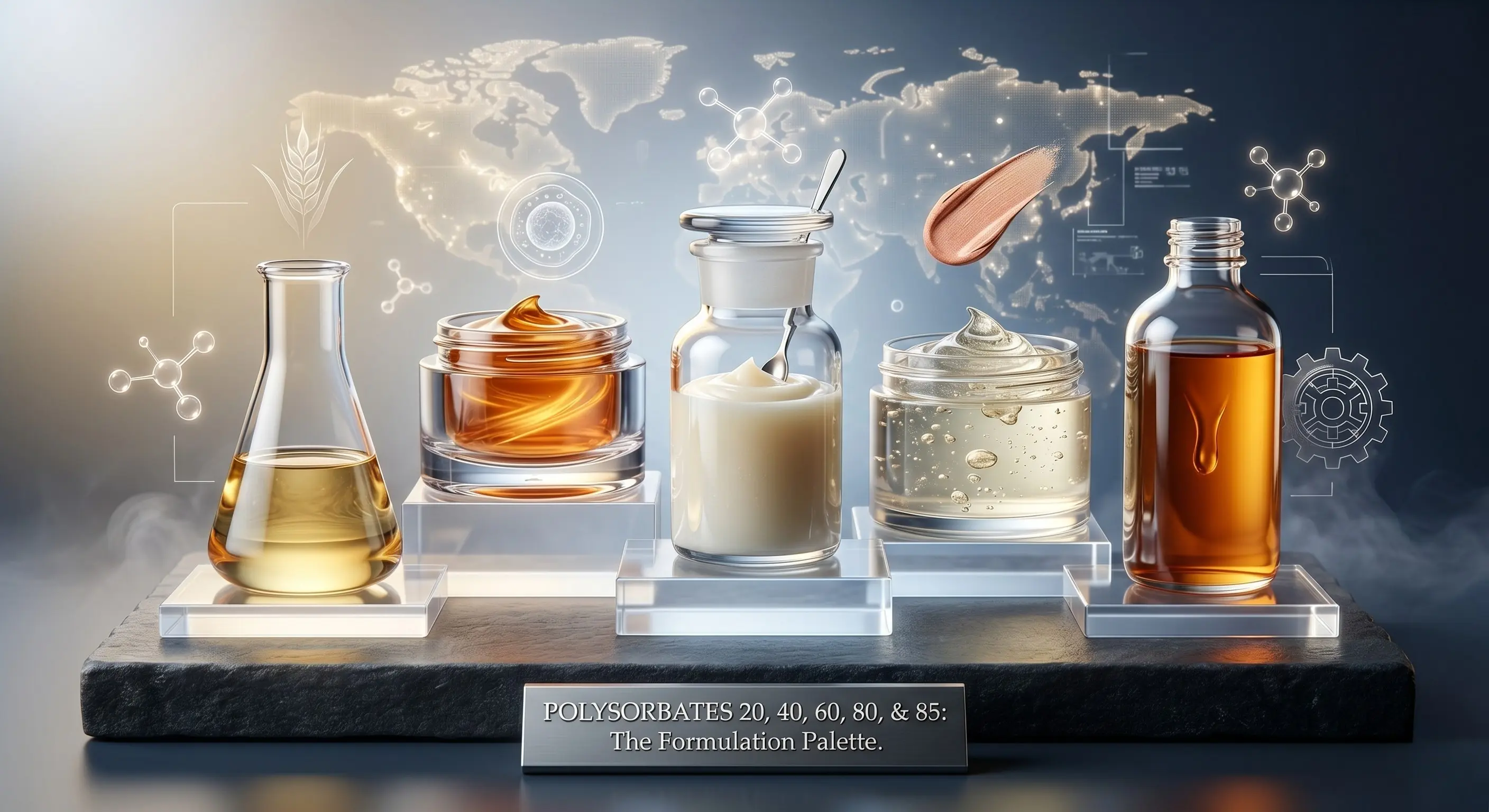
Polysorbate 20, 40, 60, 80 & 85: Applications, Industrial Uses & Global Market Relevance




AI Summary:
Polysorbates are a versatile family of non-ionic surfactants widely used across personal care, agrochemicals, oil & gas, lubricants, detergents and polishes industries. Each grade - Polysorbate 20, 40, 60, 80 and 85 - carries a unique fatty acid composition, which defines its HLB value, solubility behavior and functional role in formulations. From emulsifying creams and conditioners to stabilizing drilling fluids and dispersing oil spills, polysorbates serve critical roles in both consumer and industrial sectors. Their global demand continues to rise, particularly in Europe, the USA, Russia and the Middle East, driven by expanding formulation needs and regulatory acceptance.
Introduction to Polysorbates as Multi-Industry Surfactants
Polysorbates are ethoxylated sorbitan esters derived from sorbitol and fatty acids. They are hydrophilic, non-ionic surfactants widely accepted for their mild nature, functional versatility and compatibility with a range of active ingredients. The five primary commercial grades - Polysorbate 20, Polysorbate 40, Polysorbate 60, Polysorbate 80 and Polysorbate 85 - are distinguished by the type of fatty acid esterified to the sorbitan backbone, which directly impacts their emulsification efficiency, solubilizing power and industrial applicability.
In formulation science, the choice of the right polysorbate grade is not trivial. Each grade has a specific HLB (Hydrophilic-Lipophilic Balance) value, which chemists use to predict its effectiveness in oil-in-water (O/W) or water-in-oil (W/O) systems. From the lightest laurate ester in Polysorbate 20 to the tri-oleate structure of Polysorbate 85, each variant addresses distinct formulation challenges across sectors as diverse as personal care, agriculture, textiles, oil & gas and industrial cleaning.
Global demand for polysorbates has grown steadily. Markets in Europe, the USA, Russia and the Middle East continue to prioritize high-performance surfactant systems to meet evolving regulatory standards, product performance expectations and sustainability mandates.
 WhatsApp Now
Polysorbate 20 - Solubilizing Fragrances and Wetting in Agricultural Systems
Polysorbate 20 is a laurate-based, hydrophilic non-ionic surfactant recognized for its excellent solubilizing capability in water-based systems. Its high HLB value makes it particularly effective at dispersing fragrance oils and essential oils into aqueous formulations without compromising clarity or stability.
In personal care, Polysorbate 20 is the preferred fragrance solubilizer in body mists, facial toners, micellar waters and wet wipes. Formulators in Europe and the USA widely rely on it to achieve transparent, aesthetically clean formulations. It also acts as a mild detergent component in gentle cleansers and baby wipes, where skin compatibility is paramount.
In the agricultural sector, Polysorbate 20 is used as a wetting agent in adjuvant formulations - enhancing the spreading and penetration of pesticides and herbicides on leaf surfaces. This is particularly relevant in the Middle East and Russia, where precision agricultural applications demand reliable surfactant systems that function across varying climatic and soil conditions. Its low toxicity profile and biodegradability further strengthen its position in regulated agrochemical markets.
Polysorbate 40 - Palmitate-Derived Emulsifier for Personal Care and Textiles
Polysorbate 40 is derived from palmitic acid, giving it a slightly waxy character compared to Polysorbate 20. Its primary function is as an oil-in-water emulsifier in cosmetic creams, lotions and light moisturizers. It helps stabilize emulsions by reducing interfacial tension between oil and water phases, enabling uniform, aesthetically pleasing product textures.
In flavor systems, Polysorbate 40 is used as a flavor solubilizer in food-grade applications where permitted, helping to uniformly distribute lipophilic flavor components in water-based systems.
Beyond personal care, Polysorbate 40 holds notable relevance in industrial applications. In textile processing, it serves as an anti-static agent and lubricant, reducing fiber-to-fiber friction during spinning and weaving operations. This is an important function in manufacturing hubs across Europe and Russia, where synthetic and blended textile production demands reliable processing aids. Its dual role - cosmetic emulsifier and industrial lubricant - makes it a cost-effective ingredient for multi-sector supply chains.
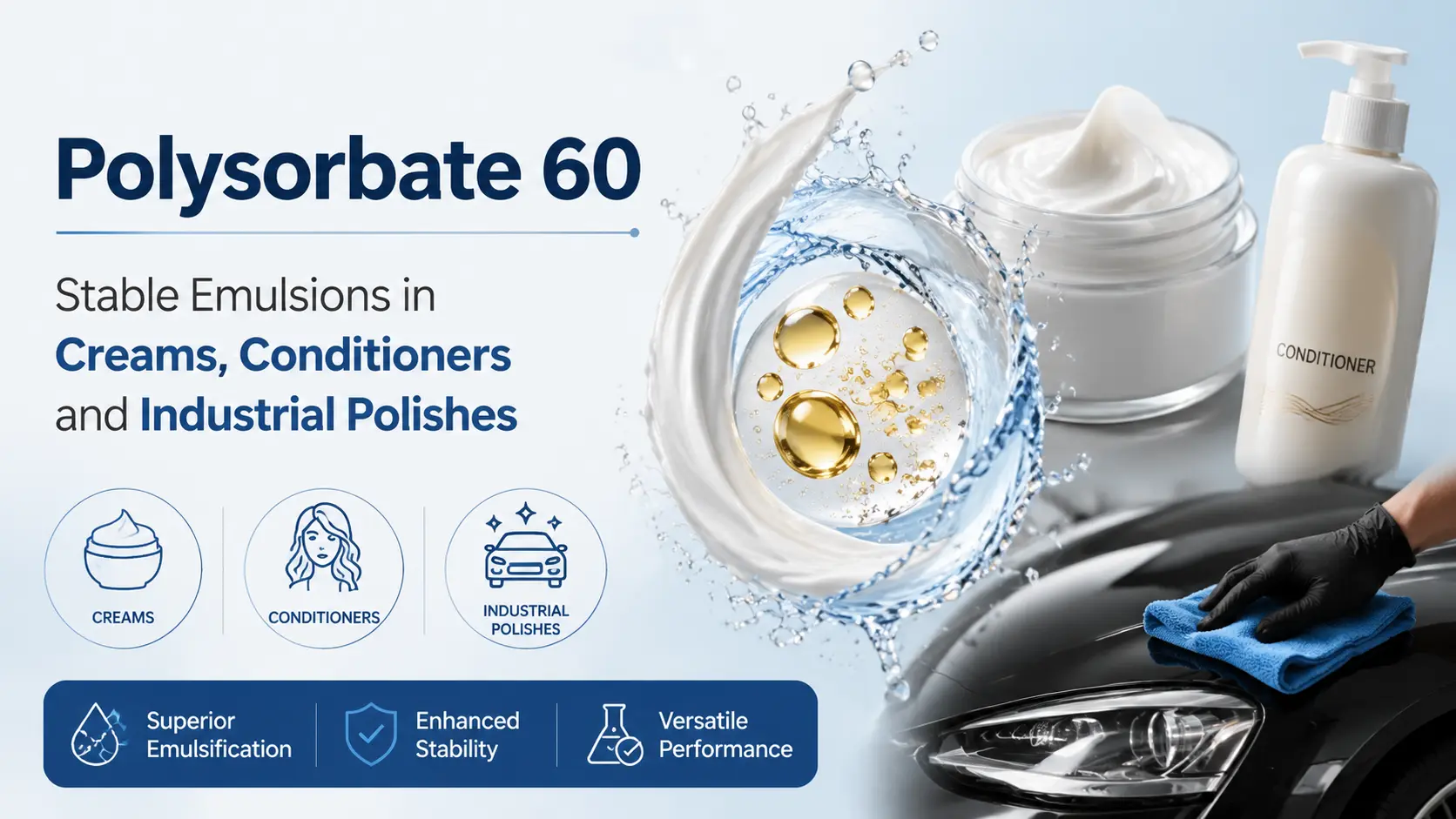
Polysorbate 60 - Stable Emulsions in Creams, Conditioners and Industrial Polishes
Polysorbate 60 is a stearate-based surfactant with a waxy, semi-solid form. It is widely recognized for its ability to work synergistically with fatty alcohols such as Cetyl Alcohol and Stearyl Alcohol to form stable, rich emulsions. This combination is fundamental in the formulation of hair conditioners, body creams and skin-moisturizing lotions.
In hair care, Polysorbate 60 contributes to the creamy, spreadable texture of conditioners while ensuring even distribution of conditioning actives on the hair shaft. In skin formulations, it supports the stability of emollients and moisturizing agents in both O/W and W/O cream systems - a feature that is well-utilized by personal care manufacturers in Europe and the USA.
One often underappreciated functionality of Polysorbate 60 is its effectiveness as a silicone emulsifier. Silicones are notoriously difficult to incorporate into water-based systems, but Polysorbate 60 enables their stable emulsification in industrial polishes, metal care products and textile finishing agents. In the Middle East's growing industrial polishes and lubricants sector, this property is increasingly valued. Additionally, Polysorbate 60 is used as a plastics anti-fog agent, preventing condensation on film surfaces in packaging applications.
Our Other Product
PEG 4 Rapeseed Amide (Liquid | Surfactants)Polysorbate 80 - The Versatile Oleate Ester across Personal Care, Oil & Gas and Agro
Polysorbate 80 is arguably the most widely used grade in the polysorbate family. Its oleate ester structure gives it a liquid consistency at room temperature and an excellent ability to solubilize oils, active ingredients and hydrophobic compounds in aqueous systems.
In personal care, Polysorbate 80 is used in shampoos and heavy-duty cleansers to solubilize conditioning oils, silicones and fragrance components. Its cleaning efficacy and emulsifying power make it suitable for rinse-off formulations designed for challenging soil removal.
Where Polysorbate 80 truly differentiates itself is in industrial and specialty applications. In oil & gas drilling fluids, it functions as an emulsifier - helping to maintain stable water-in-oil emulsions in drilling muds, which is critical for operational efficiency in Russian oilfields and Middle Eastern petroleum operations. In agrochemicals, it is used as a tank-mix adjuvant and emulsifier for agricultural concentrates, supporting the uniform dispersion of active ingredients.
In pharmaceutical-grade formats, Polysorbate 80 serves as a vaccine stabilizer and solubilizer for poorly soluble APIs (Active Pharmaceutical Ingredients). This pharma-grade demand is strong in regulated markets across Europe and the USA, where cGMP-compliant excipients are required for biologics, injectables and oral formulations.
Polysorbate 20 and Polysorbate 80 both function as active solubilizers, but while Polysorbate 20 is suited for lighter fragrance systems, Polysorbate 80 is specifically preferred where more resistant oils or actives require solubilization.
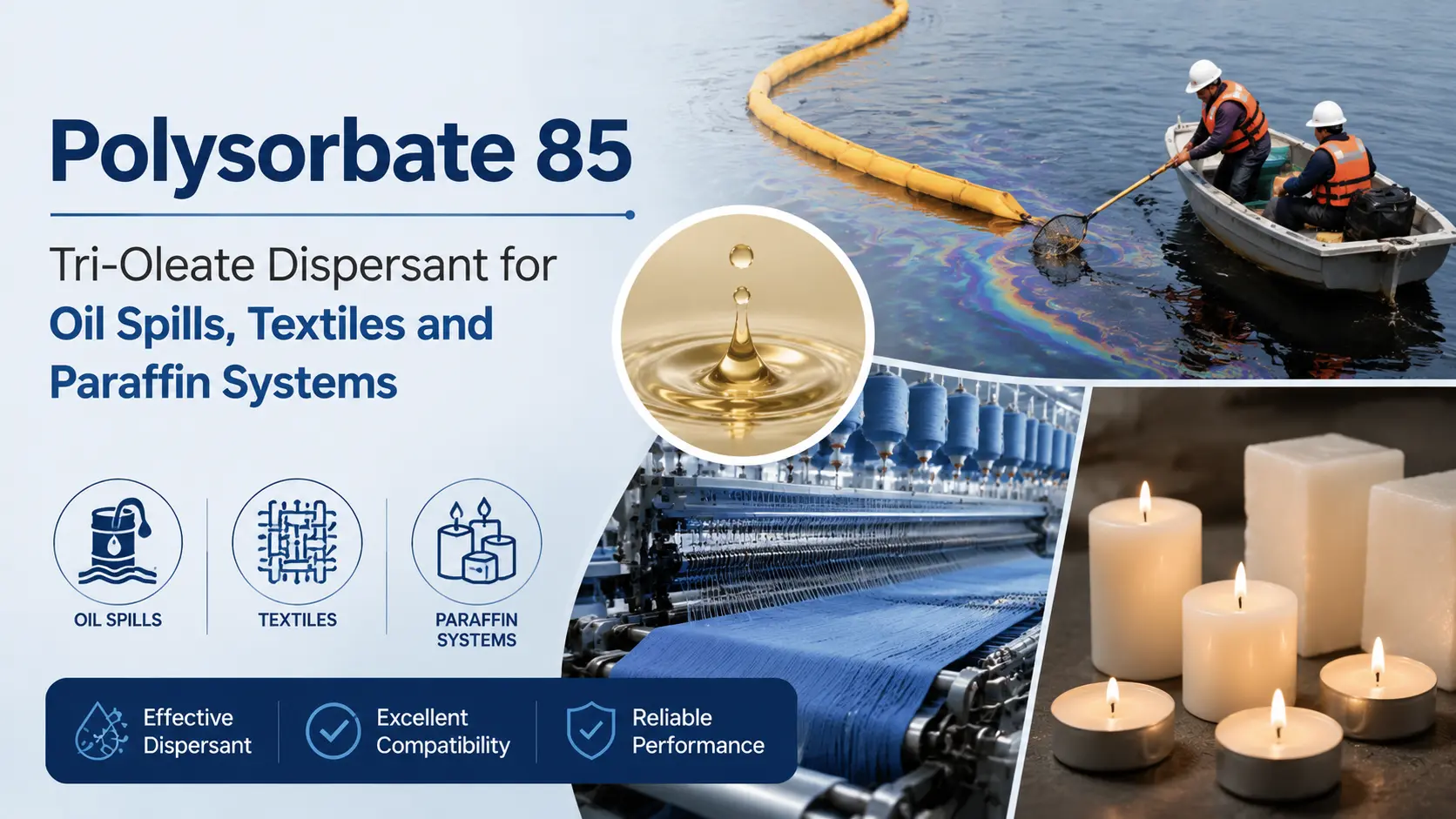
Polysorbate 85 - Tri-Oleate Dispersant for Oil Spills, Textiles and Paraffin Systems
Polysorbate 85 is the most lipophilic of the five grades, featuring a tri-oleate structure that significantly reduces its HLB value. This makes it hydrophobic-leaning, positioning it as a highly effective dispersant and emulsifier for non-polar systems rather than aqueous-based formulations.
Its most critical industrial application is as an oil spill dispersant. In maritime and offshore environments - especially relevant to oil & gas operations in the Middle East, the North Sea (Europe) and Russian Arctic zones - Polysorbate 85 is used to break down oil slicks into fine droplets for biodegradation. Its tri-oleate structure ensures deep penetration and dispersion of heavy hydrocarbons.
In textiles, Polysorbate 85 functions as a fiber lubricant and processing aid, reducing friction during synthetic fiber extrusion and weaving. It is also used as a coupling agent in industrial formulations where compatibility between polar and non-polar components is required.
Polysorbate 85 also excels at emulsifying paraffin waxes in polish formulations - a use case it shares with Polysorbate 60 (for silicone-based polishes) but in a distinctly different chemical mechanism. Its paraffin emulsification capability is valued in floor care, automotive and furniture polish products across European and North American markets.
Regional Market Perspective: Europe, USA, Russia & Middle East
Across global markets, polysorbates maintain strong regulatory acceptance and commercial relevance:
Europe leads in the adoption of polysorbates for personal care and cosmetics under ECHA/REACH compliance. The EU's cosmetics regulation (EC No 1223/2009) permits all five grades, making them accessible to formulation chemists designing for premium skincare and haircare lines.
USA is a major consumer of Polysorbate 80 and Polysorbate 20 in both personal care and pharmaceutical applications. The FDA's GRAS (Generally Recognized as Safe) status for food-grade applications and their USP/NF inclusion for pharmaceutical excipients, ensures strong institutional demand.
Russia relies on polysorbates heavily in drilling fluid systems (Polysorbate 80), textile processing (Polysorbates 40 and 85) and agricultural adjuvants (Polysorbate 20), driven by its resource-intensive industrial sectors.
Middle East is a growing market for industrial surfactants - particularly for oil spill management (Polysorbate 85), drilling emulsifiers (Polysorbate 80) and personal care manufacturing growth in UAE, Saudi Arabia and Egypt.
 Call Us Now!
About Pharcos Speciality Ltd.
Pharcos Speciality Ltd. is an Indian-based specialty chemicals manufacturer with a focused portfolio in surfactants, emulsifiers, solubilizers and dispersants catering to personal care, agrochemicals, lubricants, oil & gas and detergent industries. With a commitment to quality manufacturing and formulation expertise, Pharcos Speciality Ltd. supplies high-performance ingredients to domestic and international markets, offering customized solutions that align with regional regulatory frameworks. Their polysorbate product range covers all major commercial grades, enabling formulators across industries to access reliable, consistent raw material supply backed by technical support.
Our Other Product
PEG 400 Monostearate (Semi-solid | Emulsifiers)Conclusion
Polysorbates - spanning Polysorbate 20, 40, 60, 80 and 85 - collectively represent one of the most functionally diverse and commercially indispensable surfactant families in modern industrial chemistry. Their utility spans fragrance solubilization and emulsion stabilization in personal care to oil spill dispersal, drilling fluid emulsification, agricultural adjuvancy and pharmaceutical excipient use. The right grade selection is determined by the fatty acid chain length, HLB value and intended application environment. As formulation demands evolve across Europe, the USA, Russia and the Middle East, polysorbates continue to offer chemists and engineers a proven, regulatory-compliant and cost-effective toolkit. Whether in a luxury European skincare cream, a US-manufactured vaccine, a Russian oilfield operation or a Middle Eastern textile plant, polysorbates quietly power product performance at the molecular level.
FAQs on Polysorbate

Dr. Avinash Dubey (R&D Head)
Dr. Avinash Dubey is a PhD in Organic Chemistry with a distinguished career spanning more than four decades. As the head of R&D at Pharcos, he focuses on the development of novel molecules for a wide array of industrial sectors, blending long-standing experience with a passion for innovation.

Mr. Ankit Shah (Managing Director)
Mr. Ankit Shah has led Pharcos Speciality for over three decades, establishing it as a pioneer in specialty chemicals. He currently directs the company’s strategic expansion into the APIs, Excipient and Speciality Surfactants markets, upholding a steadfast commitment to "Make in India" and world-class manufacturing quality and new product development.