
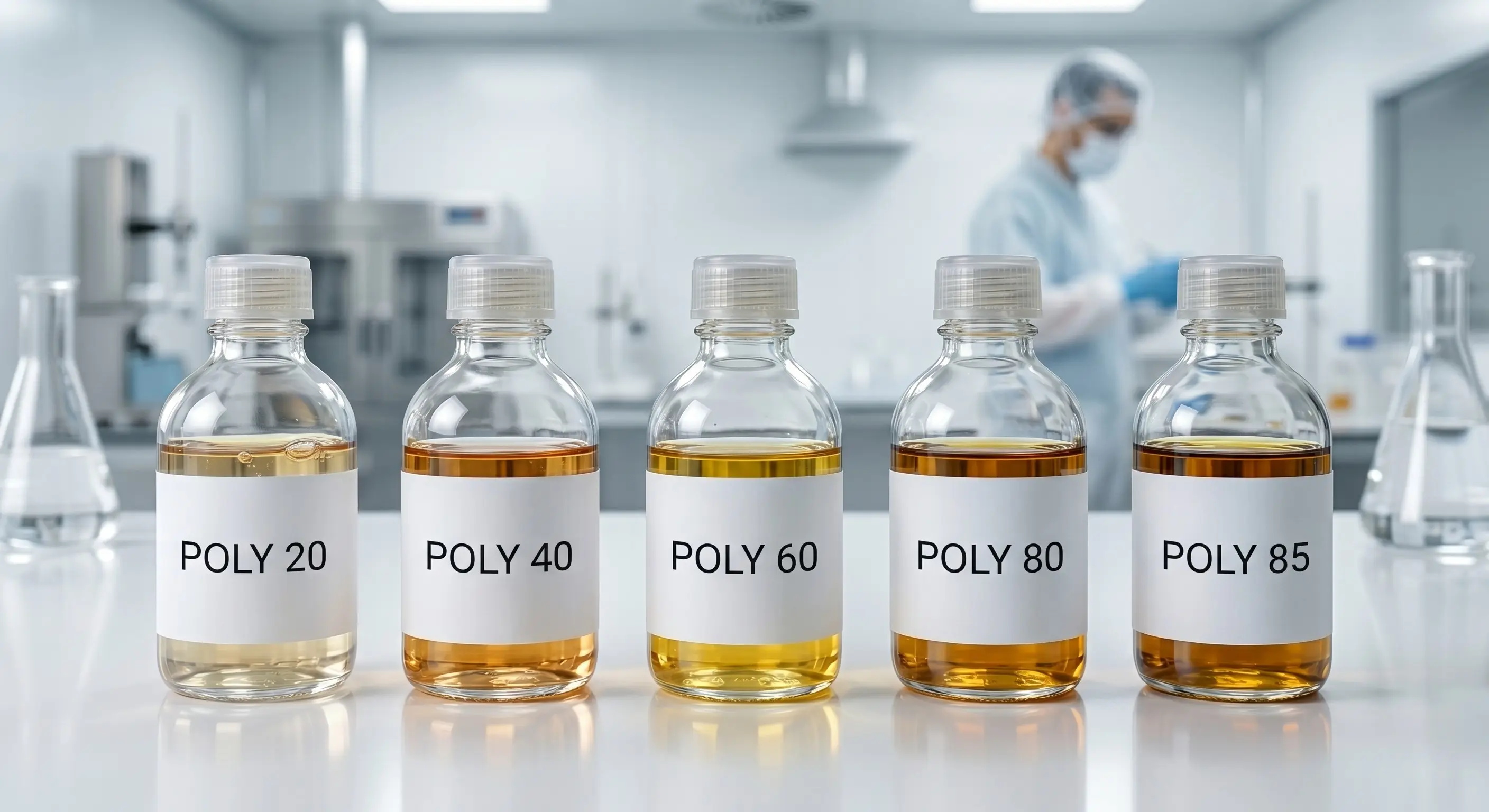
Polysorbate in Pharmaceutical Formulations: A Complete Guide to Grades 20, 40, 60, 80 & 85




AI Summary
Polysorbates are non-ionic surfactants widely used across pharmaceutical formulations worldwide for their emulsifying, solubilizing and stabilizing properties. From oral liquids to parenteral injectables and topical creams, each polysorbate grade - 20, 40, 60, 80 and 85 - offers distinct functional advantages based on its fatty acid composition and HLB value. Pharcos Speciality Ltd. supplies pharmaceutical-grade polysorbates that meet stringent USP-NF, EP and BP compliance standards, serving key markets across Europe, the USA, Russia and the Middle East.
 Call Us Now!
What Are Polysorbates and Why Do They Matter in Pharma?
In modern pharmaceutical manufacturing, excipients are far more than inert fillers - they directly influence drug stability, bioavailability and patient experience. Among the most versatile excipients in use today, polysorbates have earned a central role across dosage forms ranging from oral suspensions to sterile injectables.
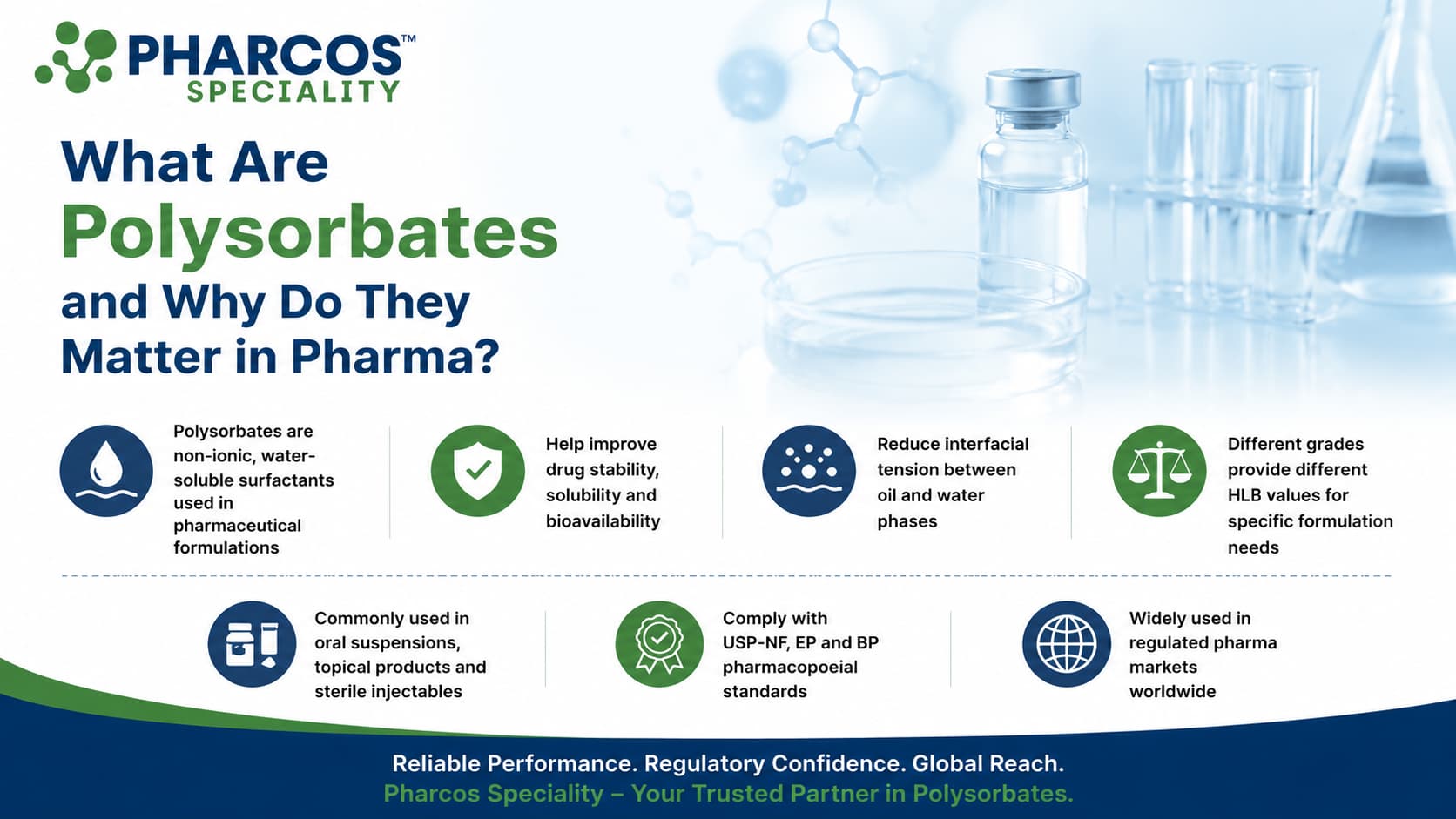
Derived from sorbitol and fatty acids through ethoxylation, polysorbates are non-ionic, water-soluble surfactants. Their amphiphilic structure - with both hydrophilic and lipophilic regions - makes them effective at reducing interfacial tension between oil and water phases. Depending on the fatty acid used in synthesis, each grade carries a different Hydrophilic-Lipophilic Balance (HLB) value, which determines its preferred application in a formulation.
Globally, demand for high-purity polysorbates is growing steadily. Pharmaceutical manufacturers in Europe, the USA, Russia and the Middle East increasingly require excipients that comply with international pharmacopoeial standards, including USP-NF, EP and BP. Pharcos Speciality Lts. addresses this demand with a dedicated range of pharmaceutical-grade polysorbates, formulated to meet regulatory and performance requirements across varied markets.
Polysorbate 20 - Solubilizer for Essential Oils and Poorly Soluble APIs
Polysorbate 20 (Polyoxyethylene (20) Sorbitan Monolaurate | CAS No. 9005-64-5) is derived from lauric acid and carries a high HLB value, making it one of the most hydrophilic members of the polysorbate family.
Its primary pharmaceutical role is as a solubilizing agent for essential oils and poorly soluble active pharmaceutical ingredients (APIs) in aqueous systems. When a hydrophobic ingredient needs to be uniformly dispersed in a water-based formulation - without resorting to co-solvents - Polysorbate 20 provides an elegant and effective solution. It forms micelles around hydrophobic molecules, improving their apparent solubility and ensuring dose uniformity.
Beyond solubilization, Polysorbate 20 functions as a mild, non-irritating surfactant suitable for sensitive formulations. Its gentle skin and mucosal compatibility makes it particularly useful in topical preparations, nasal sprays and oral rinses. In markets such as Western Europe and the USA, where regulatory scrutiny on excipient safety is especially rigorous, the mild profile of Polysorbate 20 makes it a preferred choice for dermatological and pediatric preparations.
Key Applications: Solubilizer, Emulsifier, Stabilizer
Polysorbate 40 - Palmitate-Based Emulsifier for Specific HLB Demands
Polysorbate 40 (Polyoxyethylene (20) Sorbitan Monopalmitate | CAS No. 9005-66-7) is synthesized from palmitic acid. It occupies a middle position in the polysorbate HLB range, offering formulators a precise tool when a specific emulsification balance is required.
It serves as an effective oil-in-water emulsifier and solubilizer, particularly in oral liquid suspensions and topical preparations where matching a target HLB value is critical to achieving emulsion stability. The choice of Polysorbate 40 over other grades is often driven by the need to fine-tune interfacial behavior - especially when blending emulsifiers to reach composite HLB targets for complex oil phases.
In pharmaceutical markets across the Middle East and Russia, where topical and oral liquid formulations represent a significant product category, the reliable emulsifying behavior of Polysorbate 40 supports consistent manufacturing outcomes. Its role as a wetting agent also makes it valuable in suspensions where particles need to be evenly coated and dispersed for dose accuracy.
Key Applications: Emulsifier, Solubilizer, Wetting Agent
Polysorbate 60 - Stearate-Based Grade for Semi-Solid Formulations
Polysorbate 60 (Polyoxyethylene (20) Sorbitan Monostearate | CAS No. 9005-67-8) is derived from stearic acid, a saturated long-chain fatty acid. This structural feature gives Polysorbate 60 a distinctly higher melting point compared to its unsaturated counterparts, which translates into significant advantages in semi-solid dosage forms.
Formulators working on creams, ointments and gels rely on Polysorbate 60 for its ability to stabilize emulsions while simultaneously contributing to texture and viscosity. It helps prevent phase separation in products that must remain stable across a wide range of storage temperatures - a critical requirement for pharmaceutical exports to regions with warm climates, such as the Middle East and parts of Eastern Europe.
As both an emulsifier and thickener, Polysorbate 60 reduces the need for additional viscosity-modifying agents, simplifying the formulation matrix. Its dispersing function further supports uniform distribution of active ingredients throughout semi-solid bases.
Key Applications: Emulsifier, Thickener, Dispersing Agent
Our Other Product
PEG 4 Rapeseed Amide (Liquid | Surfactants)Polysorbate 80 - The Industry's Most Widely Used Pharmaceutical Grade
Among all polysorbate variants, Polysorbate 80 (Polyoxyethylene (20) Sorbitan Monooleate | CAS No. 9005-65-6) holds the distinction of being the most extensively used grade in pharmaceutical manufacturing worldwide. Its oleic acid backbone provides excellent solubilizing capacity for lipophilic drugs, while its broad compatibility makes it suitable across multiple dosage forms.
In oral formulations, Polysorbate 80 functions as a highly effective solubilizer and bioavailability enhancer - improving the absorption of poorly water-soluble drugs by maintaining them in a solubilized state through the gastrointestinal tract. In parenteral formulations, including intravenous infusions and injections, it is indispensable for stabilizing oil droplets and solubilizing lipophilic actives in aqueous vehicles. Regulatory agencies in the USA, Europe and Russia have well-established safety data for Polysorbate 80 in parenteral use, supporting its continued dominance in this application space.
Perhaps one of its most critical modern applications lies in protein and vaccine stabilization. Polysorbate 80 prevents protein aggregation in biopharmaceutical formulations by coating protein molecules, shielding them from interfacial stresses during processing, storage and administration. This function has made it a standard excipient in vaccine development pipelines - an area of heightened global relevance in recent years. Pharcos Speciality Ltd., offers high-purity Polysorbate 80 that meets the stringent quality benchmarks required for such sensitive applications.
Key Applications: Solubilizer, Bioavailability Enhancer, Suspension Stabilizer
Polysorbate 85 - Trioleate Grade for Complex Emulsion Systems
Polysorbate 85 (Polyoxyethylene (20) Sorbitan Trioleate | CAS No. 9005-70-3) is structurally distinct from the other polysorbate grades - it carries three oleate chains rather than one, making it the most lipophilic of the group. This gives it a lower HLB value compared to Polysorbate 80, fundamentally altering its emulsification behavior.
Rather than forming stable oil-in-water emulsions independently, Polysorbate 85 excels as a dispersing agent for oils and as a co-emulsifier in complex pharmaceutical emulsion systems. It is frequently combined with higher-HLB emulsifiers to achieve the precise interfacial activity required for formulations involving multiple oil phases or challenging lipidic actives.
Its role as a lubricant in certain pharmaceutical processes also adds functional value, particularly in specialized manufacturing contexts. Polysorbate 85 meets USP-NF, EP and BP compliance standards, making it suitable for regulated pharmaceutical environments in the USA, Europe, Russia and the Middle East. Pharcos Speciality Ltd. recognizes its importance in advanced formulation strategies and supplies it as part of a comprehensive polysorbate portfolio.
Key Applications: Emulsifier, Dispersing Agent, Lubricant
Choosing the Right Polysorbate Grade: Key Considerations
Selecting the appropriate polysorbate grade depends on several formulation variables - fatty acid type, HLB value, dosage form, route of administration and regulatory requirements. The following summarizes the practical decision framework:
| Grade | Fatty Acid | Primary Use | Dosage Form Fit |
|---|---|---|---|
| Polysorbate 20 | Lauric | Solubilization of oils/APIs | Topicals oral rinses |
| Polysorbate 40 | Palmitic | O/W emulsification | Oral liquids, topicals |
| Polysorbate 60 | Stearic | Semi-solid stabilization | Creams, ointments |
| Polysorbate 80 | Oleic | Solubilization, bioavailability | Oral, parenteral, biologics |
| Polysorbate 85 | Trioleic | Complex emulsions | Specialized emulsions |
For formulators navigating stringent pharmacopoeial requirements across Europe, the USA, Russia and the Middle East, sourcing from a reliable, compliance-focused supplier is non-negotiable. Pharcos Speciality Ltd. provides this assurance through consistent product quality, documented regulatory compliance and a full-spectrum polysorbate product line tailored to pharmaceutical manufacturing needs.
 WhatsApp Now
About Pharcos Speciality Ltd.
Pharcos Speciality Ltd. is a trusted name in the pharmaceutical excipients industry, dedicated exclusively to the development and supply of high-purity specialty ingredients for pharmaceutical applications. With a strong focus on quality, compliance and innovation, Pharcos Speciality Ltd. serves a diverse customer base spanning regulated markets in Europe, the USA, Russia and the Middle East. The company's product portfolio is built around internationally recognized pharmacopoeial standards - USP-NF, EP and BP - ensuring that every excipient delivered meets the stringent requirements of modern drug formulation. Backed by robust manufacturing infrastructure and a commitment to consistent supply, Pharcos Speciality Ltd. positions itself as a reliable, long-term excipient partner for pharmaceutical manufacturers seeking both performance and regulatory confidence.
Our Other Product
PEG 400 Monostearate (Semi-solid | Emulsifiers)Conclusion
Polysorbates remain among the most indispensable excipients in pharmaceutical formulation science and selecting the right grade - whether Polysorbate 20, Polysorbate 40, Polysorbate 60, Polysorbate 80 or Polysorbate 85 - directly impacts product stability, efficacy and regulatory acceptance. Each grade brings a distinct functional profile suited to specific dosage forms, from topical creams and oral suspensions to parenteral injectables and biopharmaceutical preparations. As pharmaceutical manufacturers across Europe, the USA, Russia and the Middle East continue to raise the bar on formulation quality and compliance, the need for reliable, pharmacopoeial-grade excipient sources becomes increasingly critical. Pharcos Speciality Ltd., offers a comprehensive and compliant polysorbate portfolio designed to meet the evolving demands of global pharmaceutical production.
FAQs on Polysorbate Grades 20, 40, 60, 80 & 85

Dr. Avinash Dubey (R&D Head)
Dr. Avinash Dubey is a PhD in Organic Chemistry with a distinguished career spanning more than four decades. As the head of R&D at Pharcos, he focuses on the development of novel molecules for a wide array of industrial sectors, blending long-standing experience with a passion for innovation.

Mr. Ankit Shah (Managing Director)
Mr. Ankit Shah has led Pharcos Speciality for over three decades, establishing it as a pioneer in specialty chemicals. He currently directs the company’s strategic expansion into the APIs, Excipient and Speciality Surfactants markets, upholding a steadfast commitment to "Make in India" and world-class manufacturing quality and new product development.