

Polysorbate 80 Storage and Handling: What to Check from Delivery to Production




AI Summary
Polysorbate 80 moves through receipt, storage, container opening, dispensing and production handover, and each stage needs its own record. Storage conditions, dates and stability guidance must come from the supplier for the grade delivered, while internal records show whether the material can be used.
Polysorbate 80 Storage and Handling from Receipt to Use
Polysorbate 80 passes through several hands before it reaches a production vessel: receiving, storage, dispensing and production. At every handover, identity, condition or history can become uncertain if nobody records it.
Pharcos Speciality Ltd, an Indian manufacturer of pharmaceutical ingredients and speciality chemicals established in 1974, supplies this material as Pharcos PS 80, a liquid solubilizer. Conditions for polysorbate 80 storage must come from instructions that apply to the grade delivered. The internal checks for polysorbate 80 handling below help a site organise and evidence those instructions, not replace them.
 Start a Chat on WhatsApp!
Polysorbate 80 Incoming Inspection
The receiving procedure should define how each item is checked and where the result is recorded:
- Material name and supplied grade.
- Supplier and manufacturer identification, where available.
- Batch number and container identification.
- Delivered quantity against the order.
- Container and closure condition.
- Leakage, damage or interference.
- Delivery and batch documentation.
- Dates shown on labels or documents.
- Any reported transport incident.
When information is missing or inconsistent, record what was expected, what was found and who was informed. A grade that differs from the purchase order, a mismatched batch number or an unreadable date is logged as a discrepancy, not corrected informally, and the consignment stays on hold until it is resolved.
A satisfactory visual inspection shows only that containers and labels look intact. It does not establish that the contents meet specification; that decision belongs to the release process.
Polysorbate 80 Storage Instructions from the Supplier
Pharcos product information identifies Pharcos PS 80 as a liquid grade. The Pharcos information reviewed does not specify storage temperatures, shelf life, instructions after opening or data on polysorbate 80 stability, so seek confirmation from the supplier of:
- Specified storage conditions.
- Instructions on light, moisture or other environmental exposure.
- Requirements for keeping containers closed.
- Instructions that apply after opening.
- Shelf life or retest information.
- Handling instructions linked to physical condition.
- Guidance for transport or storage excursions.
Record where each instruction came from, its revision or issue date and any supplier clarification. If the instructions and the intended storage location do not match, raise the gap before the material is put away.
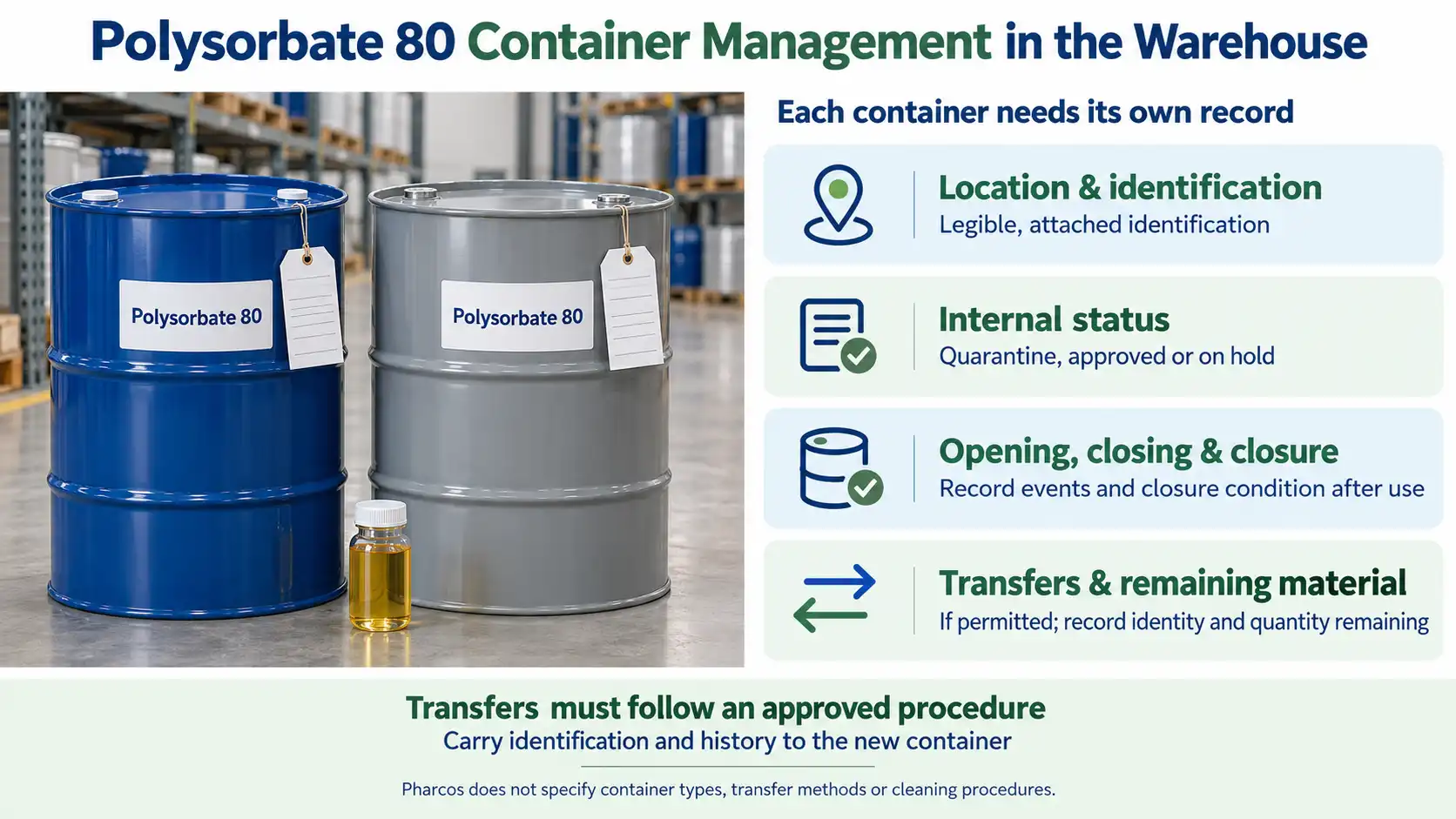
Polysorbate 80 Container Management in the Warehouse
Two drums from one batch can have very different histories, so each container needs its own record. The organisation may need to define records for:
- Container location.
- Legible, attached identification.
- Status under internal procedures, such as quarantine, approved or on hold.
- Each opening and closing event.
- Closure condition after use.
- Transfers to other containers, if permitted.
- Identity and quantity of material remaining.
The Pharcos information reviewed does not specify container types, transfer methods or cleaning procedures, so any transfer must follow an approved procedure that carries identification and history to the new container.
Polysorbate 80 Dispensing and Exposure Records
Dispensing is when a container is open and material leaves it. The record should capture:
- Container and batch used.
- Date and quantity dispensed.
- Equipment or utensils used under approved procedures.
- Opening and closing times.
- Any exposure or interruption needing review.
- Quantity remaining.
- The production batch receiving the material.
Note interruptions when they happen, such as a closure left off at a shift change or a spill near the dispensing point. Returning unused material to its original container is not routine; it needs an approved procedure and an assessment of the material.
Our Other Product
Polysorbate 20 | Solubilizers (Liquid)Oxidation Considerations and Polysorbate 80 Stability
Pharcos describes Polysorbate 80 as Polyoxyethylene (20) Sorbitan Monooleate, an oleate ester based on oleic acid that is liquid at room temperature. The Pharcos information reviewed does not specify how the material responds to air, light or heat, or any oxidation limits, test methods or protective measures. Questions to put to the supplier include:
- Is oxidation relevant for this grade, and under which conditions?
- Are there precautions for opened or partly used containers?
- Which specification parameters indicate a change in quality?
- Is retesting advised after an exposure event, and by which method?
- What supports the assigned shelf life or retest date?
Until those answers are on file, a colour or odour change is an observation for review, not proof of oxidation.
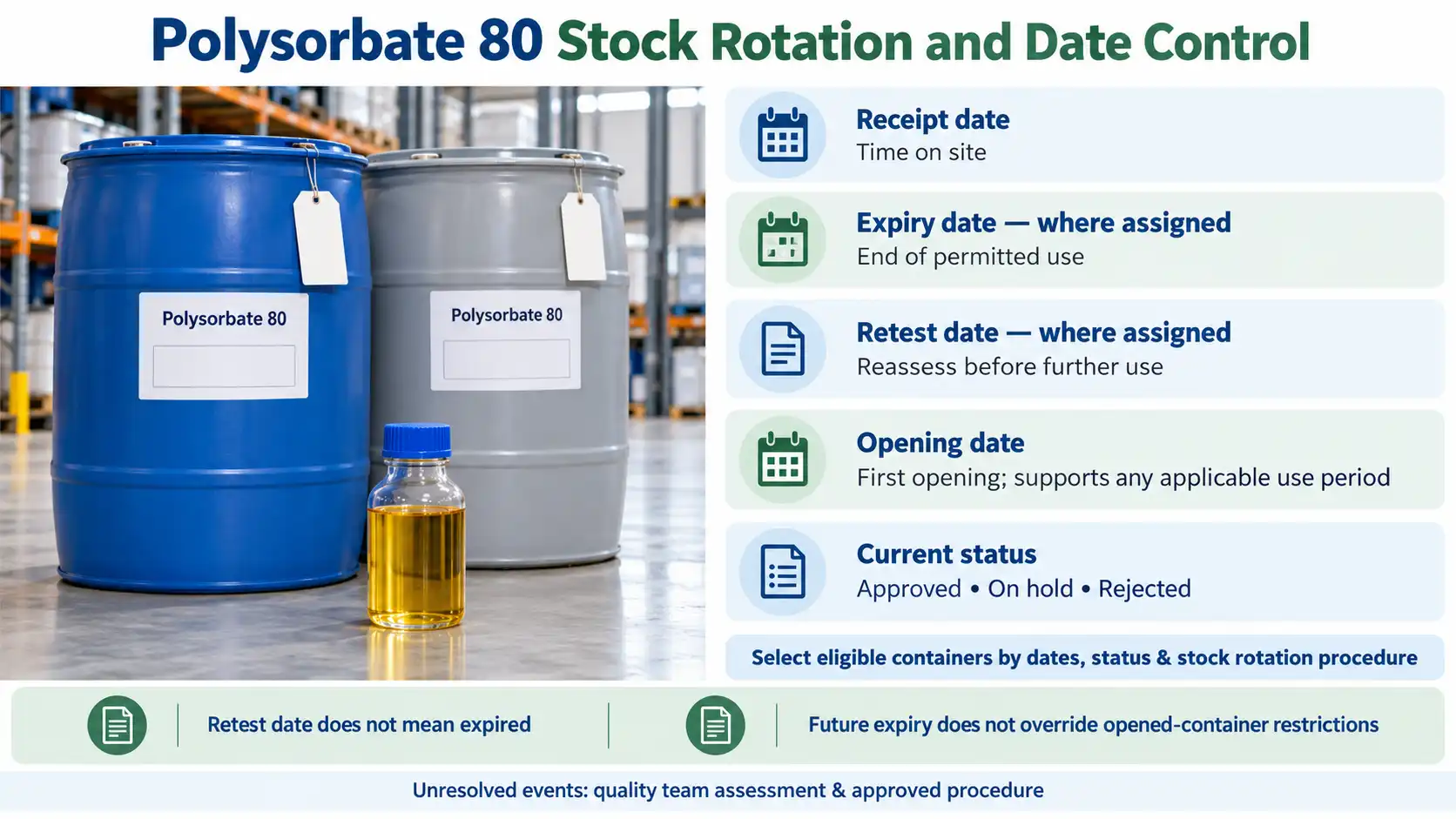
Polysorbate 80 Stock Rotation and Date Control
Stock selection depends on dates with different meanings:
- Receipt date: how long the material has been on site.
- Expiry date, where assigned: the end of the permitted period of use.
- Retest date, where assigned: when the material must be reassessed before further use.
- Opening date: records when a container was first opened and supports any applicable period of use after opening.
- Current status: approved, on hold or rejected.
Reaching a retest date does not mean the material has expired, and a future expiry date does not override a restriction on an opened container. Select eligible containers according to applicable dates, approval status and the organisation's stock rotation procedure. Eligibility of containers with unresolved events should follow the quality team's assessment and approved procedure.
Polysorbate 80 Production Handover and Traceability
The handover record should let production confirm, without searching elsewhere:
- Correct material and grade.
- Batch and container traceability.
- Quantity issued.
- Current approval status.
- Any handling restriction or open event.
- The intended production batch.
If any item cannot be confirmed, the handover pauses until it can.
Investigating Unexpected Changes in Polysorbate 80
Triggers include unexpected appearance, a damaged closure, missing identification, uncertain exposure history or a departure from supplier instructions. None automatically makes the material unsuitable, but each needs a documented assessment covering:
- The observation or event.
- Affected batch and containers.
- Timing and handling history.
- Comparison with the applicable specification or instruction.
- Supplier clarification, where needed.
- The decision and the responsible reviewer.
Warming, mixing, filtering or other corrective treatment should be applied only where the supplier or an approved procedure specifies it.
Polysorbate 80 Documentation Table
| Stage | Record to Maintain | Decision the Record Supports |
|---|---|---|
| Receipt | Identity, batch, quantity, container condition, documents, discrepancies | Whether the consignment enters stock and under which status |
| Storage instructions | Instruction source, revision, supplier clarification | Whether storage practice matches what applies to the material |
| Container opening | Opening and closing events, closure condition, remaining quantity | Whether container history supports continued use |
| Dispensing | Container, quantity, equipment, interruptions, receiving batch | Whether exposure is accounted for and material is traceable |
| Stock selection | Receipt, expiry, retest and opening dates, status | Which container is eligible next |
| Production handover | Material, grade, batch, quantity, status, restrictions | Whether production can accept the material |
| Investigation | Event, affected containers, comparison, supplier input, reviewer | Whether material is approved, restricted or rejected |
 Call Us Now!
About Pharcos Speciality Ltd, Polysorbate 80 Manufacturer and Exporter
Pharcos Speciality Ltd, established in 1974 and WHO GMP certified, supplies more than 150 products to over 30 countries, including Pharcocel HPMC, Pharcogol PEG, polysorbates, castor oil ethoxylates, Laureth and Ceteareth grades, emulsifiers and surfactants. As a polysorbate 80 manufacturer and exporter, it offers Pharcos PS 80 Polysorbate 80 liquid solubilizer.
Conclusion: Documented History Supports Polysorbate 80 Release
Documented handling history supports the quality team's release decision alongside applicable specifications, testing and approval requirements. A complete record of each container's receipt, storage, opening and dispensing gives that decision a traceable basis.
Our Other Product
Polysorbate 60 | Emulsifiers (Paste)Polysorbate 80 Storage and Handling FAQs

Dr. Avinash Dubey (R&D Head)
Dr. Avinash Dubey is a PhD in Organic Chemistry with a distinguished career spanning more than four decades. As the head of R&D at Pharcos, he focuses on the development of novel molecules for a wide array of industrial sectors, blending long-standing experience with a passion for innovation.

Mr. Ankit Shah (Managing Director)
Mr. Ankit Shah has led Pharcos Speciality for over three decades, establishing it as a pioneer in specialty chemicals. He currently directs the company’s strategic expansion into the APIs, Excipient and Speciality Surfactants markets, upholding a steadfast commitment to "Make in India" and world-class manufacturing quality and new product development.