
Polysorbate 40 in Creams and Lotions: A Practical Guide to Emulsifier Selection and Testing




AI Summary
Polysorbate 40, offered by Pharcos Speciality Ltd as Pharcos PS 40, is a palmitic acid derived oil in water emulsifier listed for creams and lotions. This guide explains how to judge it within a complete emulsifier system using a structured development checklist, and separates documented ingredient properties from performance that only the intended formulation can confirm.
Polysorbate 40 Emulsifier Selection for Creams and Lotions
An ingredient name on a formulation sheet does not decide whether a cream or lotion will work. The right emulsifier depends on the oil phase, target texture, process and shelf behaviour the product must deliver. This guide treats the polysorbate 40 emulsifier offered by Pharcos Speciality Ltd as one candidate within a complete emulsifier system, judged against the requirements of a specific product.
 Start a Chat on WhatsApp!
Polysorbate 40 Formulation Brief: Defining Emulsion Requirements
Before any polysorbate 40 formulation is drafted, the team needs a written brief describing what the finished product must be.
- Product format and use: whether the product is a cream, a lotion or another emulsion, and how it will be applied.
- Emulsion structure: the intended structure, recorded as a project decision rather than assumed from the emulsifier.
- Oil phase: the proposed oils, butters or other lipophilic components, and their planned loading.
- Consistency and application: the target body, spread and finish, described in terms the team can later assess.
- Processing and packaging: equipment limits, batch considerations and the container the product will be filled into.
- Reference: an existing product or formulation that serves as the comparison point.
Pharcos content links polysorbate grade selection to fatty acid type, HLB value and the intended application environment. The brief is where that environment is defined.
Polysorbate 40 in Cosmetics: Identity and Emulsifier Role
Pharcos identifies Polysorbate 40 as Polyoxyethylene (20) Sorbitan Monopalmitate, CAS 9005-66-7. Supplied as Pharcos PS 40, it is derived from palmitic acid and sits in the Pharcos personal care line under emulsifiers, in a liquid or paste grade.
Pharcos describes Pharcos PS 40 as an O/W emulsifier in creams and lotions. Its published material on polysorbate 40 in cosmetics adds that the ingredient helps stabilise emulsions by reducing interfacial tension between the oil and water phases, and notes a slightly waxy character relative to Polysorbate 20. The same grade is also listed for flavour solubilising, lubricant and textile antistatic uses.
This supports treating Polysorbate 40 as a candidate oil in water emulsifier. It does not establish that the material will work as the sole emulsifier in a particular cream or improve moisturisation, absorption or skin feel.
Polysorbate 40 Oil Phase Compatibility
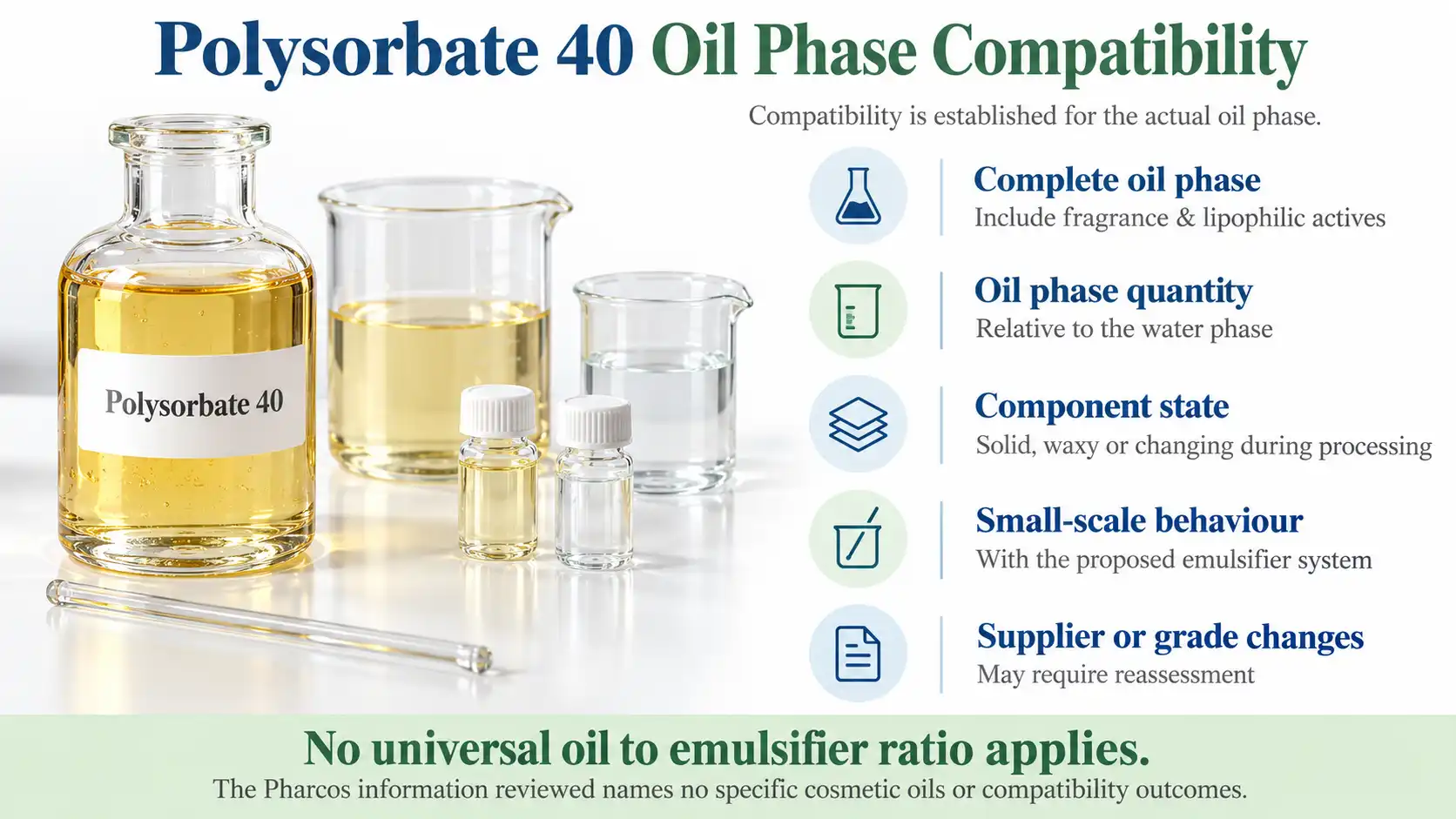
The Pharcos information reviewed names no specific cosmetic oils or compatibility outcomes for Polysorbate 40, so compatibility is established for the actual oil phase. The formulator should record:
- The complete oil phase composition, including minor lipophilic additives such as fragrance or actives.
- The intended oil phase quantity relative to the water phase.
- Whether any component is solid, waxy or likely to change state during processing.
- How the oil phase behaves with the proposed emulsifier system in small scale preparations.
- Any change of oil supplier or grade that may require reassessment.
No universal oil to emulsifier ratio applies.
Polysorbate 40 HLB Screening
Pharcos describes HLB, the hydrophilic lipophilic balance, as the value chemists use to predict an emulsifier's effectiveness in oil in water or water in oil systems, and notes that Polysorbate 40 is used to fine tune interfacial behaviour when emulsifiers are blended toward a composite HLB target.
Confirm the HLB value for Pharcos PS 40 with its technical team and consider it alongside the requirements of the selected oil phase. Required HLB figures for the oils should come from documented data the team accepts.
HLB narrows the list of candidates and suggests starting blends. A matched value is a screening result, not proof that the emulsion will hold or meet the brief.
Our Other Product
Polysorbate 60 | Emulsifiers (Paste)Polysorbate 40 Coemulsifier Selection
Whether Polysorbate 40 is assessed alone or with other emulsifiers is a project decision. Pharcos offers sorbitan ester ethoxylates in laurate, palmitate, stearate and oleate types to match specific emulsification needs, but the information reviewed names no recommended coemulsifier for Polysorbate 40 in creams or lotions.
For each component considered, record:
- Its intended role, such as primary emulsifier or coemulsifier.
- The evidence supporting that role in this type of product.
- What the formulation would lose if the component were removed.
Assess whether the coemulsifier helps the complete system meet the formulation brief. Not every formulation needs one.
Polysorbate 40 Concentration Trials
The Pharcos information reviewed gives no recommended use level for Polysorbate 40 in creams or lotions, so the team sets and justifies the trial range. The steps in this and the next two sections are suggested development practice, not Pharcos instructions. A trial record includes:
- Candidate material identity, including grade, batch and specification reference.
- The reference formulation used as the control.
- Each trial concentration and the reason it was chosen.
- Variables held constant, such as oil phase composition, process steps and equipment.
- Any planned change to the emulsifier blend, logged as a separate trial series.
- Observations recorded for every trial in the same format.
- The criteria used to select candidates for further assessment.
Changing the emulsifier level while also altering the oil phase, thickener or process makes it harder to isolate the effect of concentration.
Polysorbate 40 Texture and Application Assessment
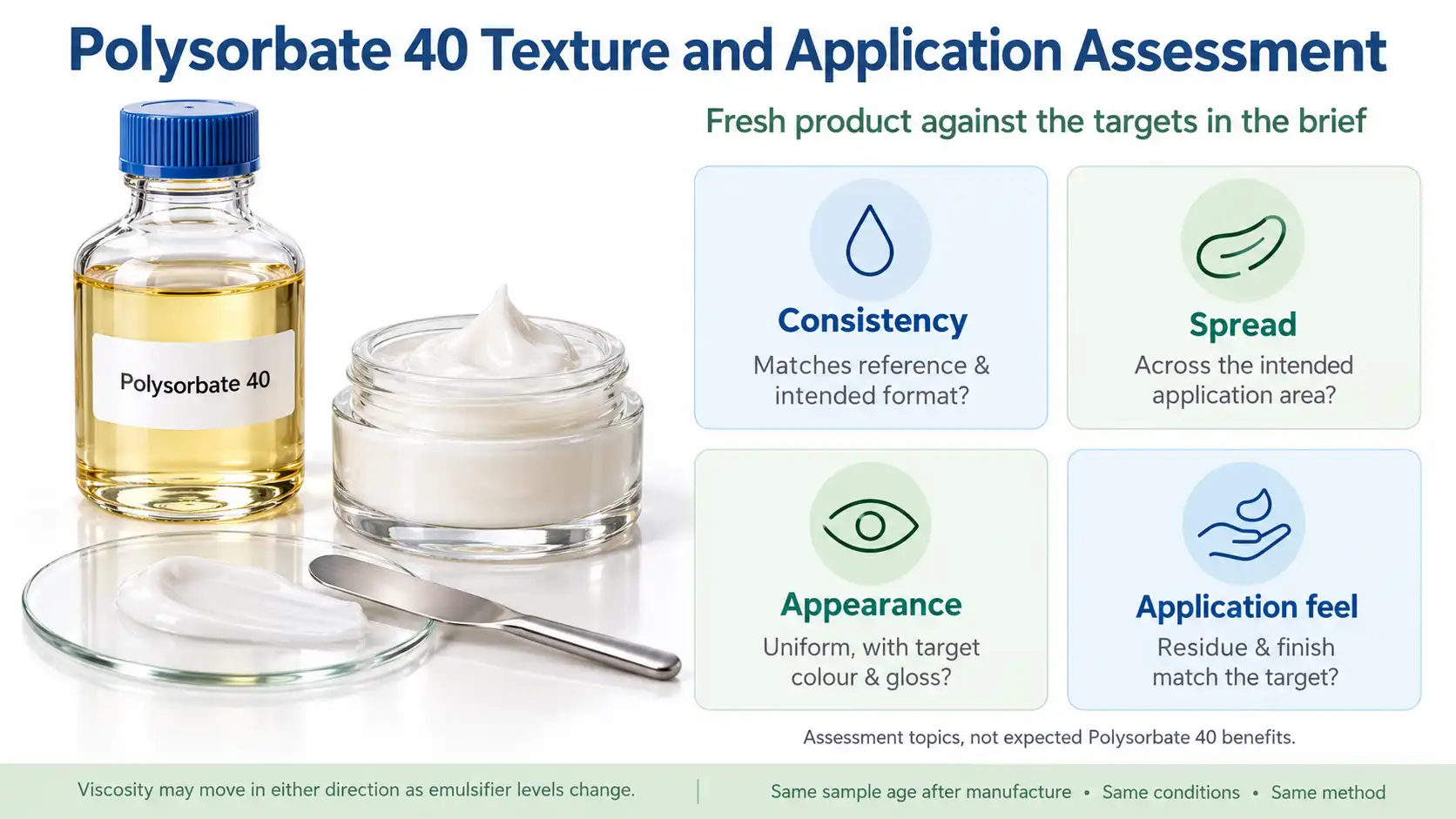
Initial assessment checks the fresh product against the targets in the brief:
- Does the consistency match the reference and the intended format?
- How does the product spread across the intended application area?
- Is the appearance uniform, with the colour and gloss the brief describes?
- Does the application feel, including any residue or finish, match the target?
These are assessment topics, not expected Polysorbate 40 benefits, and viscosity may move in either direction as emulsifier levels change. Assess every sample at the same age after manufacture, under the same conditions and with the same method.
Polysorbate 40 Emulsion Stability Evaluation
Stability evaluation asks whether the candidate keeps the characteristics the brief requires over time. The Pharcos information reviewed does not provide finished product stability data for the cream or lotion being developed. The team needs to define:
- Attributes to monitor, such as appearance, consistency, odour and signs of separation.
- The assessment method for each attribute.
- Evaluation conditions and duration, chosen and justified by the team.
- The packaging used, ideally the intended final container.
- Acceptance criteria for each attribute, set before assessment begins.
- How changes and unresolved observations will be recorded and escalated.
A sample that looks uniform straight after manufacture has passed only its first inspection, and ingredient information alone cannot support a shelf life claim.
Polysorbate 40 Formulation Development Checklist
This planning checklist summarises the suggested practice above; it is not a validated formula or an official Pharcos protocol.
| Development Stage | Decision to Make | Evidence or Record Needed |
|---|---|---|
| Formulation brief | What must the product be, and what is it compared against? | Written brief covering format, structure, oil phase, targets, constraints and reference |
| Ingredient role | Is Polysorbate 40 a reasonable candidate for the intended role? | Confirmed identity, specification and stated function |
| Oil compatibility | Can the proposed emulsifier system handle this oil phase? | Full oil phase composition, loading and small scale observations |
| HLB screening | Which emulsifiers and blends are worth trialling? | Supplier HLB data and documented oil requirements |
| Coemulsifier assessment | Does the system need another emulsifier, and why? | Role statement and comparative results for the combination |
| Concentration trials | Which levels move forward? | Controlled trial records with constant variables and stated rationale |
| Texture | Does the fresh product meet application targets? | Assessments under consistent conditions against the reference |
| Stability | Does the candidate keep its required characteristics? | Defined attributes, methods, conditions, packaging and acceptance criteria |
Polysorbate 40 Manufacturer: Pharcos Speciality Ltd
Pharcos Speciality Ltd is a Polysorbate 40 manufacturer with more than five decades of experience in specialty chemicals, excipients and ingredients. It offers the Pharcos PS 40 Polysorbate 40 emulsifier within its personal care range, and its technical team handles enquiries for samples, pricing and technical documentation.
 Call Us Now!
Polysorbate 40 Selection Decision
Polysorbate 40 should be selected because evidence from the intended formulation shows the complete emulsifier system meets the product's requirements, not because of its general classification. Development teams looking for an Indian Polysorbate 40 exporter are welcome to discuss their Pharcos PS 40 requirements with Pharcos Speciality Ltd.
Our Other Product
Polysorbate 80 | Solubilizers (Liquid)Polysorbate 40 Supplier Enquiry FAQ

Dr. Avinash Dubey (R&D Head)
Dr. Avinash Dubey is a PhD in Organic Chemistry with a distinguished career spanning more than four decades. As the head of R&D at Pharcos, he focuses on the development of novel molecules for a wide array of industrial sectors, blending long-standing experience with a passion for innovation.

Mr. Ankit Shah (Managing Director)
Mr. Ankit Shah has led Pharcos Speciality for over three decades, establishing it as a pioneer in specialty chemicals. He currently directs the company’s strategic expansion into the APIs, Excipient and Speciality Surfactants markets, upholding a steadfast commitment to "Make in India" and world-class manufacturing quality and new product development.