

Polysorbate 85 Supplier Qualification: Identity, Quality Specifications and Batch Consistency




AI Summary: Polysorbate 85 Supplier Qualification
Qualifying a polysorbate 85 supplier means confirming identity, specification compliance, application suitability and supply reliability as separate questions, since no single document or trial answers all four. Pharcos Speciality Ltd supplies Polysorbate 85 as Pharcos PS 85, a liquid dispersant for oil spill, textile, coupling and paraffin emulsification applications.
Why Polysorbate 85 Supplier Qualification Matters
Selecting a source of polysorbate 85 is rarely a matter of finding the right name on a price list. The harder task is confirming that what a supplier offers matches what the buyer's application, quality system and customers actually require. A polysorbate 85 supplier can quote material that carries the expected name yet differs in grade, documentation or supply arrangement from what the purchasing team assumed. This article follows that decision from technical brief to recorded approval.
 Start a Chat on WhatsApp!
Polysorbate 85 Application and Grade Requirements
Before any quotation is compared, the buyer needs a written brief covering:
- The intended application, described precisely enough for a technical reviewer to judge relevance.
- The material designation and grade exactly as the buyer's own specification names them.
- The internal specification reference against which offers will be assessed.
- Documentation the end use demands, which differs between industrial and regulated applications.
- Packaging, pack size, labelling and delivery requirements.
- The people responsible for technical review and final approval.
Grade designations are not interchangeable. Material offered for industrial use should not be assumed to satisfy pharmaceutical, cosmetic or food expectations, or the reverse, unless the supplier confirms the grade for that purpose.
Pharcos lists PS 85 under its personal care line, in the dispersants category, supplied as a liquid. Its stated applications are oil spill dispersion, textile lubrication, use as a coupling agent and paraffin wax emulsification in polishes, serving the personal care, lubricants, oil and gas and polishes industries. A buyer whose use falls outside that list should raise it directly rather than infer suitability. A clear brief also tells each polysorbate 85 manufacturer which polysorbate 85 specifications matter, so responses address the buyer's criteria instead of generic descriptions.
Polysorbate 85 Identity Verification
What is polysorbate 85? Pharcos identifies Polysorbate 85 as Polyoxyethylene (20) Sorbitan Trioleate, CAS 9005-70-3. It is offered as Pharcos PS 85 and described as a trioleate surfactant that is more lipophilic than Polysorbate 80.
Buyers confirm that the supplied material matches this identity by checking that the trade name, chemical name and CAS number agree across the quotation, supplier specification, container label and batch documentation. Where some records carry Pharcos PS 85 and others the generic name, the supplier should confirm in writing that both refer to the same material and grade. The grade itself is confirmed separately, by matching the supplier's stated grade and intended use against the buyer's brief, because a correct name and CAS number establish the substance but not its suitability or analytical quality.
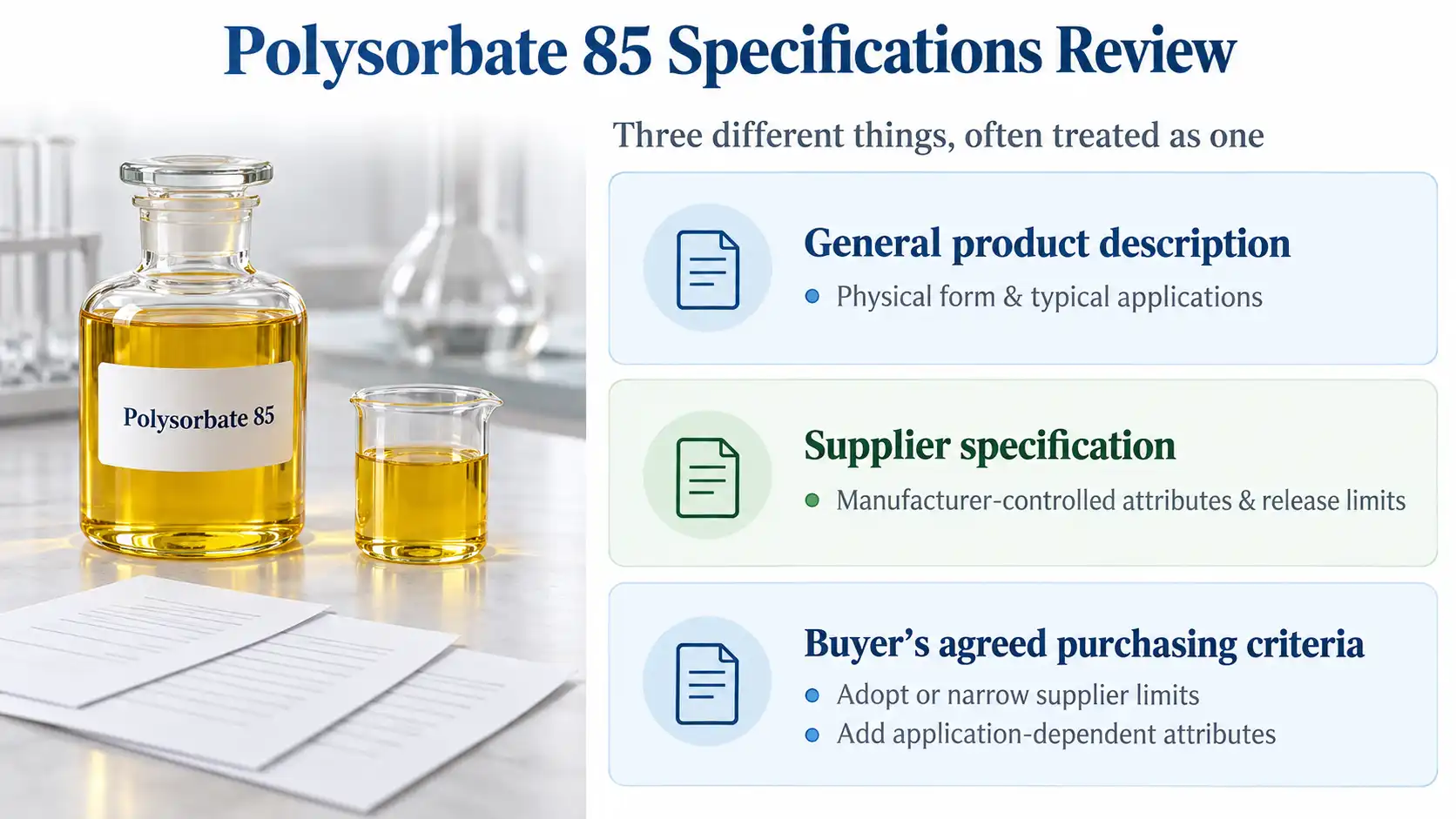
Polysorbate 85 Specifications Review
Three different things are often treated as one:
- A general product description, stating physical form and typical applications.
- The supplier specification, listing the attributes the manufacturer controls and the limits it releases against.
- The buyer's agreed purchasing criteria, which may adopt the supplier's limits, narrow them or add attributes the application depends on.
The Pharcos PS 85 information reviewed does not provide numerical specification limits, and Pharcos directs requests for detailed specifications to its technical team. The supplier specification is therefore the working document. For each attribute, the buyer needs the test method, units, limit and reporting basis, plus the specification's revision number and date.
A gap analysis against the internal specification shows attributes the supplier does not control, limits wider than the buyer accepts, or methods not comparable with the buyer's own testing. Each gap is closed by agreement, additional buyer testing or a decision that the material is unsuitable. Gaps should never be filled with attributes borrowed from another polysorbate or manufacturer. The outcome is a single, versioned set of agreed criteria.
Polysorbate 85 Certificate of Analysis Review
A Certificate of Analysis (CoA) reports how one particular batch was found against the agreed specification. Review points to define in the buyer's procedure include:
- Material name and supplied grade.
- Manufacturer or issuing organisation.
- Batch identification.
- The specification reference the batch was released against.
- Reported tests, methods and units.
- Results alongside stated acceptance criteria.
- Relevant dates, such as manufacture and testing.
- Release identification or authorisation, where provided.
- Correspondence between the certificate and the delivered containers.
Each entry may be a figure measured on that batch, a qualitative statement such as "complies", or a value reported under another arrangement. An unclear reporting basis is a question for the supplier before the certificate is relied upon. A CoA provides the supplier's reported batch results and conformity statements; the buyer assesses these against its purchasing requirements. The certificate alone does not independently verify the material.
Our Other Product
Polyethylene Glycol (PEG)Polysorbate 85 Sample Qualification
Sample qualification asks whether the material works in the buyer's intended use. The evaluation record should capture:
- Sample identity and batch number.
- Origin of the sample and its storage and handling before testing.
- The purpose of the evaluation.
- The comparison material, such as an incumbent source or internal reference.
- The assessment criteria selected and why.
- Results, including unexplained observations.
- The scope of the resulting decision.
Concentrations, processing conditions and acceptance limits come from the buyer's own formulation knowledge and should be recorded as used, so the trial can be repeated and its conclusion stays tied to the conditions tested.
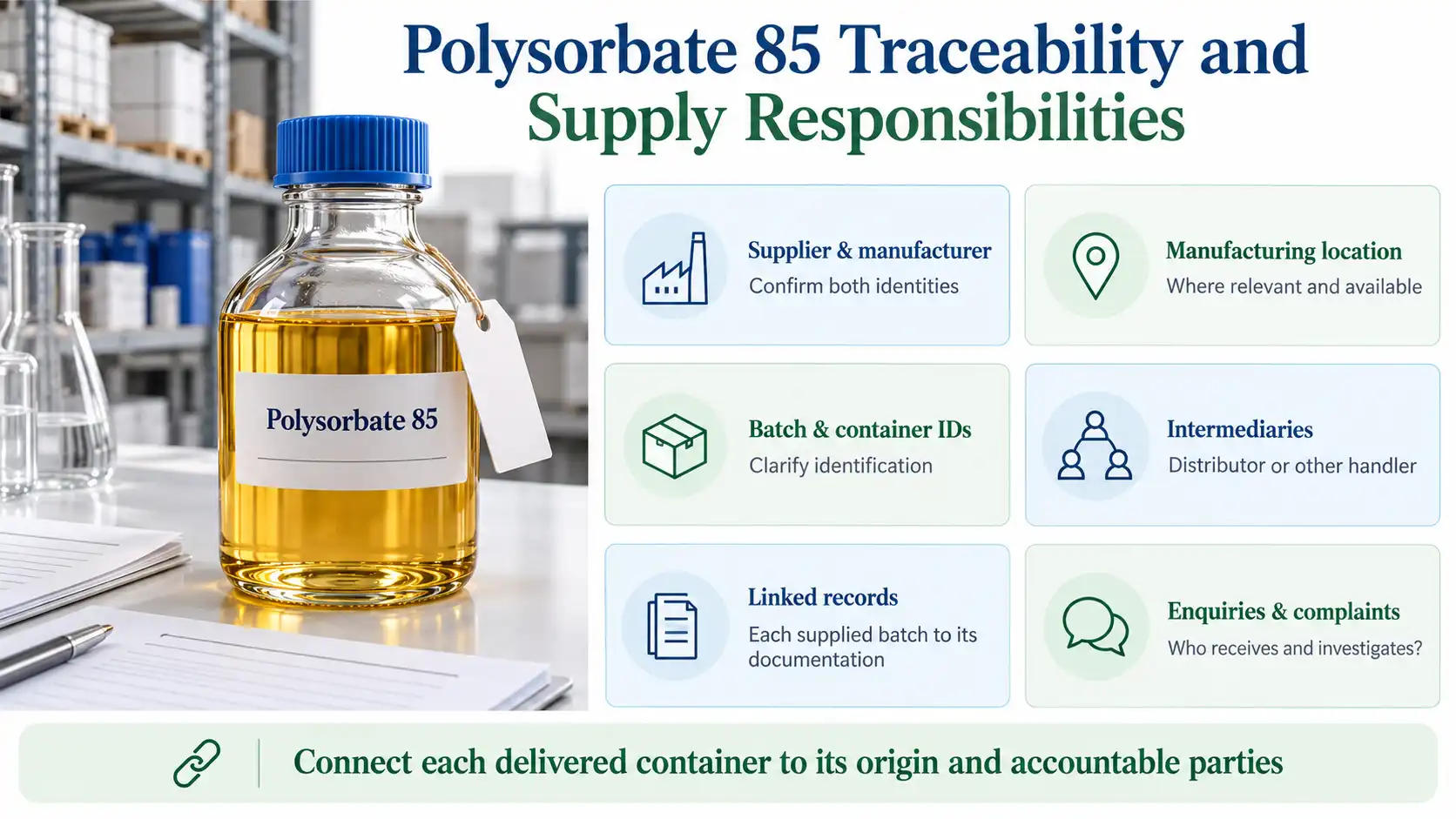
Polysorbate 85 Traceability and Supply Responsibilities
Traceability connects a delivered container to its origin and to the parties accountable for it. Buyers should clarify:
- The identities of the supplier and the manufacturer.
- The manufacturing location, where relevant and available.
- How batches and individual containers are identified.
- Whether a distributor or other intermediary handles the material.
- The records linking each supplied batch to its documentation.
- Who receives and investigates enquiries and complaints.
Supplier, manufacturer and distributor are not necessarily the same organisation, and which site produces a specific material is a point to confirm. When buying from a polysorbate 85 exporter through a local intermediary, the buyer needs to know which party holds batch records, which issues the CoA and which responds when a delivery is questioned.
Polysorbate 85 Batch Consistency
The buyer first decides which results matter most for the application and which process observations will be tracked alongside them. Compare results using consistent methods, units and reporting bases, or establish that any differences are equivalent. A method change between certificates can create an apparent shift that reflects measurement rather than material.
Two conclusions should be kept apart. Every batch falling within agreed limits shows compliance. Batches behaving alike in the buyer's process show consistency in use. Material can satisfy the first while sitting at different ends of a permitted range, with noticeable effects in production.
How many batches to review and what variation is acceptable are decisions for the buyer's own procedures. Evidence accumulates with each delivery; neither one good sample nor a run of compliant certificates proves permanent consistency.
Polysorbate 85 Change Notification Expectations
Approval reflects the material as supplied at the time of review, so buyer and supplier need to agree which future changes are communicated. Categories to discuss include:
- The material designation or trade name.
- Specification content or limits.
- The manufacturing source or site.
- Test methods.
- Packaging or labelling.
For each category, the parties should settle who notifies whom, what information accompanies the notice and how the buyer decides whether further qualification is needed. These are subjects for agreement in purchase terms or a quality agreement, not commitments to presume.
Polysorbate 85 Supplier Approval Decision
The approval record should state the approved supplier and material, including grade and trade name; the scope of approval, meaning the applications, sites and supply route covered; any conditions and open items; the responsible reviewers; and the basis and timing for future review. Approval for one grade, source or application does not extend to another.
| Qualification Stage | Decision Supported | Evidence or Clarification Needed |
|---|---|---|
| Purchasing brief | Which grade and documents an offer must match | Application, grade designation, internal specification, documentation and packaging needs |
| Identity verification | Whether the offered material is the intended substance | Consistent names and CAS number across quotation, specification, label and batch records |
| Specification review | Whether supplier controls cover the buyer's criteria | Current supplier specification with methods, units, limits and revision |
| CoA review | Whether reported batch results meet agreed criteria | Batch results, reporting basis and link to delivered containers |
| Sample qualification | Whether the material performs in the intended use | Documented evaluation against a reference, with defined scope |
| Traceability | Whether batches can be traced to source and accountable parties | Supplier, manufacturer and intermediary roles; batch linked records |
| Batch comparison | Whether variation is acceptable for the process | Comparable results and observations across several batches |
| Change notification | How future changes will be assessed | Agreed change categories, notification route and review responsibilities |
 Call Us Now!
About Pharcos Speciality Ltd, Polysorbate 85 Manufacturer
Pharcos Speciality Ltd is an Indian manufacturer, supplier and exporter with over five decades in specialty chemicals, whose Mehsana unit produces surfactants through ethoxylation and esterification. It offers Pharcos PS 85 Polysorbate 85 as a liquid dispersant, supplies markets including the USA, EU, Russia, CIS countries, Turkey and Latin America, and handles requests for detailed specifications, samples and pricing through its technical team.
Our Other Product
Hydroxypropyl Methylcellulose (HPMC)Choosing a Polysorbate 85 Supplier
A sound approval uses each piece of evidence for what it shows: identity from reconciled records, compliance from the agreed specification and assessed certificates, suitability from a scoped trial, and supply reliability from traceability, batch history and agreed change arrangements. Recording what was approved, and what was not, keeps the decision useful as supply evolves. Teams evaluating Polysorbate 85 can contact Pharcos Speciality Ltd to discuss their application, grade and documentation requirements.
Polysorbate 85 Supplier FAQs

Dr. Avinash Dubey (R&D Head)
Dr. Avinash Dubey is a PhD in Organic Chemistry with a distinguished career spanning more than four decades. As the head of R&D at Pharcos, he focuses on the development of novel molecules for a wide array of industrial sectors, blending long-standing experience with a passion for innovation.

Mr. Ankit Shah (Managing Director)
Mr. Ankit Shah has led Pharcos Speciality for over three decades, establishing it as a pioneer in specialty chemicals. He currently directs the company’s strategic expansion into the APIs, Excipient and Speciality Surfactants markets, upholding a steadfast commitment to "Make in India" and world-class manufacturing quality and new product development.