
Specialty Process Chemicals for Petroleum Refineries: Desalting Aids and Fuel Additives




AI Summary
Petroleum refining depends on specialty process chemicals at multiple stages, from the earliest crude oil processing step through to finished fuel quality. Crude oil arrives at a refinery carrying water, salt and other contaminants that must be removed before distillation, a step known as desalting, which relies on surfactant based demulsifiers to break tight water in crude oil emulsions. Later in the value chain, detergent and dispersant additives are blended into finished fuels to keep fuel injectors, valves and other engine components clean during use. Both applications depend on carefully selected ethoxylated surfactant chemistries matched to the specific crude slate or fuel system in question. This guide explains how crude desalting works, the role of fuel detergent additives, and how Pharcos Speciality Ltd supports refinery operators and fuel formulators with process chemicals manufactured in India.
 Call Us Now!
Why Process Chemicals Are Essential to Refinery Operations
Petroleum refining is a continuous, high throughput process where even small disruptions in feedstock quality or fuel formulation can have significant downstream consequences, from equipment corrosion to reduced fuel efficiency. Specialty process chemicals address these challenges at defined points in the value chain. At the front end of the refinery, desalting chemicals separate brine and contaminants from crude oil before it enters the distillation process. At the finished product end, fuel additives maintain engine cleanliness and combustion efficiency. Both categories rely on surfactant chemistry engineered for the specific demands of petroleum processing.
Understanding Crude Oil Desalting and Emulsion Breaking
Crude oil, as extracted, typically contains water droplets carrying dissolved salts, along with fine solids and other contaminants. Left untreated, these impurities can cause serious operational problems once the crude enters refinery processing.
Why desalting matters:
- Corrosion prevention: salts carried into downstream refinery units can hydrolyze under process heat to form corrosive compounds, accelerating equipment corrosion.
- Fouling reduction: residual water, salts and solids can contribute to fouling of heat exchangers and other process equipment, reducing thermal efficiency and increasing maintenance requirements.
- Product quality: effective desalting supports more consistent, higher quality output from downstream distillation and processing units.
How the desalting process works:
- Crude oil is mixed with wash water and a demulsifier chemical.
- The demulsifier destabilizes the water in oil emulsion, allowing dispersed water droplets to coalesce into larger droplets.
- An electrostatic desalter unit applies an electric field to further encourage droplet coalescence and separation.
- The now separated water, carrying dissolved salts, is drained from the bottom of the desalter, while cleaned crude oil proceeds to the distillation unit.
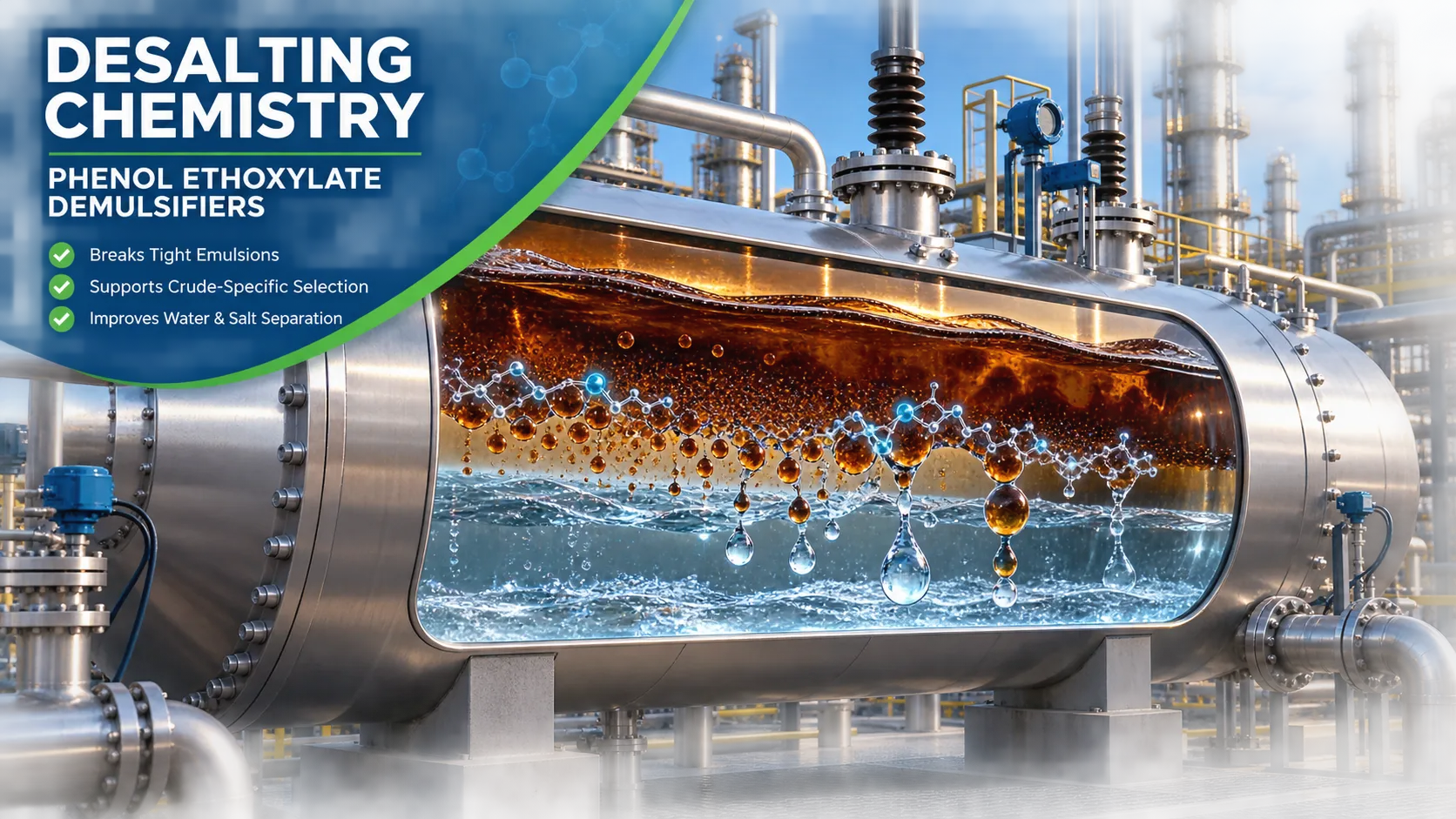
Desalting Chemistry: Phenol Ethoxylate Demulsifiers
Effective crude oil desalting depends on a demulsifier chemistry selected to match the specific crude oil's emulsion characteristics.
Key demulsifier chemistries used in desalting:
- Dodecyl phenol ethoxylates: Dodecyl Phenol Ethoxylates function as effective desalting aids by breaking tight crude oil emulsions within the desalter unit.
- Nonyl phenol ethoxylates at low mole ethoxylation: Nonyl Phenol Ethoxylates are also used as desalting aids, selected based on crude oil characteristics and desired emulsion breaking performance.
- Grade selection factors: the specific ethoxylation level and demulsifier chemistry required depends on the crude oil's American Petroleum Institute gravity and its particular emulsion stability characteristics, meaning demulsifier selection is often crude specific rather than universal.
Our Other Product
Pharmaceutical Grade HPMCFuel Detergent and Dispersant Additives
Beyond crude processing, ethoxylated surfactant chemistry also plays a role in finished fuel quality, specifically in keeping fuel delivery systems clean during vehicle and equipment operation.
- Detergent function: fuel additive surfactants help prevent and remove deposits that can accumulate on fuel injectors and intake valves over time.
- Dispersant function: these additives also help keep contaminant particles finely dispersed within the fuel, reducing their tendency to settle or agglomerate.
- Operational benefit: by keeping injectors and valves clean, these additives support more consistent fuel atomization and combustion efficiency over the operating life of an engine.
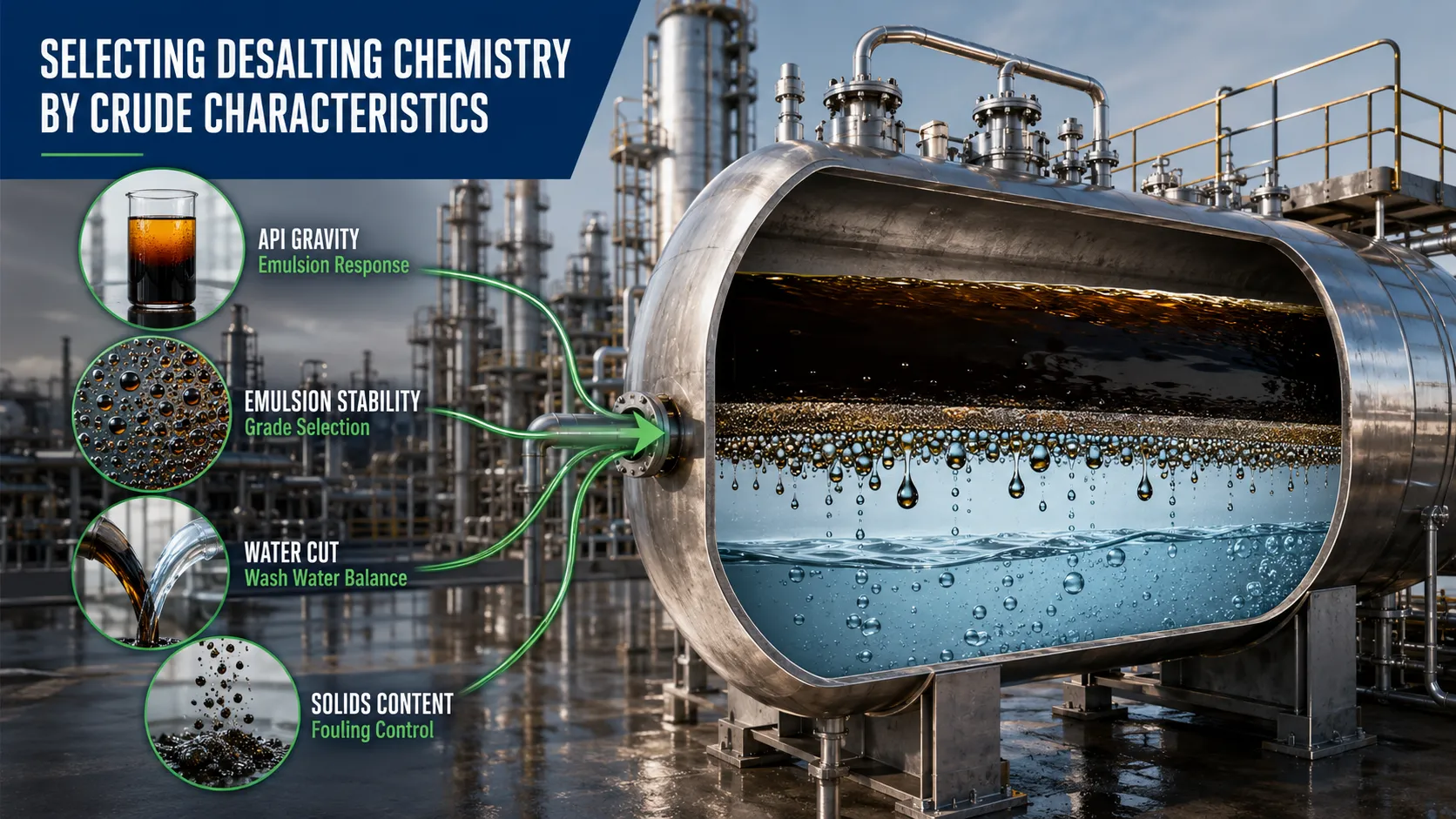
Selecting Desalting Chemistry by Crude Characteristics
| Crude Oil Characteristic | Desalting Consideration |
|---|---|
| API Gravity | Influences emulsion tightness and the demulsifier concentration and chemistry required |
| Emulsion Stability | Determines whether a stronger or milder demulsifier grade is appropriate |
| Water Cut | Affects wash water ratio and desalter operating parameters |
| Solids Content | May require additional consideration for fouling prevention alongside desalting chemistry |
Because these characteristics vary significantly across different crude slates, refinery operators typically work with pilot scale test quantities to evaluate and optimize demulsifier selection before committing to full scale continuous dosing.
Protecting Downstream Equipment from Corrosion and Fouling
Effective desalting is ultimately a protective measure for the substantial capital investment represented by downstream refinery equipment.
- Heat exchanger protection: reduced fouling from residual salts and solids helps maintain heat exchanger efficiency over time.
- Corrosion mitigation: removing chloride salts before they can hydrolyze into corrosive compounds under process heat directly protects piping and vessel integrity.
- Process reliability: consistent, well controlled desalting supports more predictable, reliable operation of downstream distillation and conversion units.
Why Choose Pharcos Speciality for Refinery Process Chemicals
Pharcos Speciality Ltd supplies specialty process chemicals for petroleum refining operations, including crude desalting aids and fuel detergent and dispersant additives.
What Pharcos offers refinery operators and fuel formulators:
- Crude desalting solutions: Dodecyl Phenol Ethoxylates and low mole Nonyl Phenol Ethoxylates functioning as effective desalting aids for breaking tight crude oil emulsions.
- Grade specific recommendations: technical guidance matching demulsifier grade to a refinery's specific crude oil API gravity and emulsion characteristics, with pilot scale test quantities available for evaluation.
- Fuel additive chemistry: ethoxylated products serving as detergent and dispersant additives for automotive and industrial fuel formulations.
- Process chemical expertise: an understanding of refinery chemistry that allows the Pharcos technical team to recommend products suited to specific crude slates and process conditions.
- Consistent bulk supply: reliable, large scale supply capability essential for continuous refinery operations that cannot tolerate interruptions in process chemical availability.
Refineries and fuel formulators evaluating a process chemical manufacturer or supplier in India can contact the Pharcos technical team to discuss crude characteristics, request pilot scale samples, and review demulsifier or fuel additive options for their specific operation.
 WhatsApp Now
Conclusion
From the moment crude oil arrives at a refinery to the point finished fuel reaches an engine, specialty process chemicals quietly support product quality, equipment protection and operational efficiency at every stage. Effective crude desalting, built on demulsifier chemistry matched to a specific crude's characteristics, protects downstream equipment from corrosion and fouling while supporting consistent processing quality. Fuel detergent and dispersant additives carry that quality focus through to the finished product, keeping engine components clean and combustion efficient. For refinery operators and fuel formulators, working with a process chemical supplier that understands crude specific desalting requirements and fuel additive chemistry is central to reliable, efficient operation.
Pharcos Speciality Ltd supplies desalting aids and fuel additive chemistries manufactured in India, backed by technical expertise and pilot scale testing support to help refinery operators identify the right process chemistry for their specific crude slate and operating conditions.
Our Other Product
Pharmaceutical Grade Polyethylene Glycol (PEG)Frequently Asked Questions

Dr. Avinash Dubey (R&D Head)
Dr. Avinash Dubey is a PhD in Organic Chemistry with a distinguished career spanning more than four decades. As the head of R&D at Pharcos, he focuses on the development of novel molecules for a wide array of industrial sectors, blending long-standing experience with a passion for innovation.

Mr. Ankit Shah (Managing Director)
Mr. Ankit Shah has led Pharcos Speciality for over three decades, establishing it as a pioneer in specialty chemicals. He currently directs the company’s strategic expansion into the APIs, Excipient and Speciality Surfactants markets, upholding a steadfast commitment to "Make in India" and world-class manufacturing quality and new product development.