
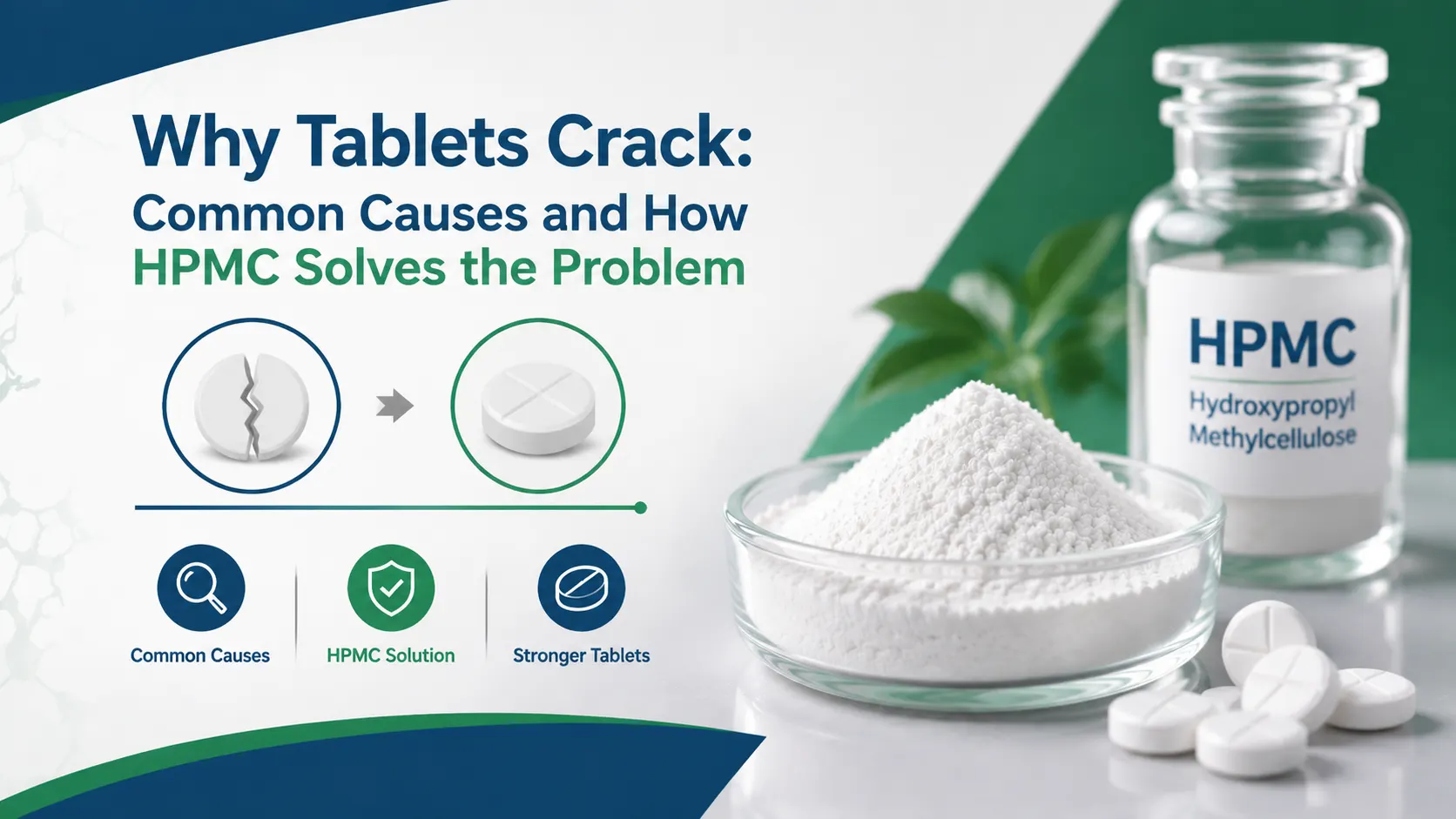
Why Tablets Crack: Common Causes and How HPMC Solves the Problem




AI Summary
Cracked tablets, technically described in pharmaceutical manufacturing as capping, lamination or chipping, are among the most common quality defects encountered in solid oral dosage form production. Capping occurs when the top or bottom crown of a tablet separates from the main body, lamination occurs when a tablet splits into distinct horizontal layers, and chipping occurs when small fragments break away from the tablet edge. These defects typically trace back to a small set of root causes: air entrapment during high speed compression, insufficient or poorly distributed binder, over dried granules with low plasticity, excessive compression force, short punch dwell time, and worn or poorly designed tooling. Hydroxypropyl Methylcellulose, known as HPMC or Hypromellose, addresses several of these root causes directly. As a binder, HPMC improves interparticle bonding and granule cohesion, reducing the internal weak points that lead to capping and lamination. Its film forming and moisture balancing properties also help prevent a related but distinct defect, film coating cracking, by keeping the applied coating flexible and well adhered to the tablet core. This guide explains why tablets crack, walks through the main causes with practical remedies, and explains how selecting the correct HPMC grade, using guidance drawn from the Pharcocel range manufactured by Pharcos Speciality Ltd, can materially reduce cracking related rejects in tablet manufacturing.
Why Tablet Cracking Is a Serious Quality Issue
A cracked tablet is not simply a cosmetic problem. Capping, lamination and chipping can affect dose uniformity, compromise the protective function of a film coat, allow moisture or oxygen to reach a sensitive active ingredient, and ultimately lead to batch rejection during in process or final quality control testing. Because these defects often appear only after compression, or in some cases only after coating or packaging, they can be costly to trace back to their root cause and expensive to correct once a batch is already in production. Understanding why tablets crack, and which excipient choices reduce the risk, is therefore a core part of robust tablet formulation design.
 WhatsApp Now
What Tablet Cracking Actually Means: Capping, Lamination and Chipping
Pharmaceutical manufacturing uses specific terms for different forms of tablet cracking, and identifying the correct type is the first step toward fixing it.
| Defect | Description | Typical Point of Occurrence |
|---|---|---|
| Capping | The top or bottom crown of the tablet separates fully or partially from the tablet body, leaving a concave gap | During ejection from the die or shortly after, sometimes during coating or packaging |
| Lamination | The tablet splits horizontally into two or more distinct layers | During or immediately after compression |
| Chipping | Small fragments break away from the tablet edge | During ejection, coating, or downstream handling and packaging |
| Sticking or Picking | Portions of the tablet surface stick to the punch face, creating an irregular, sometimes weakened surface | During compression |
Research published in peer reviewed pharmaceutical journals, including the International Journal of Pharmaceutics and AAPS PharmSciTech, has consistently identified lamination as a frequent precursor to capping, since the same internal weak plane that first causes a horizontal split can subsequently allow the tablet crown to separate entirely.
Common Causes of Tablet Cracking
Tablet cracking is rarely caused by a single factor. In most cases, it results from a combination of formulation, granulation and compression variables interacting with each other.
Point wise breakdown of the most common causes:
- Air entrapment during compression: at high compression speeds, air trapped within the powder bed does not have time to escape before the tablet is formed. When compression force is released, this trapped air expands and can push apart the top or bottom surface of the tablet, a widely documented mechanism behind capping and lamination.
- Insufficient or poorly distributed binder: binders are responsible for creating the interparticle bonds that hold a tablet together after compression. When binder levels are too low, or the binder is not evenly distributed through the granulation, the crown and body of the tablet are not strongly bonded, making separation more likely.
- Excessive fine particles in the granulation: a high proportion of fine, ungranulated powder increases the surface area that needs to be bound and increases the amount of air trapped between particles, both of which raise the risk of weak, crack prone tablets.
- Over dried granules: granules dried too aggressively lose plasticity and cohesion. These brittle granules cannot deform and bond properly under compression, leading to microcracks that can expand into visible capping or lamination.
- Excessive compression force: while adequate force is needed for tablet hardness, excessive force concentrates stress at the tablet edges and crown, increasing the likelihood of fracture, particularly in formulations with limited plastic deformation capacity.
- Short punch dwell time and high press speed: faster rotary press speeds reduce the time available for powder deaeration and particle bonding during each compression cycle, increasing the risk of trapped air and weak bonding.
- Worn or poorly designed tooling: punches and dies that are worn, poorly aligned, or lack features such as conical die openings that aid deaeration can directly contribute to capping and chipping.
- Elastic recovery of formulation materials: some excipients and active ingredients undergo significant elastic recovery after the compression force is removed, meaning the compact expands slightly once released from the die, which can reopen internal weak planes formed during compression.
- Formulation moisture imbalance: both excess moisture and moisture that is too low can weaken interparticle bonding, since an optimal moisture level supports plastic deformation during compression.
Summary Table: Root Causes and Their Underlying Mechanism
| Root Cause | Underlying Mechanism |
|---|---|
| Air entrapment | Trapped air expands on ejection, creating internal separation |
| Weak or insufficient binder | Poor interparticle bonding at the tablet crown and body |
| Excess fines | Increased air trapping and higher binder demand |
| Over dried granules | Loss of plasticity, brittle structure, microcrack formation |
| Excessive compression force | Stress concentration at edges and crown |
| High press speed, short dwell time | Insufficient time for deaeration and bonding |
| Worn or poor tooling | Uneven force distribution, inadequate deaeration |
| Elastic recovery | Post compression expansion reopens weak planes |
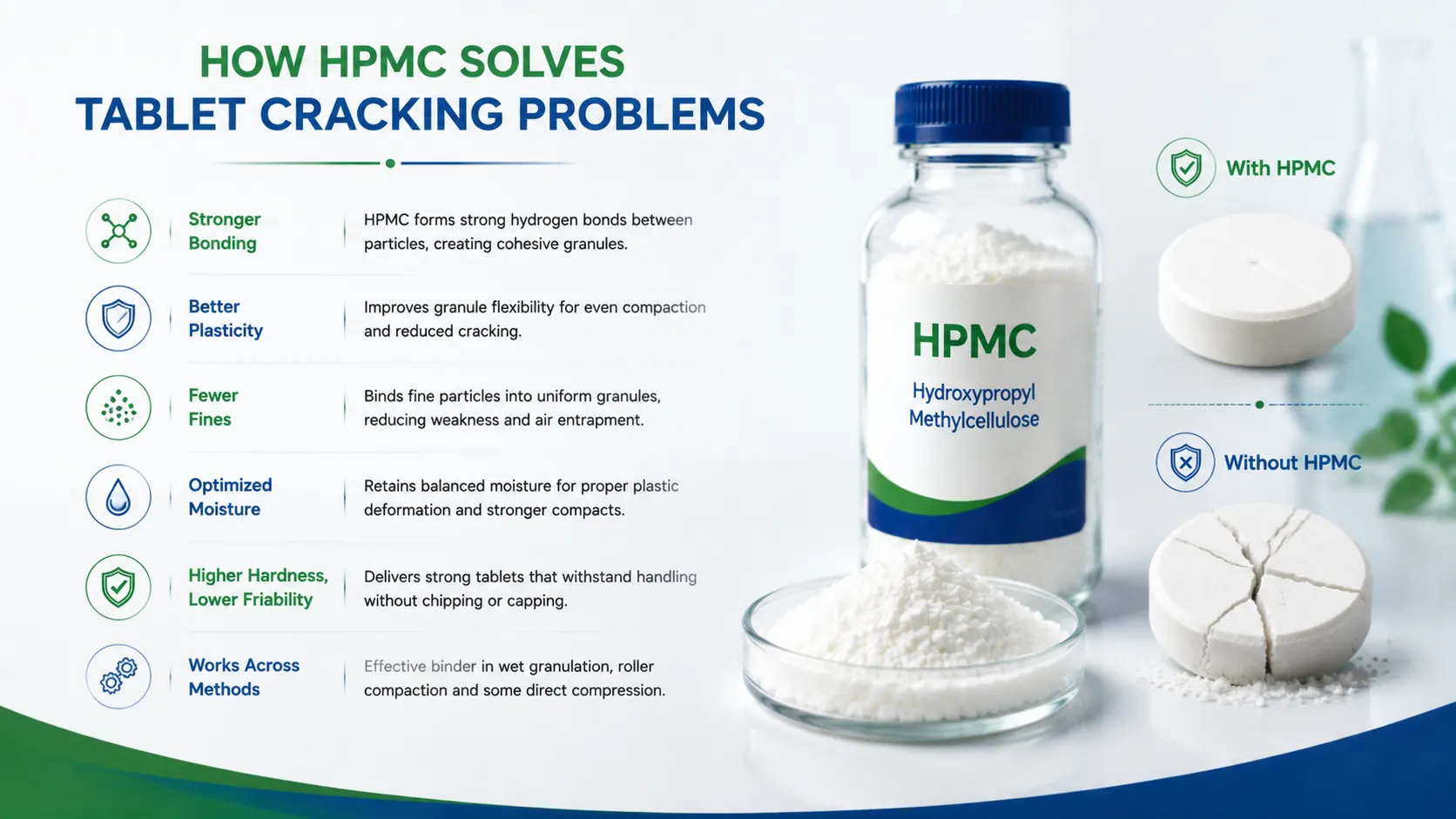
How HPMC Solves Tablet Cracking Problems
Hydroxypropyl Methylcellulose is one of the most effective and widely used excipients for addressing the formulation related causes of tablet cracking, particularly weak binding, poor granule cohesion and moisture imbalance.
Key ways HPMC contributes to crack resistant tablets:
- Improved interparticle bonding: when used as a binder in wet or dry granulation, HPMC forms a network of hydrogen bonds between particles once dissolved and redried, creating stronger, more cohesive granules than many powder blends achieve with an inadequate or poorly chosen binder.
- Enhanced plasticity of granules: HPMC bound granules generally retain a degree of plastic deformability during compression, allowing the tablet to compact more evenly and absorb compression stress rather than fracturing along internal weak planes.
- Reduced fines related weakness: by binding fine particles into larger, more uniform granules during granulation, HPMC directly reduces the proportion of loose fines that would otherwise increase air entrapment risk during compression.
- Balanced moisture retention: HPMC based granulations tend to retain a more favorable, controlled moisture profile compared to over dried or poorly controlled batches, supporting the plastic deformation needed for strong, crack resistant compacts.
- Improved tablet hardness with lower friability: formulations using an appropriately selected HPMC binder grade generally achieve the hardness needed to survive handling and coating without the brittleness that leads to chipping or capping.
- Support across granulation methods: HPMC functions effectively as a binder in wet granulation, as a dry binder in roller compaction, and in some direct compression formulations, giving formulators flexibility to address cracking risk regardless of the manufacturing route used.
Our Other Product
HPMC 4000 cpsHPMC Based Solutions Mapped to Root Causes
| Root Cause of Cracking | How HPMC Addresses It |
|---|---|
| Insufficient or uneven binder | HPMC provides strong, evenly distributed interparticle bonding when incorporated during granulation |
| Excessive fines | HPMC binds fine particles into more uniform, well bonded granules, reducing loose fines carried into compression |
| Over dried, brittle granules | HPMC based granulations support better plasticity and cohesion, reducing microcrack formation |
| Weak crown to body bonding (capping risk) | Improved interparticle adhesion strengthens the bond across the entire compact, including the crown region |
| Film coat cracking after compression | Low viscosity HPMC film coats provide flexibility and adhesion that resist cracking during drying and handling |
While HPMC cannot fully compensate for incorrect compression force, excessive press speed or worn tooling, since these are process and equipment factors, it directly strengthens the formulation side of the equation, which is frequently the deciding factor in whether a marginal process setting results in acceptable tablets or a batch affected by capping and lamination.
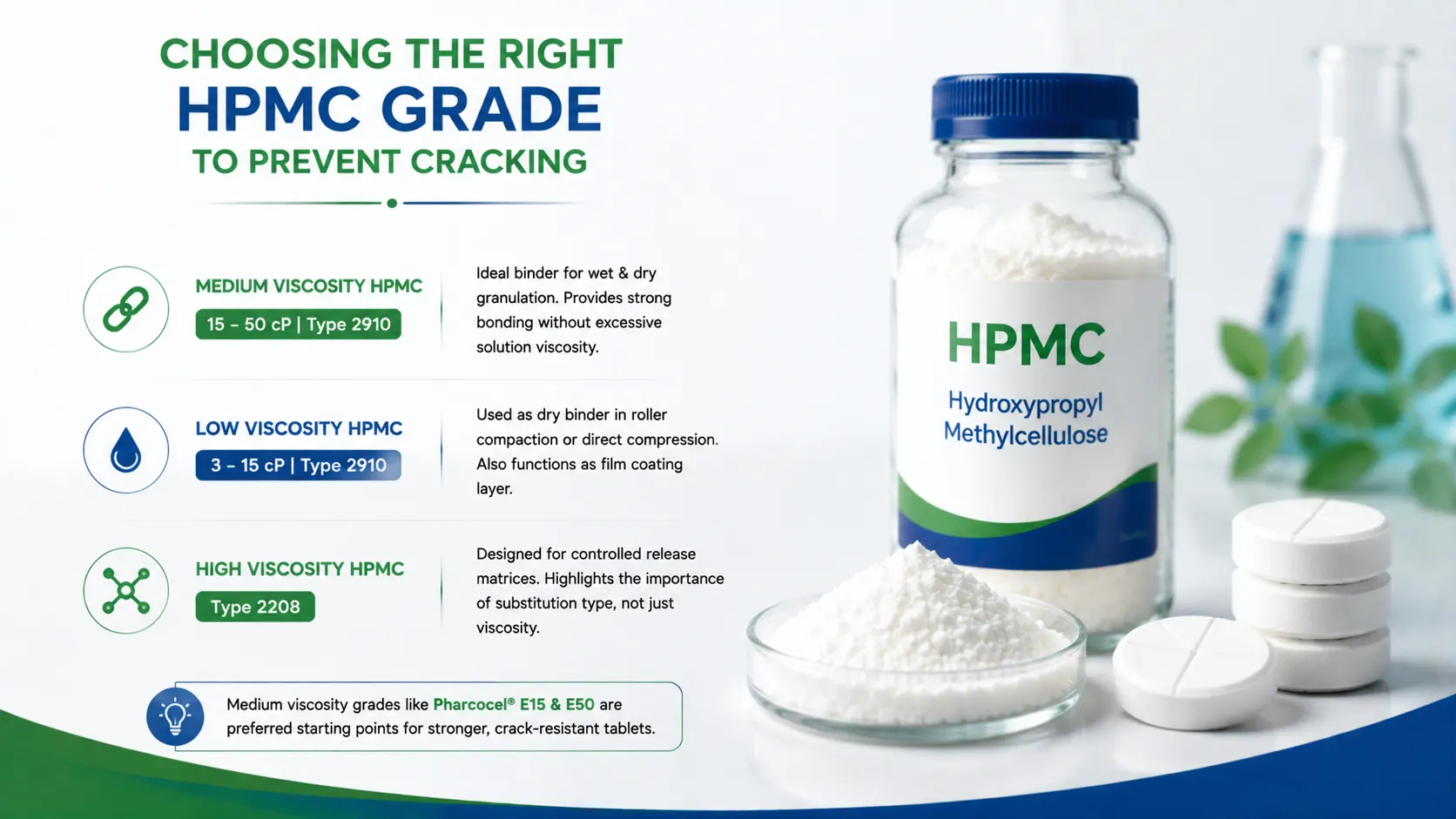
Choosing the Right HPMC Grade to Prevent Cracking
Not every HPMC grade is suited to binder applications, so grade selection matters as much as the decision to use HPMC at all.
- Medium viscosity HPMC grades (approximately 15 to 50 centipoise), Type 2910: these are the standard choice for tablet binding in both wet granulation and dry granulation, offering the balance of solution viscosity and adhesive strength needed for reliable interparticle bonding without making the granulating solution too thick to process efficiently.
- Low viscosity HPMC grades (approximately 3 to 15 centipoise), Type 2910: these are more commonly used as dry binders in roller compaction or blended directly into powder for direct compression, and also serve double duty as the film coating layer once the tablet core has been compressed.
- High viscosity HPMC, Type 2208 grades: while primarily intended for controlled release matrix systems rather than standard binding, their strong gelling behavior is a useful reference point for understanding why HPMC substitution type, not just viscosity, affects performance in different tablet applications.
As a general formulation starting point, medium viscosity grades such as Pharcocel E15 and E50 are typically evaluated first for binder applications targeting improved tablet hardness and reduced capping or lamination risk, with grade and concentration fine tuned through standard formulation development and compression trials.
HPMC and Film Coating Cracks: A Related but Different Problem
It is worth distinguishing tablet core cracking, discussed above, from film coating cracking, which is a separate but related defect where the applied coating layer itself develops fine cracks or flakes away from the tablet surface.
How HPMC based film coating reduces coating cracks:
- Flexible film formation: low viscosity HPMC grades form flexible, continuous films that can accommodate the slight expansion and contraction of the tablet core during drying and storage without cracking.
- Strong adhesion to the tablet surface: a well formulated HPMC coating solution adheres closely to the compressed core, reducing the risk of the coating separating or flaking, a defect that can visually resemble capping but originates at the coating layer rather than within the tablet core.
- Controlled drying behavior: HPMC coating systems dissolve readily in water, supporting a smooth, even coating application that dries into a uniform film rather than an uneven, stress prone layer.
- Complementary role with plasticizers: HPMC film coats are often combined with a plasticizing excipient, such as a suitable grade of polyethylene glycol, to further improve film flexibility and reduce the likelihood of cracking during the coating process and subsequent handling.
Formulators troubleshooting a cracked or flaking tablet should therefore check both the core formulation, where a weak or absent binder is often the underlying issue, and the film coating formulation, where an unsuitable HPMC viscosity grade or insufficient plasticizer can independently cause coating level cracks.
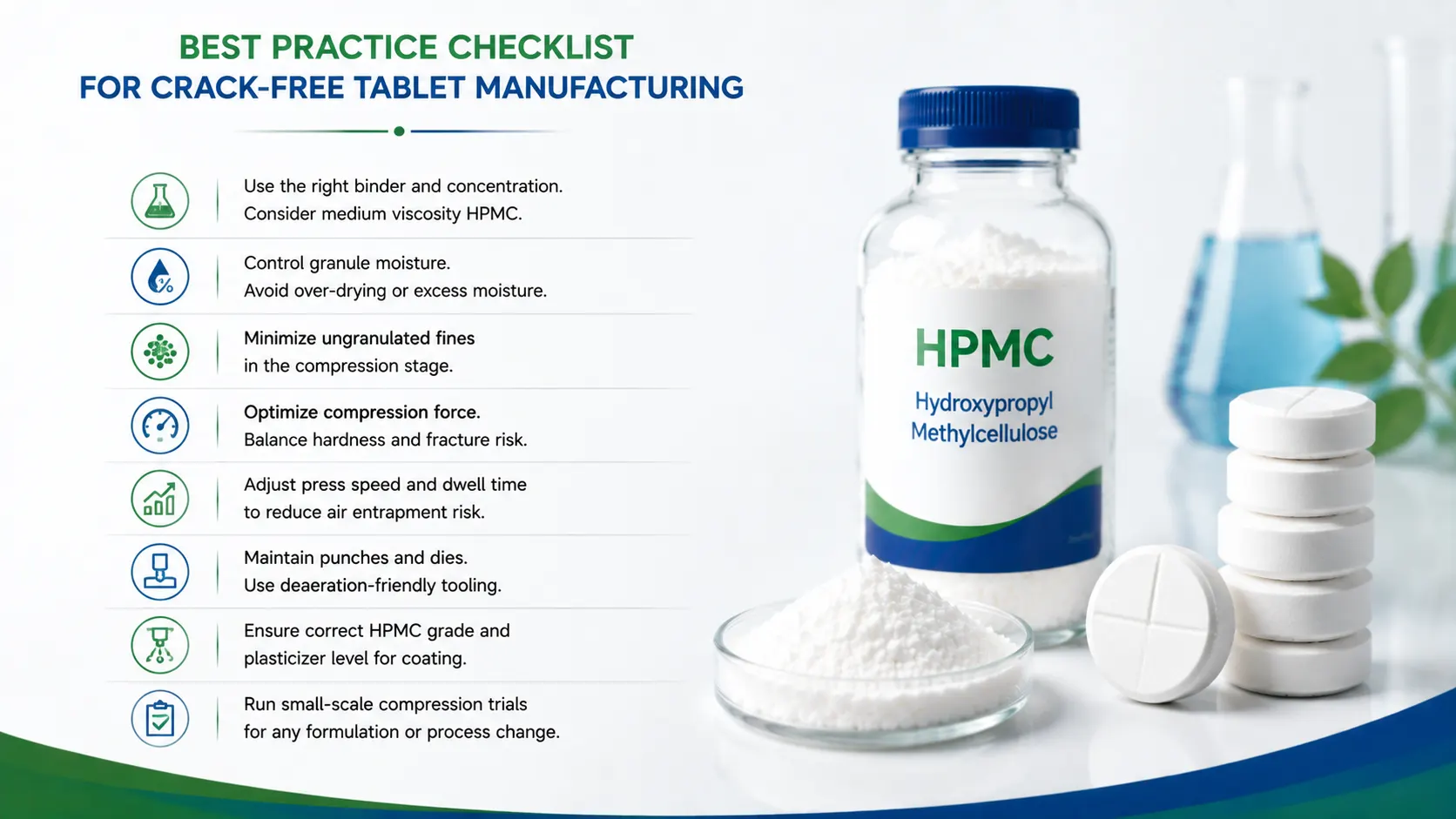
Best Practice Checklist for Crack Free Tablet Manufacturing
- Confirm binder type and concentration are appropriate for the formulation, and consider a medium viscosity HPMC grade where current binding performance is inconsistent.
- Monitor and control granule moisture content using loss on drying or moisture analyzer testing, avoiding both over drying and excess residual moisture.
- Minimize the proportion of ungranulated fines carried into the compression stage.
- Review compression force settings to avoid excessive stress concentration, balancing adequate hardness against fracture risk.
- Evaluate press speed and dwell time, since insufficient dwell time at high speed can increase air entrapment risk.
- Inspect punches and dies regularly for wear, and consider tooling designed to aid deaeration, such as dies with conical openings.
- If using film coating, confirm the HPMC viscosity grade and plasticizer level are appropriate for the coating process, whether aqueous or organic solvent based.
- Conduct small scale compression trials whenever a new binder grade, granulation method or tooling change is introduced, before committing to full batch production.
Our Other Product
HPMC 15000 cpsHow Pharcos Speciality Can Help
Pharcos Speciality Ltd manufactures Pharcocel, a pharmaceutical grade HPMC range compliant with USP NF, EP, BP and IP monographs, offering formulators the grade choice and technical support needed to address binder related tablet cracking.
How Pharcos supports formulators working on cracking related defects:
- Grade specific binder guidance: technical support in selecting between low and medium viscosity, Type 2910 HPMC grades such as Pharcocel HPMC 3 cps, HPMC 5 cps, HPMC 6 cps, HPMC 15 cps and HPMC 50 cps, based on the granulation method and target tablet hardness.
- Consistent, well documented quality: every batch is manufactured under WHO GMP certified conditions with full Certificate of Analysis, Material Safety Data Sheet and pharmacopeial compliance documentation, supporting reliable, repeatable binder performance from batch to batch.
- Formulation compatibility support: since Pharcocel HPMC is nonionic and broadly compatible with common excipients including polyethylene glycol, povidone, talc, magnesium stearate and lactose, it integrates smoothly into existing tablet formulations without introducing new compatibility risks.
- Film coating expertise: alongside binder grades, Pharcos supplies low viscosity Pharcocel grades suited to aqueous and organic solvent film coating systems, helping formulators address both core cracking and coating level cracking within a single, unified excipient sourcing relationship.
- Technical troubleshooting: the Pharcos technical team is available to review specific capping, lamination or coating cracking issues and recommend appropriate Pharcocel grade and concentration adjustments based on the formulation and process details provided.
 Call Us Now!
Conclusion
Tablet cracking, whether it appears as capping, lamination or chipping, is almost always the result of a combination of formulation and process factors, with weak or insufficient binder, over dried granules, air entrapment and excessive compression force among the most common contributors. While process adjustments such as compression force, press speed and tooling condition play an important role, the formulation side of the equation, particularly binder selection, is often the most direct lever formulators have to strengthen a tablet against cracking. Hydroxypropyl Methylcellulose, used at the appropriate viscosity grade and concentration, improves interparticle bonding, supports better granule plasticity, and can also strengthen film coatings against a related but distinct cracking defect.
For pharmaceutical manufacturers troubleshooting cracking related batch rejects, working with a reliable, well documented pharmaceutical grade HPMC supplier can make the difference between a marginal formulation and a robust one. Pharcos Speciality Ltd, through its Pharcocel range, supplies the full spread of HPMC viscosity grades needed to address both core binding and film coating requirements, backed by technical support to help identify the right grade for a specific cracking issue.
Frequently Asked Questions

Dr. Avinash Dubey (R&D Head)
Dr. Avinash Dubey is a PhD in Organic Chemistry with a distinguished career spanning more than four decades. As the head of R&D at Pharcos, he focuses on the development of novel molecules for a wide array of industrial sectors, blending long-standing experience with a passion for innovation.

Mr. Ankit Shah (Managing Director)
Mr. Ankit Shah has led Pharcos Speciality for over three decades, establishing it as a pioneer in specialty chemicals. He currently directs the company’s strategic expansion into the APIs, Excipient and Speciality Surfactants markets, upholding a steadfast commitment to "Make in India" and world-class manufacturing quality and new product development.