
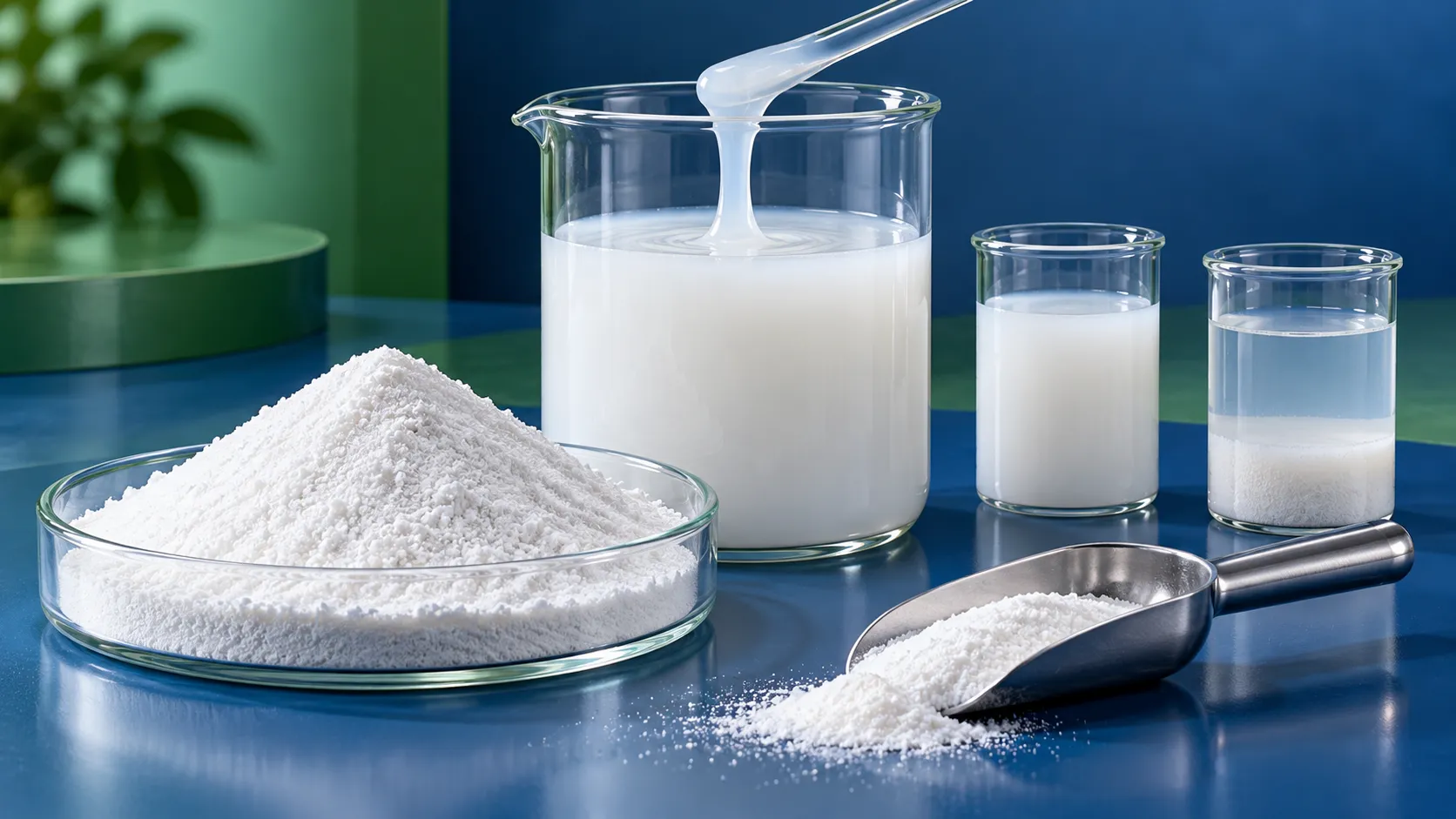
Hydroxypropyl Methylcellulose in Pharmaceutical Suspensions: Sedimentation and Rheology Control




AI Summary
Hydroxypropyl methylcellulose in suspension formulations increases continuous-phase viscosity and can help slow particle settling. It is most useful when the vehicle retains sufficient structure during storage but flows more readily during shaking, pouring, pumping or dose withdrawal. Performance depends on HPMC grade, concentration, hydration, temperature, particle properties and the complete excipient system. It does not eliminate sedimentation or caking, so redispersibility, dose uniformity, rheology and long-term physical stability must be demonstrated experimentally.
How Hydroxypropyl Methylcellulose Works in Suspension Formulations
Hydroxypropyl methylcellulose (HPMC), also known as hypromellose, is a nonionic cellulose ether used as a pharmaceutical excipient. Methyl hydroxypropyl cellulose is another naming variation sometimes associated with HPMC. In suspension systems, the polymer functions as a viscosity modifier by increasing continuous-phase viscosity and influencing flow behaviour.
In a pharmaceutical suspension, HPMC hydrates in the liquid vehicle and increases the viscosity of the continuous phase. This can restrict particle movement and reduce settling. A properly selected HPMC suspension stabilizer can provide useful structure at low shear. When used as an HPMC thickener, the polymer must still allow the suspension to flow adequately during shaking, pouring, pumping or dose withdrawal.
The result is not determined by polymer viscosity alone. Grade, concentration, substitution type, hydration, temperature, API density, particle-size distribution and other excipients all influence performance. Every candidate grade must therefore be evaluated in the actual formulation.
 WhatsApp Now
How an HPMC Suspension Stabilizer Controls Particle Settling
Under the simplified conditions described by Stokes’ law, settling velocity increases with the square of particle radius and with the density difference between the particles and vehicle, while increasing continuous-phase viscosity slows settling. Real pharmaceutical suspensions often depart from this model because particles may be irregular, polydisperse, concentrated, flocculated or interacting with one another.
Practical settling behaviour is influenced by:
- API particle size, shape and size distribution
- Density difference between the dispersed and continuous phases
- Vehicle viscosity and low-shear structure
- Particle-particle interactions and degree of flocculation
- Temperature, storage time and formulation composition
By increasing vehicle viscosity, HPMC may slow particle movement and support a more uniform distribution after shaking. It cannot guarantee permanent suspension, eliminate compact sediment or remove the need for a “shake well” instruction. Controlled, reversible settling may be acceptable when the sediment redisperses readily and withdrawn doses remain uniform. These principles are consistent with established suspension-development guidance on particle size, rheology and redispersion.
HPMC Rheology Control: Low-Shear Stability and High-Shear Flow
An effective suspension needs different behaviour at rest and during use. Higher apparent viscosity at low shear can restrain settling during storage, while lower apparent viscosity at higher shear can improve shaking, pouring, pumping and filling.
- Newtonian flow: viscosity remains essentially constant as shear rate changes.
- Shear-thinning flow: apparent viscosity decreases as shear rate increases.
- Thixotropy: structure breaks down under shear and recovers with time after shear is reduced.
- Yield stress: flow begins only after a measurable stress threshold is exceeded.
These terms are not interchangeable. A shear-thinning curve does not by itself prove thixotropy or yield stress. Those properties require suitable time-dependent and stress-controlled rheological measurements. HPMC grade and concentration may influence the flow profile, but the final behaviour belongs to the complete suspension system.
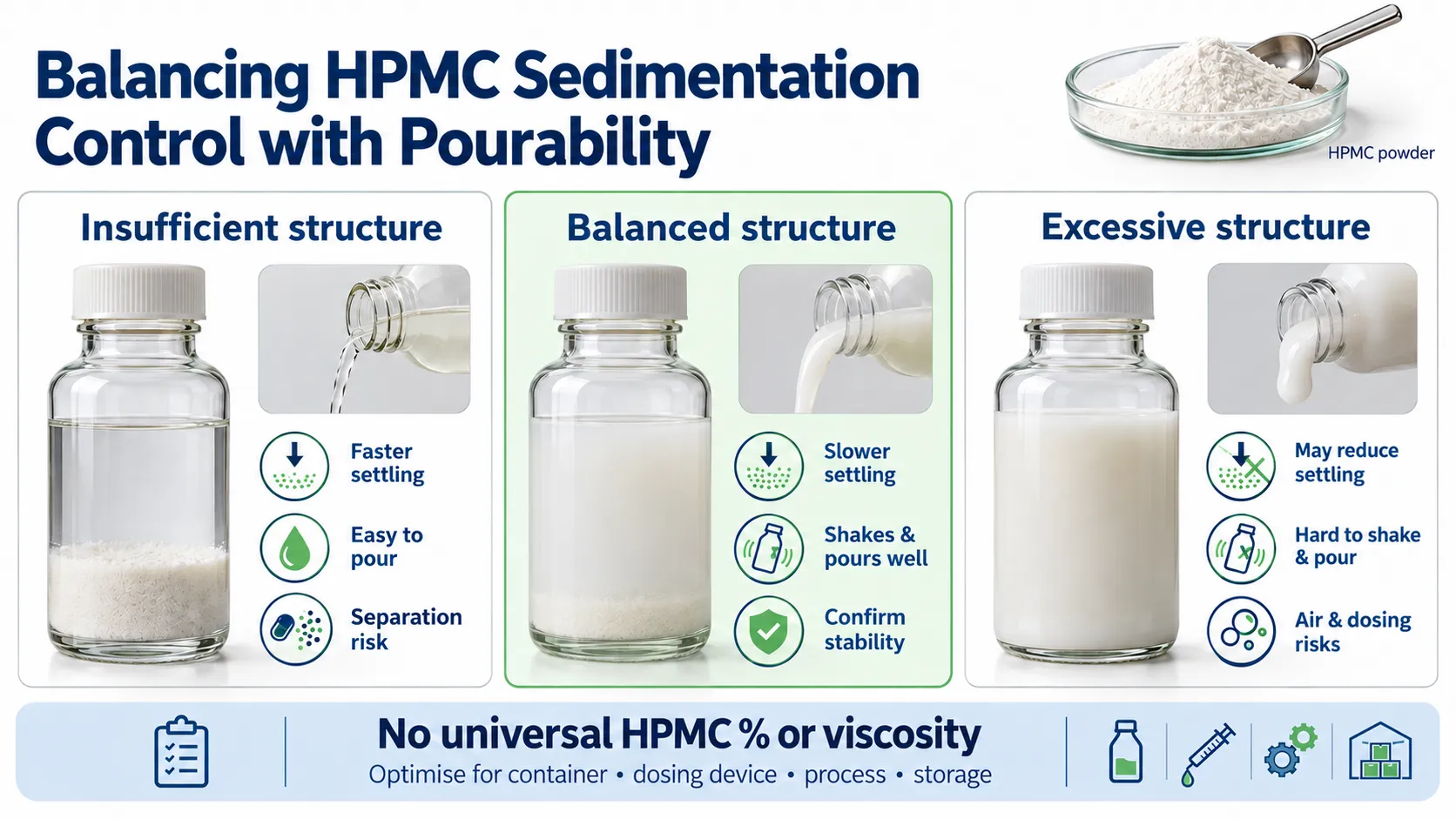
Balancing HPMC Sedimentation Control with Pourability
| HPMC level or rheological condition | Behaviour during storage | Behaviour during use | Possible risk |
|---|---|---|---|
| Insufficient structure | Faster settling | Easy to pour | Rapid separation and possible dose non-uniformity |
| Balanced structure | Slower settling with manageable flow | Shakes, pours and redistributes appropriately | Performance still requires stability confirmation |
| Excessive structure | Settling may be reduced | Difficult to shake, pump, fill or withdraw | Air entrapment, poor usability or inaccurate dosing |
No universal HPMC percentage or single viscosity value defines the balanced condition. The optimum must be established against the intended container, dosing device, manufacturing process and storage conditions.
Selecting the Right HPMC Viscosity Grade
A quoted viscosity such as 50 cps or 4,000 cps is meaningful only when the solution concentration, temperature and measurement method are known.
| Grade consideration | Potential benefit | Potential limitation | What to evaluate |
|---|---|---|---|
| Lower-viscosity grade | Easier hydration, transfer and pouring | May provide insufficient settling control | Sedimentation rate and dose uniformity |
| Medium-viscosity grade | May balance structure and flow | Outcome remains formulation-dependent | Rheology, redispersion and pourability |
| Higher-viscosity grade | Greater viscosity at a suitable concentration | More difficult mixing, deaeration or withdrawal | Processing, air entrapment and usability |
Selection also depends on substitution type, API size and density, route, filling equipment and other excipients. HPMC chemistry and degree of polymerisation influence viscosity and function.
How HPMC Concentration Affects Suspension Performance
Increasing polymer concentration generally develops more viscosity and low-shear structure, which may reduce settling. The same change can make hydration slower, increase mixing demand, trap air and impair pouring, filling or syringe withdrawal. It may also alter mouthfeel in oral suspensions.
Concentration screening should measure more than a single-point viscosity. Compare flow across relevant shear rates, recovery after shear, sedimentation, withdrawn-dose uniformity and handling.
Hydration and Dispersion of HPMC Thickener
Incomplete dispersion can create lumps or “fisheyes,” nonuniform viscosity, prolonged processing and batch variability. Entrapped air may also distort volume, appearance and rheology measurements.
Development trials should examine:
- Powder-addition rate and mixing intensity
- Water temperature and final batch temperature
- Order of addition and hydration time
- Polymer pre-dispersion strategy
- Timing of salts, sugars and other dissolved ingredients
- Deaeration, transfer and holding conditions
There is no single correct hydration procedure for every HPMC grade. Manufacturing instructions should follow the applicable Pharcocel documentation and a validated process. Scale-up must account for changes in impeller geometry, shear history, circulation and heat transfer rather than copying laboratory mixing time directly.
Our Other Product
HPMC 3 cps - Hydroxypropyl Methylcellulose | HypromelloseFlocculation, Caking and Redispersion
Deflocculated particles remain relatively separate and may settle slowly, but they can form a dense sediment that is difficult to redisperse. Flocculated particles form loose aggregates that may settle faster yet produce a larger, more porous sediment. The preferred state depends on whether the settled material can be restored to a uniform dispersion with reasonable shaking.
Slow settling alone is therefore not proof of physical stability. HPMC should be studied alongside wetting agents, surfactants, buffers and intentional flocculating agents. Redispersion testing throughout storage is essential because HPMC does not independently control every particle interaction or prevent crystal growth.
HPMC Compatibility with APIs and Other Excipients
Although HPMC is nonionic, this does not guarantee universal chemical or physical compatibility. APIs, electrolytes, buffers, sugars, polyols, surfactants, preservatives, flavours, sweeteners, colourants, other polymers and antifoaming agents may affect hydration, viscosity, particle wetting or preservative performance.
Compatibility work should use the full formulation and proposed packaging. Useful observations include viscosity drift, precipitation, aggregation, colour or odour change, preservative availability and changes in particle-size distribution. Analytical methods should be selected according to the specific degradation and interaction risks.
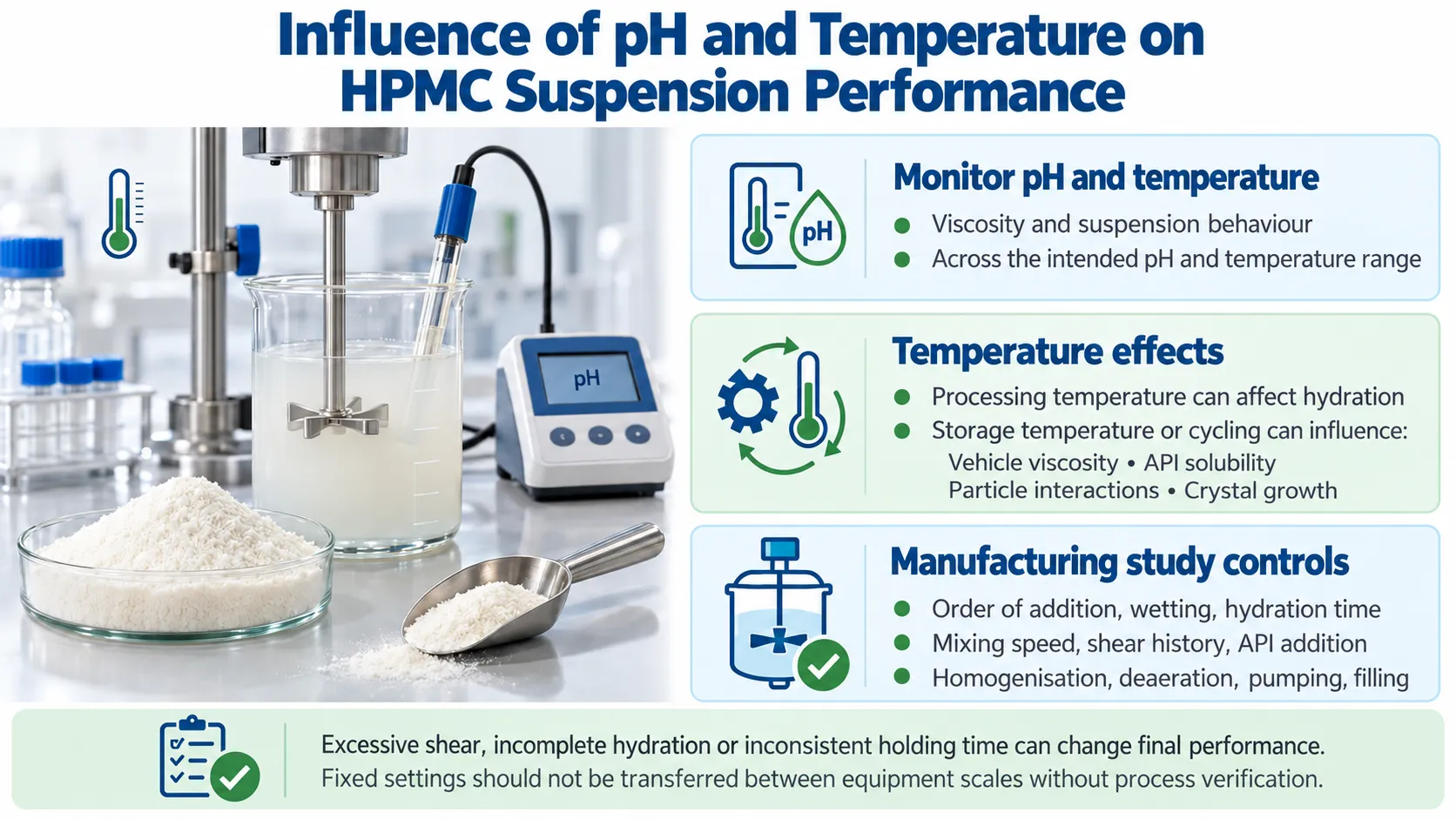
Influence of pH and Temperature on HPMC Suspension Performance
Formulators should monitor viscosity and suspension behaviour across the intended pH and temperature range. Processing temperature can affect hydration, while storage temperature or cycling can influence vehicle viscosity, API solubility, particle interactions and crystal growth.
The manufacturing study should control order of addition, wetting, hydration time, mixing speed, shear history, API addition, homogenisation, deaeration, pumping and filling. Excessive shear, incomplete hydration or inconsistent holding time can change final performance. Fixed settings should not be transferred between equipment scales without process verification.
Testing Sedimentation and Rheology in HPMC Suspensions
| Test or observation | What it evaluates | Why it matters |
|---|---|---|
| Sedimentation rate and volume | Speed and structure of settling | Characterises physical separation |
| Redispersibility | Effort needed to restore uniformity | Supports repeatable dose withdrawal |
| Flow curve | Viscosity across shear rates | Relates storage structure to handling |
| Thixotropy assessment | Time-dependent breakdown and recovery | Shows recovery after shaking or pumping |
| Particle-size analysis or microscopy | Aggregation or crystal growth | Identifies changes not shown by viscosity alone |
| Pourability or syringeability | Practical withdrawal behaviour | Evaluates usability with the intended device |
| Assay/content uniformity | API distribution in sampled doses | Confirms dosing consistency |
| Temperature cycling and appearance | Response to storage stress | Detects separation, caking or viscosity drift |
Measurements should define temperature, shear conditions, sample history and timing. Depending on product risk, the programme may also include pH, centrifugation screening, freeze-thaw studies, long-term stability, container-closure compatibility, microbiological quality and preservative-effectiveness testing. Accelerated tests can reveal risks but cannot establish shelf life alone.
HPMC Grade-Selection Checklist for Pharmaceutical Suspensions
- Define API particle size, density and intended degree of flocculation.
- Set targets for settling, low-shear viscosity, pouring and redispersion.
- Confirm the dose-withdrawal method and container-closure system.
- Compare substitution type, viscosity grade and test method.
- Screen polymer concentration using complete formulations.
- Develop a robust dispersion and hydration procedure.
- Evaluate pH, electrolytes and excipient compatibility.
- Confirm mixing, transfer, deaeration and filling performance at scale.
- Test relevant storage conditions and packaging.
- Verify current pharmacopeial, technical and regulatory requirements.
 Call Us Now!
About Pharcos Speciality Ltd
Pharcos Speciality Ltd manufactures pharmaceutical ingredients and speciality chemicals, including the Pharcocel HPMC range. The range includes multiple substitution types and viscosity grades for different formulation requirements. According to the company’s official product information, technical support and regulatory documentation are available to assist grade evaluation. Formulators and procurement teams can request current product specifications, Certificates of Analysis and samples before qualification.
Our Other Product
HPMC 5 cps - Hydroxypropyl Methylcellulose | HypromelloseConclusion: Selecting HPMC for Pharmaceutical Suspensions
Successful suspension development requires a balance among viscosity, rheology, particle properties, pourability, redispersion and manufacturing performance. Select the appropriate Pharcocel grade through formulation-specific screening and process studies. Contact Pharcos Speciality Ltd to discuss grade documentation, samples and technical requirements.
Frequently Asked Questions About HPMC in Pharmaceutical Suspensions

Dr. Avinash Dubey (R&D Head)
Dr. Avinash Dubey is a PhD in Organic Chemistry with a distinguished career spanning more than four decades. As the head of R&D at Pharcos, he focuses on the development of novel molecules for a wide array of industrial sectors, blending long-standing experience with a passion for innovation.

Mr. Ankit Shah (Managing Director)
Mr. Ankit Shah has led Pharcos Speciality for over three decades, establishing it as a pioneer in specialty chemicals. He currently directs the company’s strategic expansion into the APIs, Excipient and Speciality Surfactants markets, upholding a steadfast commitment to "Make in India" and world-class manufacturing quality and new product development.