
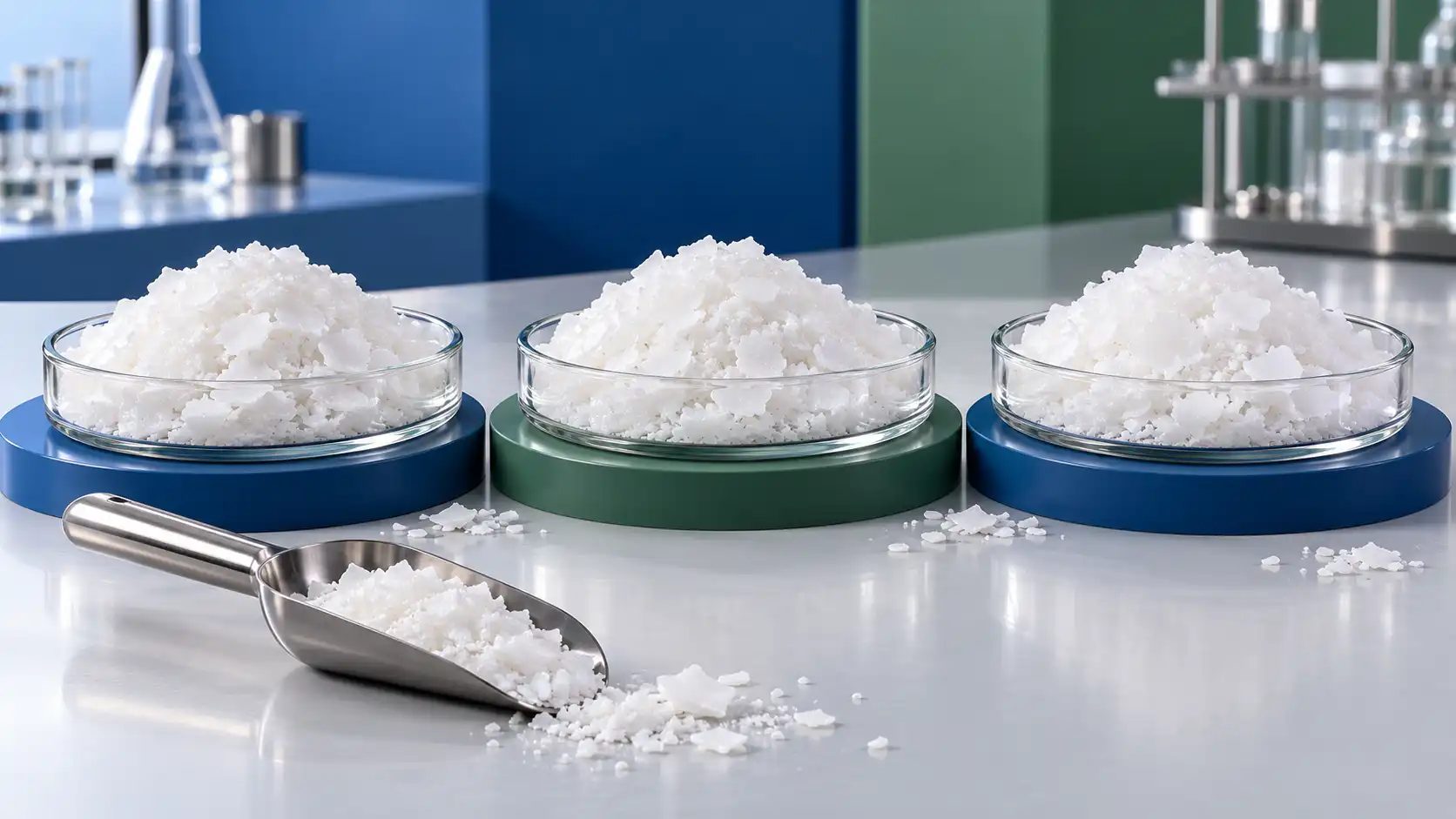
PEG 4000 vs PEG 6000 vs PEG 8000: Choosing the Right Solid Pharmaceutical Grade




AI Summary
Selecting between PEG 4000 vs PEG 6000 and PEG 6000 vs PEG 8000 requires more than comparing grade numbers. These nominal molecular-weight grades contain distributions of polymer chains around designated average molecular weights. Their physical form, melting behaviour, viscosity, binding performance and processing characteristics may differ. The appropriate choice depends on the API, dosage form, manufacturing process, target product profile and stability data.
How Solid PEG Grades Differ by Molecular Weight
PEG 4000, PEG 6000 and PEG 8000 are hydrophilic, higher-molecular-weight polyethylene glycols normally supplied as solid or wax-like materials. In pharmaceutical and pharmacopoeial contexts, polyethylene glycol may also be identified as macrogol. Therefore, Macrogol 6000 is a synonym for PEG 6000 rather than a separate ingredient.
The numbers 4000, 6000 and 8000 represent nominal average molecular-weight positions. They do not identify pure compounds in which every molecule has the same chain length. Each grade contains a distribution of polymer chains, which can influence thermal behaviour, viscosity, crystallinity and functional performance.
Increasing molecular weight may influence dissolution or hydration behaviour, although particle size, physical presentation, crystallinity, temperature and agitation can have an equally important effect. Other directional changes may include:
- Greater solid structure or hardness
- Higher solution or melt viscosity under comparable conditions
- Somewhat higher melting behaviour within this grade group
- Different cooling, solidification and milling characteristics
These trends support initial screening but are not substitutes for supplier specifications. Commercial grades can vary in physical form, particle-size distribution, moisture content and molecular-weight distribution.
All three grades may share the general CAS number 25322-68-3. However, the CAS number identifies polyethylene glycol broadly; it does not establish a particular grade, specification or pharmaceutical equivalence. Buyers must review the applicable monograph and batch documentation.
 Start a Chat on WhatsApp!
PEG 4000 vs PEG 6000 vs PEG 8000: Technical Comparison
The following polyethylene glycol grade comparison presents directional differences rather than fixed specifications:
| Selection Factor | PEG 4000 | PEG 6000 | PEG 8000 | Formulation Significance |
|---|---|---|---|---|
| Nominal molecular-weight position | Lowest of the three grades | Intermediate | Highest of the three grades | Influences viscosity, thermal behaviour and processing |
| Typical physical character | Solid or wax-like, depending on presentation | Solid | Higher-molecular-weight solid | Confirm supplier form and handling requirements |
| Melt behaviour | Generally melts somewhat earlier than higher grades | Intermediate thermal behaviour | Generally toward the higher end of the group | Verify the actual melting range |
| Viscosity at comparable conditions | Generally lower | Intermediate | Generally higher | Use identical measurement conditions |
| Dissolution or hydration rate | May be faster under comparable conditions | Intermediate | May require more time | Particle size, temperature and agitation also matter |
| Processing character | May be easier to melt or incorporate in some processes | Offers intermediate properties | May provide greater solid structure | Confirm through process-development trials |
| Selection basis | Formulation-specific | Formulation-specific | Formulation-specific | No grade is universally superior |
Different suppliers may offer materials with different molecular-weight distributions, physical presentations and specifications. Grade identity should therefore be confirmed through the relevant technical and quality documentation.
Physical Form and Melting Behaviour of Solid PEG Grades
Physical form and handling
These solid PEG grades may be presented as flakes, granules, powder or another supplier-specific form. Presentation influences material charging, dust formation, powder flow, blending and dissolution.
A harder or larger-particle material may require different milling conditions from a waxier grade. Excessive size reduction can generate heat, alter particle distribution or encourage agglomeration. Moisture content and storage history may also affect handling.
Melting and thermal processing
PEG 4000 generally reaches a processable molten state at a somewhat lower temperature than PEG 6000 or PEG 8000. Higher grades generally show greater melt viscosity and solid structure under comparable conditions. Actual melting ranges must be obtained from the applicable specification or thermal analysis.
For melt granulation or solid-dispersion processing, evaluate:
- API stability during the complete time-temperature exposure
- Mixing and drug distribution in the molten phase
- Melt viscosity at the proposed processing temperature
- Phase separation before solidification
- Cooling rate and recrystallization
- Milling behaviour after cooling
- Heat transfer during scale-up
A relatively modest processing temperature does not confirm suitability for a heat-sensitive API. Thermal and chemical stability must be demonstrated experimentally.
Polyethylene Glycol Grade Comparison for Solubility and Viscosity
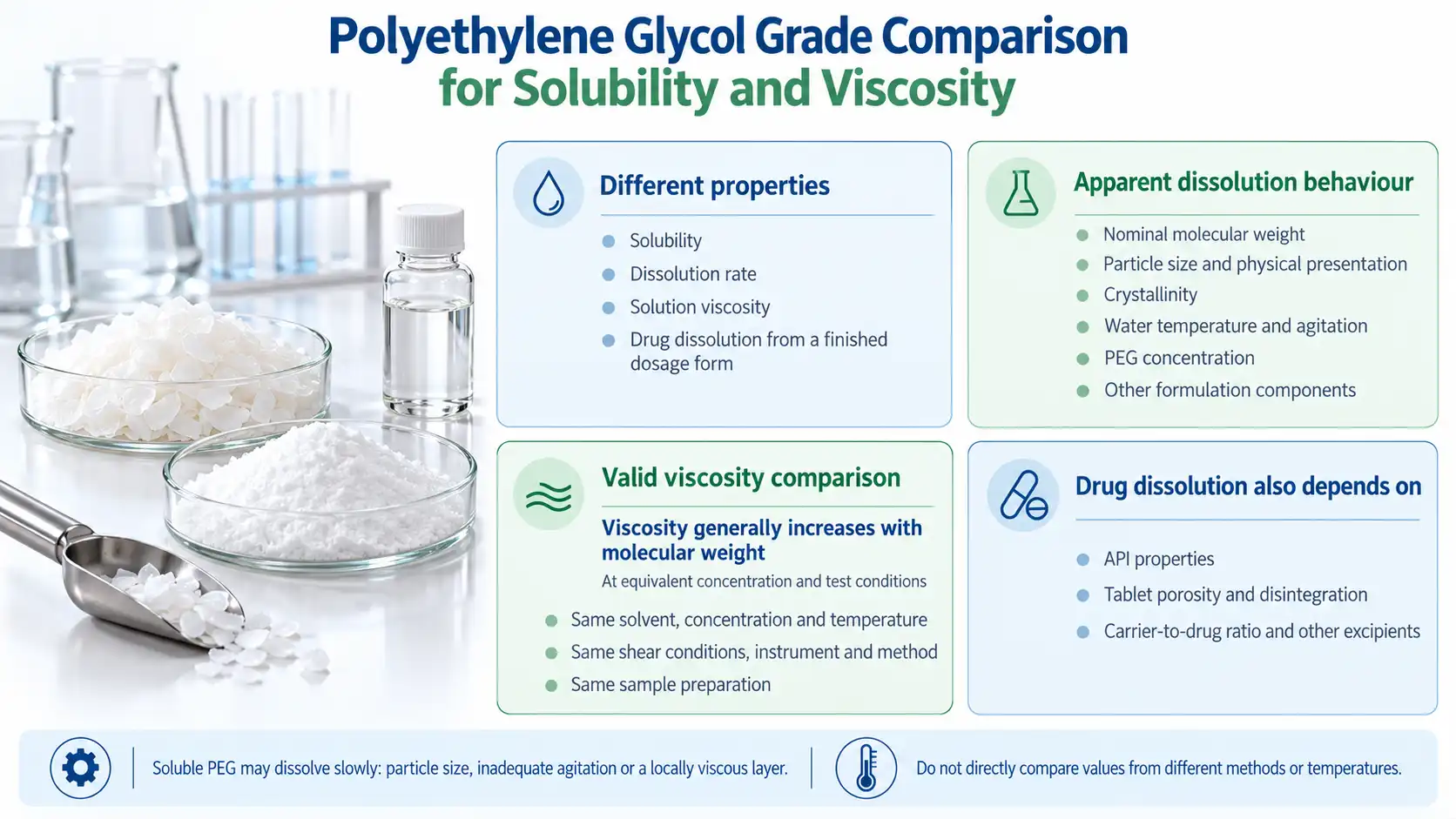
Although all three grades are hydrophilic, solubility, dissolution rate, solution viscosity and drug dissolution from a finished dosage form are different properties.
A soluble PEG may dissolve slowly because of particle size, inadequate agitation or a locally viscous layer around the material. Apparent dissolution behaviour can be affected by:
- Nominal molecular weight
- Particle size and physical presentation
- Crystallinity
- Water temperature and agitation
- PEG concentration
- Other formulation components
At equivalent concentration and test conditions, viscosity generally increases with molecular weight. A valid comparison requires the same solvent, concentration, temperature, shear conditions, instrument, method and sample preparation. Values obtained using different methods or temperatures should not be compared directly.
Drug dissolution from a tablet or solid dispersion also depends on API properties, tablet porosity, disintegration, carrier-to-drug ratio and other excipients.
PEG 4000 vs PEG 6000 in Pharmaceutical Formulations
In a PEG 4000 vs PEG 6000 evaluation, PEG 4000 occupies the lower nominal molecular-weight position and may offer lower melt viscosity or easier incorporation in certain processes. PEG 6000 may contribute greater viscosity or solid structure.
The grades can be compared for:
- Binder distribution during granulation
- Granule size, flow and compressibility
- Tablet hardness, friability and ejection
- Melt mixing and cooling
- Coating flexibility, adhesion and tack
- API wetting and dissolution
- Tablet disintegration
PEG 6000 does not automatically produce stronger tablets or greater drug solubility. These outcomes are influenced by concentration, API properties, formulation composition and processing.
Our Other Product
PEG 10000 (Polyethylene Glycol 10000)PEG 6000 vs PEG 8000 in Pharmaceutical Formulations
A PEG 6000 vs PEG 8000 study examines whether the higher molecular-weight position of PEG 8000 provides useful viscosity or solid structure for the proposed dosage form.
Compared with PEG 6000, PEG 8000 may require additional attention to molten mixing, heat transfer, cooling and solidification. Differences in viscosity and water interaction may also affect matrix hydration, pore formation and drug release.
PEG 8000 does not automatically provide better controlled release than Macrogol 6000. Because both are water-soluble polymers, their effects depend on PEG concentration, tablet structure, API solubility and the remaining matrix components.
Solid PEG Grades for Binding, Granulation and Tablet Performance
A solid PEG may contribute to granule formation, interparticle bonding and lubrication. Its performance depends on the grade, concentration, method of incorporation and surface characteristics of the formulation components.
Relevant development measurements include:
- Granule size distribution and flow
- Compressibility and compactability
- Tablet tensile strength or hardness
- Friability and lubricant sensitivity
- Ejection force and sticking
- Disintegration and dissolution
Greater tablet hardness does not necessarily mean better product performance. Excessive binder action may delay disintegration, while unsuitable lubricant levels can weaken bonding or alter dissolution. The appropriate grade and concentration should be established through formulation trials.
Solid PEG Grades in Solid Dispersions and Matrix Systems
Solid-dispersion processing
PEG can act as a hydrophilic carrier for dispersing an API through melting, solvent-based preparation or another suitable process. Improved wetting, reduced drug particle size or changes in API physical state may increase dissolution in some systems.
Performance depends on API–polymer miscibility, drug loading, carrier ratio, crystallinity and processing history. Phase separation or recrystallization during storage may change dissolution. Solid-state characterization, chemical stability studies and comparative dissolution testing are therefore important.
Matrix and drug-release behaviour
The release profile of a PEG-containing matrix can be affected by:
- PEG grade and concentration
- API solubility
- Matrix-forming excipients
- Tablet porosity and compression force
- Water penetration
- PEG dissolution or erosion
- Other soluble and insoluble components
PEG 4000, PEG 6000 and PEG 8000 should not be treated as universally acting controlled-release polymers when used alone. The release behaviour must be established for the complete formulation.
Read Our Article
PEG 400 as a Plasticizer in Pharmaceutical Tablet Film CoatingAPI Compatibility and Stability of Solid Pharmaceutical PEG Grades
Compatibility screening should examine the selected PEG with APIs, polymers, fillers, disintegrants, binders, lubricants, surfactants, coating ingredients, antioxidants and packaging materials.
Potential considerations include:
- Peroxide-related oxidation of susceptible APIs
- Water-mediated degradation
- Thermal degradation during melt processing
- Drug–polymer interactions
- Phase separation or crystallization
- Changes in PEG or API physical state
- Packaging interactions during storage
A PEG grade should not be assumed to be universally compatible or peroxide-free. Where oxidation is relevant, formulators should obtain current impurity information and evaluate representative material with the API.
Regulatory quality frameworks expect the selection, concentration and functional characteristics of excipients—and their compatibility with the drug substance—to be supported by pharmaceutical-development studies.
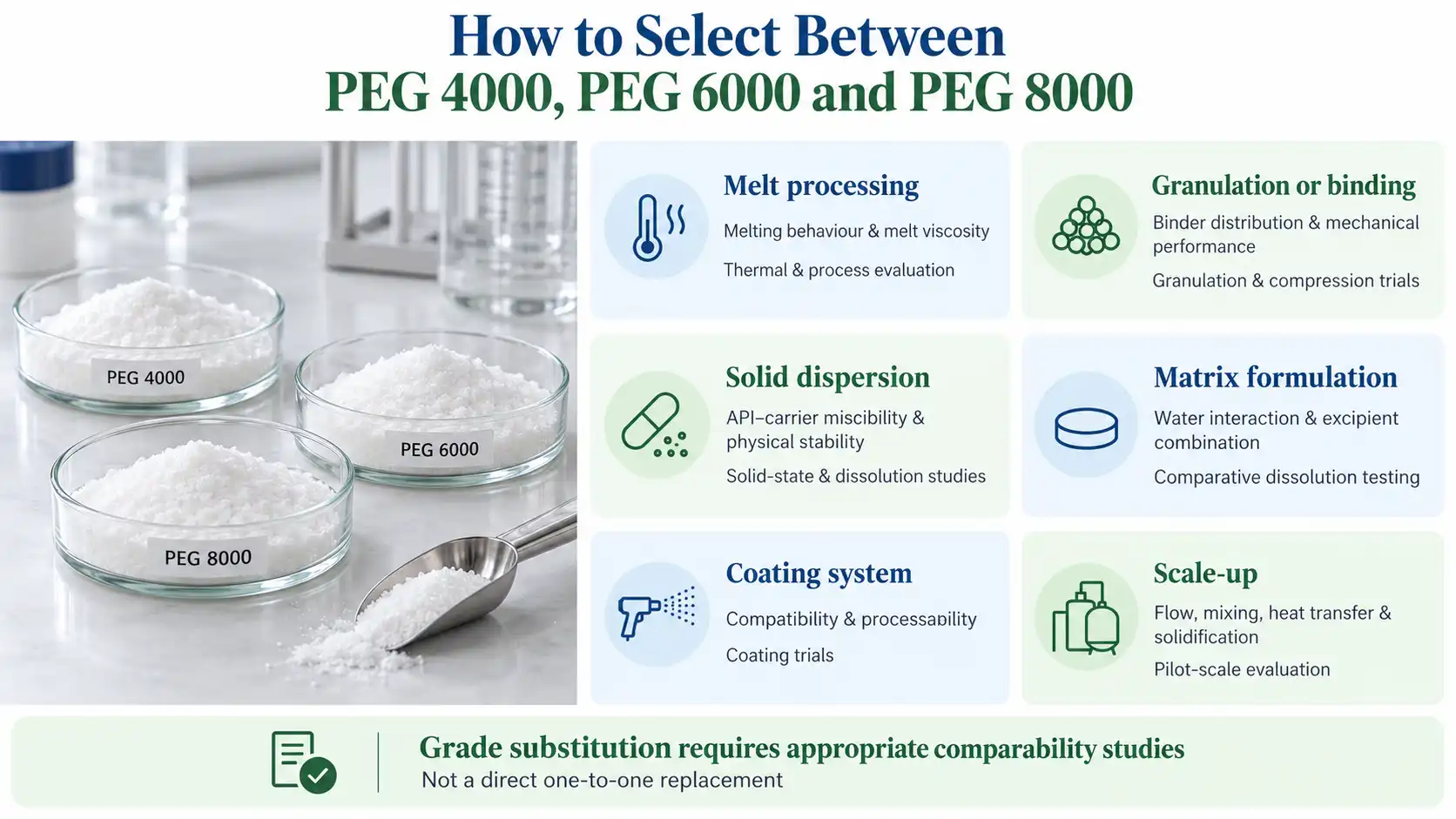
How to Select Between PEG 4000, PEG 6000 and PEG 8000
| Formulation Requirement | Grade Characteristic to Prioritize | Questions to Ask | Study Required |
|---|---|---|---|
| Melt processing | Suitable melting behaviour and melt viscosity | Is the API stable throughout processing? | Thermal and process evaluation |
| Granulation or binding | Binder distribution and mechanical performance | Are granule and tablet properties acceptable? | Granulation and compression trials |
| Solid dispersion | API–carrier miscibility and physical stability | Will the API remain stable during storage? | Solid-state and dissolution studies |
| Matrix formulation | Water interaction and excipient combination | What release profile does the complete matrix produce? | Comparative dissolution testing |
| Coating system | Compatibility and processability | Are flexibility, adhesion and tack acceptable? | Coating trials |
| Scale-up | Flow, mixing, heat transfer and solidification | Does laboratory behaviour transfer to production? | Pilot-scale evaluation |
Changing from one PEG grade to another may affect charging, mixing, heating, cooling, milling, granulation, compression and cleaning. A grade substitution should be supported by appropriate comparability studies rather than treated as a direct one-to-one replacement.
Quality Documentation for Pharmaceutical PEG 4000, PEG 6000 and PEG 8000
Procurement and quality teams should review:
- Grade identity and applicable pharmacopoeial monograph
- Molecular-weight or hydroxyl-value requirements
- Physical form, melting range and water content
- Acidity or alkalinity and viscosity, where specified
- Impurity profile and peroxide-related controls, where relevant
- Certificate of Analysis, Technical Data Sheet and Safety Data Sheet
- Storage requirements and shelf life or retest period
- Manufacturing-site and change-control information
Specification limits depend on the applicable pharmacopoeia, intended pharmaceutical use and approved internal requirements. Different pharmacopoeias should not be assumed to apply identical criteria.
Our Other Product
PEG 20000 (Polyethylene Glycol 20000)Pharcogol 4000 vs Pharcogol 6000 vs Pharcogol 8000
Pharcos Speciality Ltd offers the following solid pharmaceutical PEG grades within its Pharcogol range:
| Pharcos Product | Exact Product Name | Listed Applications | Compliance Shown |
|---|---|---|---|
| Pharcogol 4000 | PEG 4000 (Polyethylene Glycol 4000 | Macrogol 4000) | Binder, lubricant and matrix former | USP-NF, EP, BP and IP |
| Pharcogol 6000 | PEG 6000 (Polyethylene Glycol 6000 | Macrogol 6000) | Granulation, solid dispersions, binding and sustained-release formulation | USP-NF, EP and BP |
| Pharcogol 8000 | PEG 8000 (Polyethylene Glycol 8000 | Macrogol 8000) | Binding, viscosity modification, granules and matrix systems | USP-NF, EP and BP |
These application descriptions should not be interpreted as guaranteed finished-product performance. Pharmaceutical manufacturers should request current specifications, Certificates of Analysis and market-specific regulatory documentation for the supplied batch.
 Call Us Now!
About Pharcos Speciality Ltd
Pharcos Speciality Ltd manufactures pharmaceutical ingredients and speciality chemicals. Its pharmaceutical portfolio includes the Pharcogol polyethylene glycol range, covering multiple liquid and solid PEG grades. Pharcos offers Pharcogol 4000, Pharcogol 6000 and Pharcogol 8000 for pharmaceutical formulation requirements. Current specifications, Certificates of Analysis, product samples and regulatory documentation are available through direct enquiry.
Conclusion: Selecting PEG 4000, PEG 6000 or PEG 8000
The appropriate grade should be selected by considering molecular-weight distribution, physical presentation, melting behaviour, viscosity, API compatibility, dosage-form requirements, process conditions and stability. PEG 4000, PEG 6000 and PEG 8000 should not be substituted solely according to their grade numbers.
Pharmaceutical manufacturers and formulation teams can contact Pharcos Speciality Ltd regarding PEG grade selection, current specifications, Certificates of Analysis, technical documentation, samples, regulatory requirements and commercial enquiries for Pharcogol 4000, Pharcogol 6000 and Pharcogol 8000.
FAQs About PEG 4000, PEG 6000 and PEG 8000

Dr. Avinash Dubey (R&D Head)
Dr. Avinash Dubey is a PhD in Organic Chemistry with a distinguished career spanning more than four decades. As the head of R&D at Pharcos, he focuses on the development of novel molecules for a wide array of industrial sectors, blending long-standing experience with a passion for innovation.

Mr. Ankit Shah (Managing Director)
Mr. Ankit Shah has led Pharcos Speciality for over three decades, establishing it as a pioneer in specialty chemicals. He currently directs the company’s strategic expansion into the APIs, Excipient and Speciality Surfactants markets, upholding a steadfast commitment to "Make in India" and world-class manufacturing quality and new product development.