
Switching Between Polysorbate 20, 40, 60, 80 & 85: A Reformulation and Validation Guide




AI Summary
Switching between polysorbate 20, polysorbate 40, polysorbate 60, polysorbate 80 and polysorbate 85 requires evaluation of their composition, function and suitability for the intended formulation. This guide outlines a structured approach to polysorbate substitution, covering concentration screening, ingredient compatibility, performance and stability acceptance criteria, and documented approval. It helps formulation and quality teams assess emulsifier reformulation without assuming that equal quantities of different polysorbates will deliver equivalent results.
Reasons for Polysorbate Substitution
A team may consider a different polysorbate when formulation objectives, processing requirements or ingredient availability change. If procurement only needs an alternative supplier, first establish whether the existing polysorbate type and specification can be retained.
Processing requirements matter because Pharcos lists these grades in physical forms ranging from liquid to paste.
 Call Us Now!
Polysorbate 20, 40, 60, 80 and 85 Composition and Function
The table summarises how Pharcos describes each grade.
| Polysorbate | Chemical Description | Stated Function | Information Needed Before Selection |
|---|---|---|---|
| Polysorbate 20 | Polyoxyethylene (20) Sorbitan Monolaurate; lauric acid based; liquid | Hydrophilic solubilizer for fragrance oils in water based systems; wetting agent; mild cleanser component | Grade, specification and whether the oils to be solubilized match its described use |
| Polysorbate 40 | Polyoxyethylene (20) Sorbitan Monopalmitate; palmitic acid based; liquid or paste | Oil in water emulsifier in creams and lotions; flavor solubilizer; textile antistat and lubricant | Physical form supplied and the HLB target of the existing emulsifier system |
| Polysorbate 60 | Polyoxyethylene (20) Sorbitan Monostearate; stearic acid based; paste | Emulsifier for creams and conditioners alongside cetyl and stearyl alcohol; silicone emulsifier | Handling needs for a paste and its role in the texture of the current base |
| Polysorbate 80 | Polyoxyethylene (20) Sorbitan Monooleate; oleic acid based; liquid | Solubilizer for difficult to dissolve actives and oils; pharmaceutical grade listed as solubilizer, bioavailability enhancer and suspension stabilizer | Grade (industrial, personal care or pharmaceutical) and the documentation the application requires |
| Polysorbate 85 | Polyoxyethylene (20) Sorbitan Trioleate; three oleate chains; liquid | Dispersant; paraffin emulsifier; coupling agent; textile lubricant | Grade, specification and the oil system it would need to disperse |
HLB information can help teams compare candidate materials during initial selection. Confirm the numerical value and supporting specification for the exact polysorbate grade under review.
Polysorbate 20 vs 80 in Equal Weight Replacement Trials
An equal weight replacement may be considered during initial screening, but it should not be treated as an established substitution ratio. Differences in composition influence each polysorbate's solubility behaviour and functional role, so the replacement requires evaluation within the intended formulation.
Polysorbate 20 vs 80 shows the point clearly. Pharcos describes Polysorbate 20 for solubilizing fragrance oils in water based systems and Polysorbate 80 for solubilizing difficult to dissolve active ingredients and oils.
A shortfall at equal weight is useful data for the screening that follows.
Concentration Screening for Polysorbate Substitution
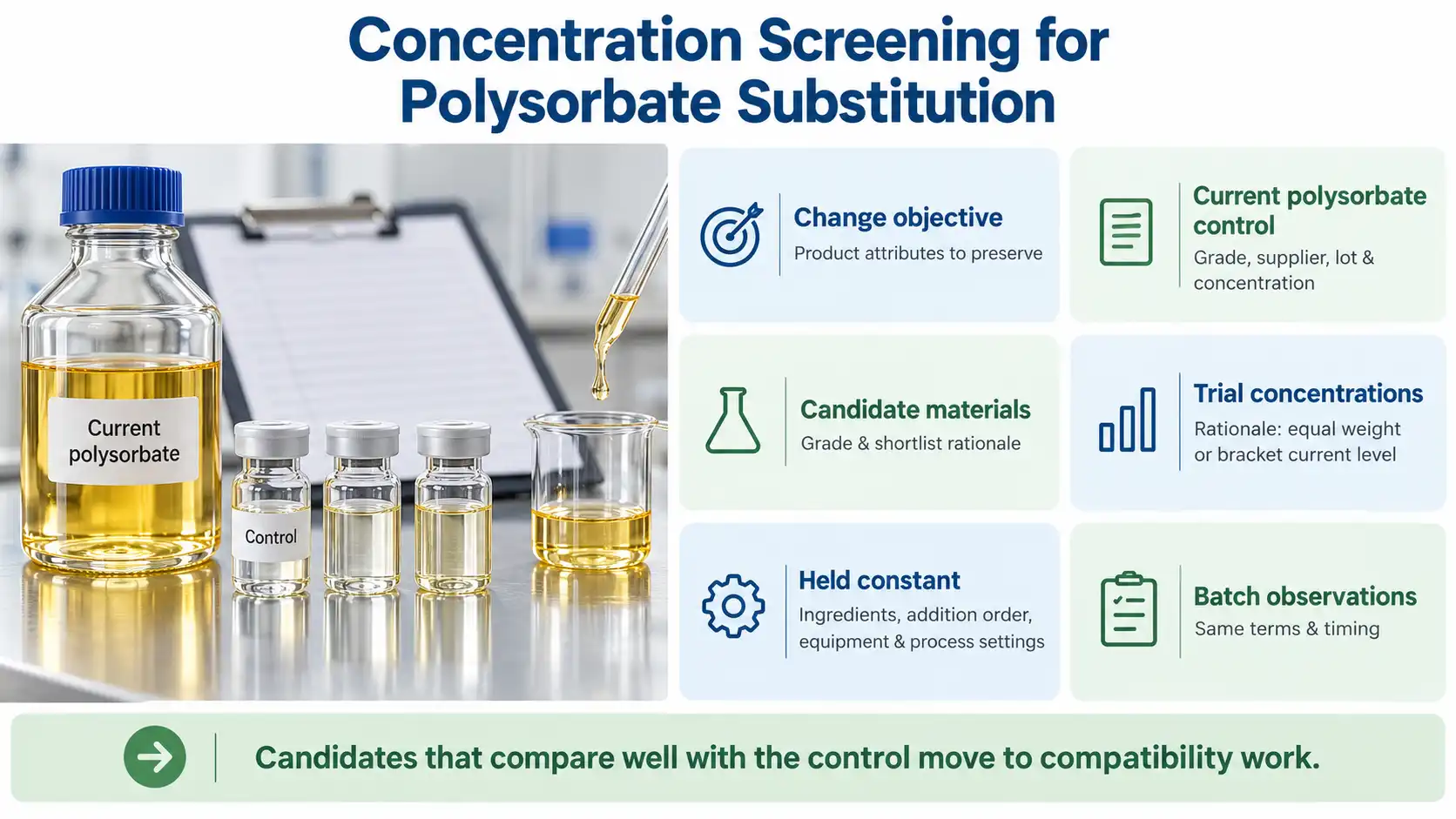
Screening turns the substitution question into recorded results. A complete screening record covers:
- The change objective and the product attributes that must be preserved.
- The current polysorbate, its grade, supplier, lot and concentration, run as the control.
- Each candidate material, its grade and why it was shortlisted.
- The rationale for every trial concentration, such as equal weight or a bracket around the current level.
- The ingredients, order of addition, equipment and process settings held constant.
- Observations recorded with the same terms and timing for every batch.
Candidates that compare well with the control move to compatibility work.
Our Other Product
PEG 4 Rapeseed Amide (Liquid | Surfactants)Polysorbate Compatibility Checks During Reformulation
Compatibility work asks whether a shortlisted candidate behaves within the complete formulation, beyond the screening batches.
Start with the other ingredients. Pharcos describes Polysorbate 60 as working with cetyl and stearyl alcohol, so replacing it raises the question of whether the candidate supports the same structure. Systems containing silicones or paraffin waxes need similar attention, since Pharcos links those uses to specific grades.
Then check processing and packaging: whether the candidate can be added at the same stage and in the same way, and whether the reformulated product behaves differently in its container. Any question the available information cannot answer stays open until tested.
Emulsifier Reformulation Performance and Stability Criteria
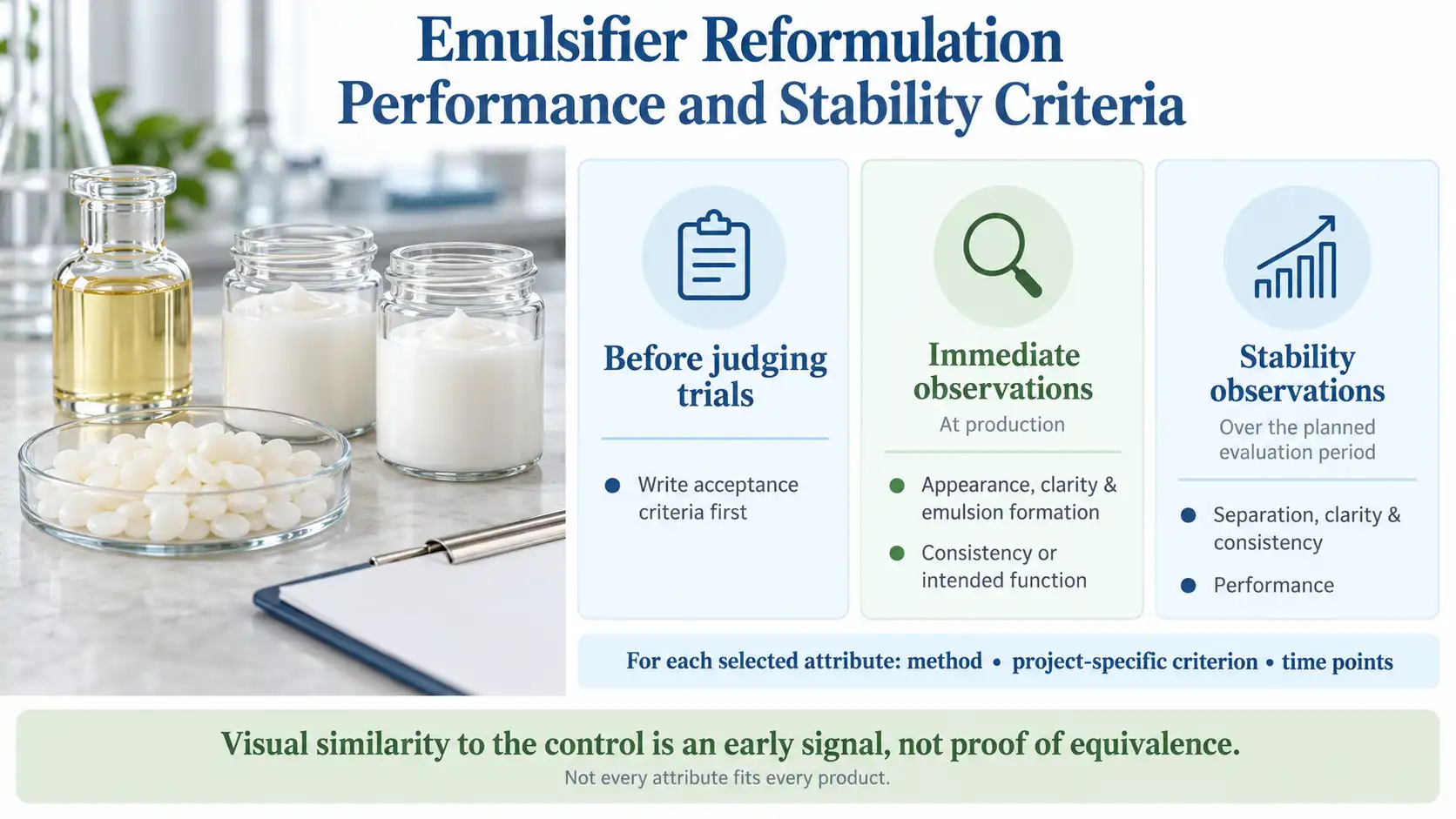
Acceptance criteria should be written before any trial is judged; otherwise a result can be argued either way.
Separate two kinds of evidence. Immediate observations, made at production, may cover appearance, clarity, emulsion formation, consistency or intended function. Stability observations track separation, clarity, consistency and performance over the planned evaluation period.
Not every attribute fits every product. For each one selected, record the assessment method, the project specific criterion and the time points. Visual similarity to the control is an early signal, not proof of equivalence.
Polysorbate Substitution Documentation and Approval
The approval file brings together the screening records, compatibility findings and results against each criterion. It should state unresolved questions plainly and name who reviews the evidence and who signs off.
Screening and compatibility work show whether a candidate deserves further investment. Verification or validation before production follows each organisation's own change control procedures, which differ between pharmaceutical, personal care and industrial settings.
 Start a Chat on WhatsApp!
Polysorbates Manufacturer Pharcos Speciality Ltd
Pharcos Speciality Ltd, established in 1974, manufactures pharmaceutical, food, personal care and speciality ingredients at units in Mehsana, Gujarat and Daman, and lists WHO GMP, Excipact and FSSAI certifications. Its product range includes Pharcocel HPMC, Pharcogol PEG, emulsifiers, surfactants, ethoxylates and solubilizers.
Its polysorbates include Polysorbate 20, Polysorbate 40, Polysorbate 60, Polysorbate 80 and Polysorbate 85.
Our Other Product
PEG 400 Monostearate (Semi-solid | Emulsifiers)Conclusion: Approving a Polysorbate Substitution
A polysorbate substitution is ready for approval only when the documented evaluation shows that the candidate meets the project's own requirements within the intended formulation.
Polysorbate Substitution FAQs

Dr. Avinash Dubey (R&D Head)
Dr. Avinash Dubey is a PhD in Organic Chemistry with a distinguished career spanning more than four decades. As the head of R&D at Pharcos, he focuses on the development of novel molecules for a wide array of industrial sectors, blending long-standing experience with a passion for innovation.

Mr. Ankit Shah (Managing Director)
Mr. Ankit Shah has led Pharcos Speciality for over three decades, establishing it as a pioneer in specialty chemicals. He currently directs the company’s strategic expansion into the APIs, Excipient and Speciality Surfactants markets, upholding a steadfast commitment to "Make in India" and world-class manufacturing quality and new product development.